
Monaco is a sovereign city-state on the French Riviera, wedged between France and the Mediterranean Sea. It is the second-smallest country in the world and one of the most densely built, with a compact urban area that rises from a narrow shoreline into steep hills. Its official name is the Principality of Monaco, reflecting its long rule by the House of Grimaldi and its continuing status as a constitutional monarchy.
Stories from Monaco
6 stories



About Monaco
- Monaco is both a country and a city, with a single dense urban fabric rather than separate towns.
- Its economy relies heavily on finance, luxury real estate, tourism, motorsport, and high-end events.
- The built environment is shaped by land scarcity, which pushes construction upward, underground, and out into reclaimed space.
- Monaco is closely associated with yacht culture, the Formula 1 Grand Prix, and prestige architecture.
- Design and engineering in Monaco often focus on visibility, efficiency, and high-value materials rather than scale.
Read the full overviewWhy Monaco looks and functions the way it does, How Monaco became associated with luxury and spectacle, What does Monaco mean for architecture and design?, What kinds of projects are most typical in Monaco?
Why Monaco looks and functions the way it does
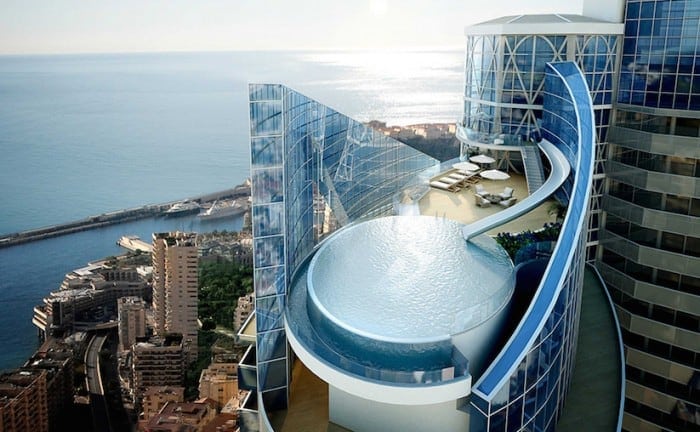
Monaco’s geography has dictated nearly everything about its urban form. There is very little flat land, so buildings stack vertically, roads thread through tunnels and terraces, and major public projects often require land reclamation from the sea. This pressure has produced a place where architecture is intensely compact and highly managed, with towers, podiums, and retaining structures shaping the skyline.
That density has also made Monaco a laboratory for premium construction. Developers work with reinforced concrete, glass curtain walls, polished stone, metal cladding, and sophisticated shading systems to fit luxury housing into tight plots. Large apartment buildings, marinas, and mixed-use developments often rely on deep foundations and complex engineering to stabilize structures on steep terrain and reclaim usable space.
How Monaco became associated with luxury and spectacle
Monaco’s modern identity took shape in the 19th and 20th centuries as rail links, hotels, casinos, and tax policy attracted wealthy visitors and residents. The Casino de Monte-Carlo and the surrounding district became symbols of leisure, gambling, and elite social life, while the state cultivated an image of order, glamour, and exclusivity. That image remains central to its international reputation.
Design culture in Monaco tends to follow that economy of display. Hotels, penthouses, yacht interiors, exhibition spaces, and event venues often use rare woods, marble, brass, leather, and high-gloss finishes to signal value. Even when the architecture is restrained, the materials and detailing usually aim for precision and polish rather than overt ornament.
What does Monaco mean for architecture and design?
Monaco matters to designers because it compresses many urban problems into a very small area. How do you house a wealthy population, maintain public circulation, preserve views, and expand infrastructure when land is scarce? The answer in Monaco is often technical ingenuity: subterranean parking, stepped massing, marine engineering, and tightly coordinated planning.
It also matters because it provides a stage for architecture under conditions of intense scrutiny. A building in Monaco is rarely anonymous; it is seen against the Mediterranean, by visitors arriving by road, rail, or yacht, and by an audience attuned to status. That makes Monaco a place where form, material choice, and urban performance carry unusual weight.
What kinds of projects are most typical in Monaco?
Residential towers, luxury hotels, marinas, event spaces, and redevelopment schemes dominate. Many projects aim to increase usable floor area without expanding the city’s footprint, so they depend on vertical construction and careful site engineering. The result is a landscape of high-value buildings where even ordinary elements, such as balustrades, façades, and lobbies, are executed with unusual care.
Monaco also hosts temporary architecture in the form of grand prix infrastructure, exhibition installations, and ceremonial event staging. These projects often use modular systems, lightweight metal framing, composite panels, and branded graphics to create short-lived but highly visible environments. The temporary and the permanent both serve the same purpose: projecting precision, wealth, and control.
Frequently Asked Questions
Is Monaco a city or a country?
Monaco is both. It is an independent sovereign state and a single urban settlement, so the country and the city largely coincide. That is one reason its public realm feels so concentrated and carefully organized.
Why is Monaco so closely linked to luxury architecture?
Limited land and very high property values have encouraged dense, expensive development. As a result, projects in Monaco often use premium materials, advanced engineering, and polished finishes to justify their cost and status. The city’s international image reinforces that pattern.
What makes building in Monaco difficult?
The main difficulty is geography. Steep slopes, a narrow shoreline, and limited available land make foundations, access, and infrastructure complicated. Many projects require excavation, retaining walls, marine works, or land reclamation before the visible architecture can begin.