
Pachuca de Soto is the capital city of Hidalgo, a state in central Mexico, and the seat of the surrounding municipality of the same name. It sits about 90 kilometres north of Mexico City and is best known as an old mining city that later became a centre for public art, especially large-scale murals and the brightly painted façades seen across parts of the city.
Stories from Pachuca
2 stories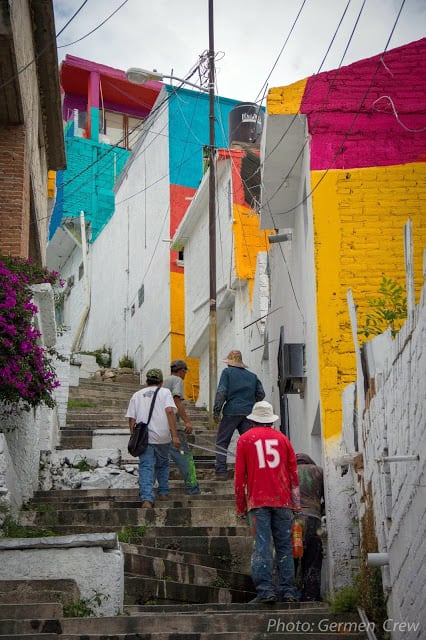

About Pachuca
| Fact | Detail |
|---|---|
| Country | Mexico |
| State | Hidalgo |
| Status | State capital and municipal seat |
| Location | South-central Hidalgo, about 90 km from Mexico City |
| Known for | Mining heritage, murals, painted housing, urban art projects |
Read the full overviewWhy Pachuca matters, What does Pachuca look like in practice?, What is Pachuca’s history?, Why does it appear in art and design coverage?
Why Pachuca matters
Pachuca matters because it is not just an administrative capital; it is a city whose built environment has repeatedly been used as a surface for civic identity. Its streets and housing have appeared in projects that use paint, scale, and repetition to change how a neighbourhood reads visually. That makes the city relevant to visual culture: it offers examples of how colour can be used not as decoration alone, but as a public tool for recognition, renewal, and collective authorship.
The city’s background as a mining centre also shapes its image. In central Mexico, mining towns often developed dense working-class neighbourhoods and strong local institutions, which later became fertile ground for community-oriented art programmes. Pachuca’s later association with murals and mass painting projects builds on that history of labour, infrastructure, and urban change.
What does Pachuca look like in practice?
In practice, Pachuca appears as a city where public art can extend beyond a single wall or gallery commission. Articles that mention it often focus on housing blocks, streets, and neighbourhood elevations transformed into coordinated fields of colour. These projects usually rely on house paint, repeated geometric or painterly schemes, and collaboration between artists, residents, and municipal actors.
The visual result is often orderly rather than spontaneous. Entire clusters of buildings may be assigned specific palettes so that a district reads as one composition from a distance. That approach gives Pachuca a place in conversations about socially engaged muralism, because the work is not confined to a picture plane; it changes how people move through and identify a place.
What is Pachuca’s history?
Pachuca developed as a mining city, and that history still matters to its urban form and reputation. Mining brought population growth, industrial wealth, and a relationship to extraction that shaped the city’s economy for centuries. Like many Mexican cities with colonial and postcolonial mining legacies, it became a place where labour, migration, and civic institutions overlapped.
The name’s origin is uncertain, and there is no settled consensus about its etymology. The city is formally called Pachuca de Soto, a name that distinguishes it from the wider municipality. That formal name is part of its administrative identity, but in everyday and cultural use the shorter form, Pachuca, is the one most often encountered.
Why does it appear in art and design coverage?
Pachuca appears in art and design coverage because it has been used as a site for large interventions that treat the city itself as a surface. A mural on one wall can be photographed as an image, but a painted neighbourhood changes the entire visual field. The city therefore becomes a case study in how public art scales up from object to environment.
It also matters because these projects sit between design, community engagement, and urban policy. Coordinated colour schemes require planning, durable materials, labour, and maintenance. In Pachuca, that combination has made the city useful to writers looking at how artists and communities work together to remake ordinary housing into something legible as shared visual culture.
Frequently Asked Questions
Is Pachuca a city or a municipality?
Pachuca is both the city and the seat of the municipality officially called Pachuca de Soto. In Mexican administrative terms, the municipality is the larger unit, while the city is its urban core. The shorter name usually refers to the city itself.
Why is Pachuca associated with murals and painted houses?
Pachuca has appeared in projects that use coordinated colour across homes and neighbourhoods, turning buildings into collective artworks. These efforts are often tied to community art initiatives rather than individual mural commissions. The city’s walls, housing blocks, and hillside streets make it a strong site for visible, large-scale interventions.
How far is Pachuca from Mexico City?
Pachuca lies roughly 90 kilometres from Mexico City, connected by Mexican Federal Highway 85. That proximity has made it accessible for artists, journalists, and organisers working between the capital and Hidalgo. It also places the city within the wider cultural orbit of central Mexico.