
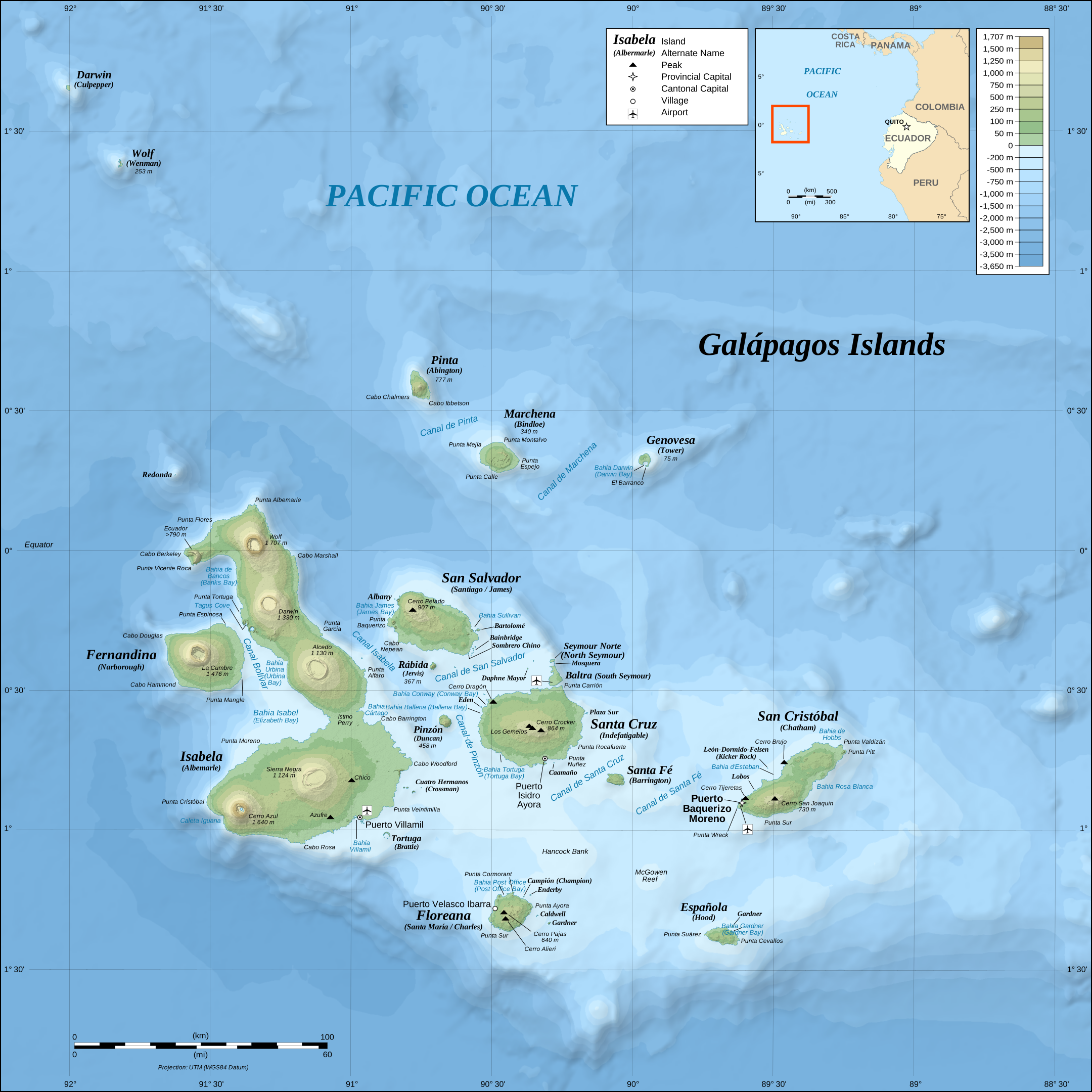
The Galápagos Islands are a volcanic archipelago in the Pacific Ocean, about 926 kilometres west of mainland Ecuador. They form an Ecuadorian province, a national park, and a marine reserve, and they are best known for their unusually high number of endemic species. Spanish is the main language, and the resident population is a little over 25,000.
- Made up of volcanic islands scattered across the equator.
- Part of Ecuador, but far from the mainland.
- Protected as both a national park and a marine reserve.
- Famous for species found nowhere else, on land and in the sea.
- Known to naturalists, photographers, and travellers for stark landscapes and distinctive wildlife.
Why the Galápagos matter
The islands matter because isolation shapes life. Their distance from the continent and their patchwork of young volcanic surfaces created conditions where plants and animals evolved separately from mainland relatives. That made the Galápagos one of the most important places in the history of ecology and evolutionary biology, and a reference point whenever artists or documentary makers want to show adaptation in action.
They also matter as a working landscape, not just a scientific symbol. People live on the islands, fish their waters, and manage tourism within strict environmental limits. The place is defined by a constant tension between preservation and use, which is part of what makes it so closely watched.
What do the islands look like?
Visually, the Galápagos are stark and elemental. Black lava fields, rough basalt cliffs, salt-tolerant scrub, white beaches, and shallow turquoise water create a landscape with strong contrasts. Many islands look young because much of the surface is geologically recent, with sharp lava flows and cinder cones still readable in the terrain.
That raw setting is important to photography and film. The islands tend to appear less lush than tropical destinations on the mainland, but more graphic: open skies, hard light, dark stone, and animals that often show little fear of humans. Sea cliffs, tide pools, and underwater reefs are as central to the visual identity of the islands as the better-known beaches and coves.
How were the Galápagos formed?
The islands were formed by volcanic activity on the Nazca Plate as it moved over a hotspot in the Pacific. New islands emerged over time, while older ones eroded and sank. This process means the archipelago is not a single uniform landmass but a chain of islands at different stages of geological life.
That origin explains much of the ecology. Each island developed under slightly different conditions of age, rainfall, altitude, and isolation, which encouraged divergence among species. The result is a place where nearby islands can support distinct forms of the same animal group, and where a short boat trip can produce noticeable changes in landscape and habitat.
Why are they so often associated with wildlife?
The Galápagos became famous because their wildlife is unusually approachable, varied, and distinctive. Giant tortoises, marine iguanas, Darwin’s finches, blue-footed boobies, sea lions, and many other species are strongly associated with the archipelago. Some are endemic to individual islands or to the chain as a whole, which means they do not naturally occur anywhere else.
That concentration of endemism makes the islands a powerful site for seeing adaptation rather than just reading about it. For natural history photographers, underwater specialists, and writers about climate or conservation, the Galápagos offer a rare combination of spectacle and scientific clarity. The animals are not ornamental extras; they are part of the argument for why the place is exceptional.
Frequently Asked Questions
Are the Galápagos Islands part of Ecuador?
Yes. The islands belong to Ecuador and form one of its provinces, even though they sit far out in the Pacific Ocean. They are governed as part of the country, and Spanish is the main language on the islands.
Why are the Galápagos Islands protected?
They are protected because their ecosystems are fragile and globally significant. The archipelago includes a national park and a marine reserve designed to limit damage to habitats, wildlife, and fisheries. Conservation rules are especially important because introduced species, tourism, and development can quickly upset island ecosystems.
What makes the Galápagos different from other tropical islands?
The Galápagos are younger-looking, drier, and more volcanic than many tropical island groups. They also have an unusually large number of endemic species, so the wildlife often feels specific to the place rather than broadly tropical. That combination of bare geology and distinct fauna gives the islands a visual and scientific identity that is hard to mistake.