
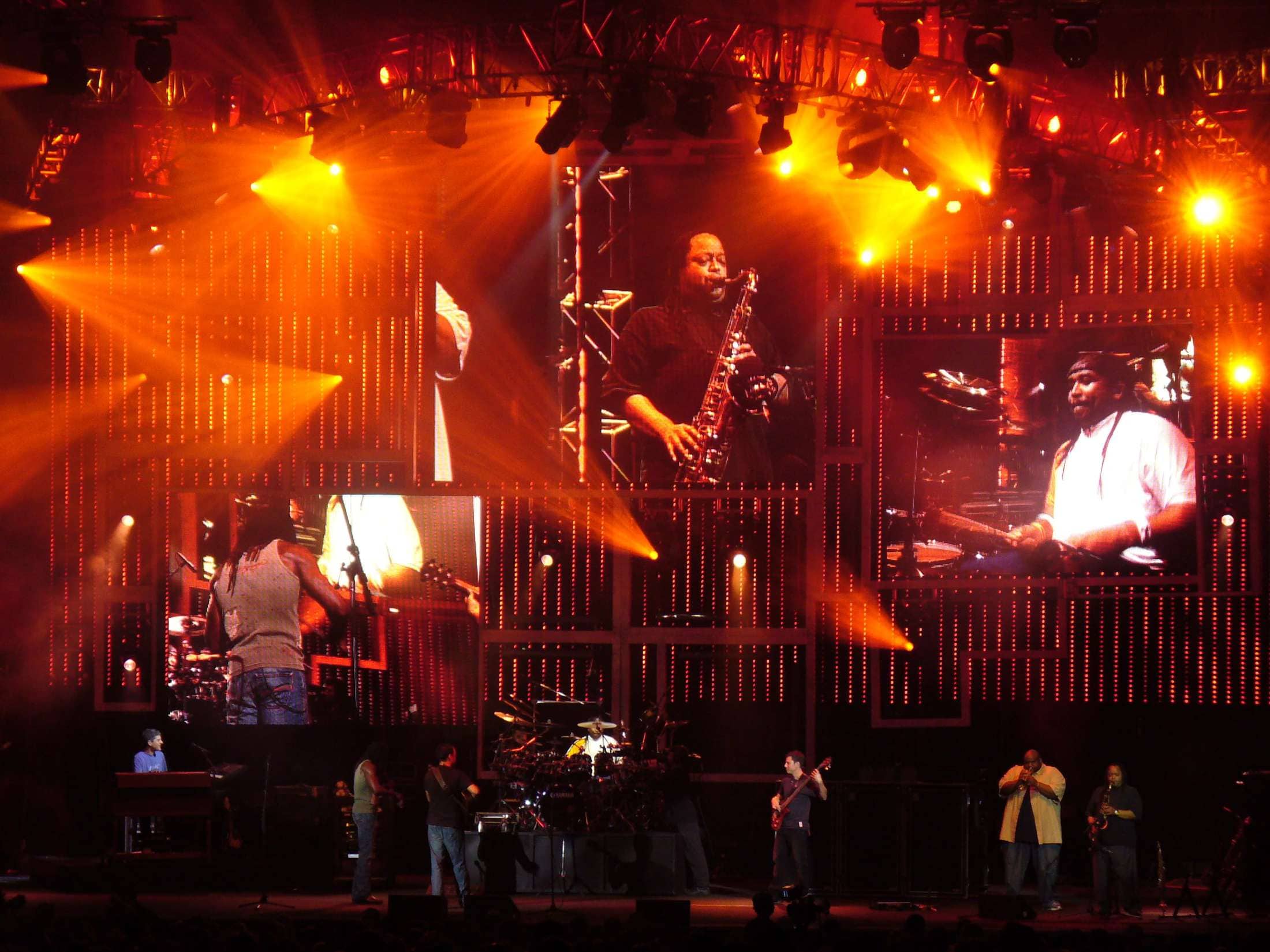
Dave Matthews Band is an American rock band formed in Charlottesville, Virginia, in 1991. Built around Dave Matthews’s songwriting and voice, the group became known for long-form songs, extended live improvisation, and a lineup that blended rock instrumentation with violin and saxophone.
| Founded | 1991 |
|---|---|
| Place of origin | Charlottesville, Virginia, United States |
| Core members at formation | Dave Matthews, Stefan Lessard, Carter Beauford, LeRoi Moore |
| Early addition | Boyd Tinsley on violin |
| Best known for | Live performance, improvisation, and a hybrid rock sound |
How the band formed
Matthews began the project after moving to Charlottesville and recording songs with local musicians. The earliest lineup took shape around players with different backgrounds: Beauford’s drumming came from jazz and funk, Lessard’s bass anchored the rhythm section, and Moore’s saxophone gave the band its most distinctive melodic voice. Tinsley’s violin added another layer, turning the group’s sound away from standard guitar-bass-drums rock.
That combination mattered because the band’s identity was never built only in the studio. It developed in performance, where songs could stretch out, change shape, and highlight each player’s phrasing. The result was a band whose recordings and concerts often felt like different versions of the same work rather than fixed replicas.
What does a Dave Matthews Band performance sound like?
The band’s songs usually begin with a clear hook or rhythmic figure, then open into instrumental passages. Beauford’s drumming often drives the arrangement with syncopation and motion, while Matthews’s guitar work is frequently percussive rather than purely chordal. Moore’s saxophone lines and Tinsley’s violin melodies helped fill the upper register, giving the music a crowded, fast-moving texture that still left room for improvisation.
In practice, this made the band especially strong as a live act. Concert versions of songs could run longer than album cuts, with solos, rhythmic breaks, and call-and-response sections that altered night to night. For listeners, the appeal often came from hearing familiar material treated as something unfinished and elastic.
Why did the band matter?
Dave Matthews Band became one of the most commercially successful American rock acts of the 1990s and 2000s while keeping a live-first identity. That combination was unusual: many bands of the period leaned either toward radio singles or jam-band culture, but DMB moved between both worlds. Its audience grew through touring, bootlegs, and word of mouth as much as through albums and singles.
The group also helped normalize a wider palette inside mainstream rock. Violin and saxophone were not decorative extras in its sound; they were structural parts of it. That orchestration made the band recognizable within a few measures and gave it a place apart from the standard guitar-led alternative rock of its era.
What changed over time?
The band’s history includes line-up changes and a major rupture in 2008, when saxophonist LeRoi Moore died after complications from injuries sustained in an ATV accident. His death marked the end of an early era, since his playing had been central to the band’s melodic identity. Afterward, the group continued performing and recording, adapting its arrangements to the absence of one of its defining voices.
Over time, Dave Matthews Band shifted from a regional touring act into an established institution with a large catalogue and a persistent concert audience. The band’s longevity came from the strength of its musicianship and from a format that could absorb personnel changes without losing its core character. Even when the songs changed, the emphasis on interaction, groove, and live variation remained visible.
Frequently Asked Questions
Is Dave Matthews Band a jam band?
It is often described that way, though the label is imperfect. The band uses improvisation and extended live sections, which connect it to jam-band culture, but its songs are usually built from tighter compositions than that label suggests. It sits between mainstream rock and the improvisational live circuit.
What instruments define the band’s sound?
Guitar, bass, and drums form the core, but saxophone and violin are essential to the arrangement. Those instruments give the music its harmonic color and melodic density, especially in live performance. Without them, the band would sound much closer to conventional rock.
Why is the live show so important?
The live show is where the band’s arrangement style fully appears. Songs are often expanded, reshaped, and treated as vehicles for interaction among the players. For that reason, the group’s reputation depends as much on concerts as on studio albums.