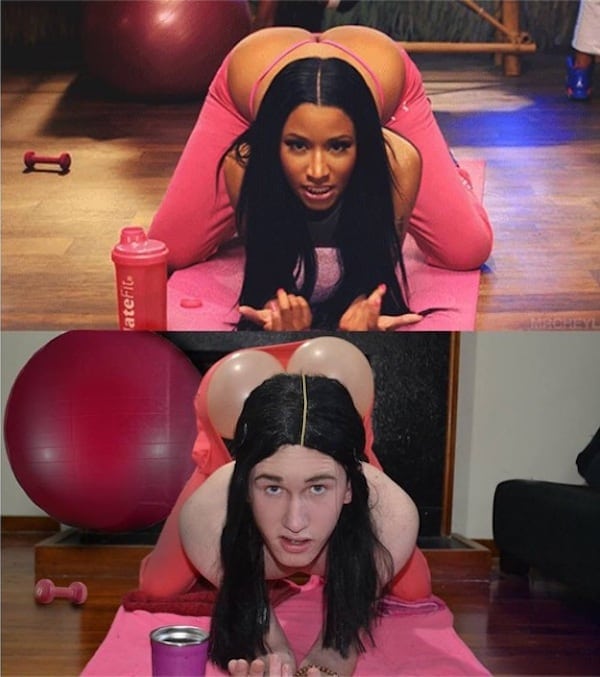
Liam Martin is a New Zealand-born visual impersonator known for styling himself as celebrity doppelgangers. His work sits somewhere between portrait performance, costume, and social-media image making: he uses hair, makeup, clothing, posture, and facial expression to resemble recognisable public figures closely enough to read at a glance.
- He is known for transformation-based portrait work rather than for a single fixed persona.
- His practice depends on styling, grooming, and image control as much as on resemblance.
- Celebrity doppelganger work turns likeness into a performance and a shareable image.
- The appeal lies in instant recognition, careful visual detail, and the slightly uncanny effect of almost-but-not-quite becoming someone else.
What does a celebrity doppelganger do?
A celebrity doppelganger creates a convincing visual stand-in for a famous person. The task is not simple imitation. It involves studying bone structure, hairstyle, makeup, clothing silhouette, and the small habits that make a face feel familiar in photographs. In practice, the result is a staged likeness that can be used for publicity, social media content, events, or editorial features.
Liam Martin’s name appears in this context because his work depends on transformation. Rather than presenting an original character, he builds recognisability out of borrowed features. The finished image usually asks for quick comparison: who is being referenced, what detail makes the illusion work, and how close can resemblance be taken before it becomes parody.
How is the look built?
Celebrity likeness is usually constructed through styling choices rather than digital effects alone. Hair is often the first marker, because it frames the face and signals identity immediately. Makeup can alter contour, skin tone, brow shape, and the apparent distance between features. Clothing then finishes the impression by copying a well-known outfit type, public-appearance look, or signature wardrobe item.
Photography matters too. Lighting, angle, crop, and expression all affect whether the impersonation lands. A flat front-facing portrait may emphasise exact resemblance, while a more theatrical pose can shift the image toward performance. In this kind of work, the image is the product; the labor of getting there is usually hidden inside the final frame.
Why does this kind of performance matter?
Celebrity doppelganger work belongs to a long tradition of mimicry, drag, costume, and staged identity. It shows how much of public identity is built from repeatable visual cues. A famous face becomes legible through a few stable features, and those features can be copied, adjusted, or exaggerated. The work reveals that recognition is partly mechanical.
It also reflects the attention economy of online culture. A striking likeness can travel quickly because it is instantly understandable and easy to compare. For young performers like Martin, the appeal often lies in precision: the challenge of turning an ordinary face into a recognisable image through craft, discipline, and a sharp eye for detail.
What does it look like in practice?
In practice, the output is usually a set of portraits or short-form images that place the performer beside or inside the visual language of the celebrity being copied. The best examples depend on clean execution. If the hair is wrong, the illusion collapses; if the expression is too neutral, the likeness feels static; if the pose is too broad, it turns into caricature.
That balance between accuracy and exaggeration is central to the form. The work is persuasive because it sits close to the real thing, but it remains visibly made. The viewer sees both the impersonated figure and the materials of impersonation: makeup, styling, posture, and camera craft.
Frequently Asked Questions
Is a celebrity doppelganger the same as an impersonator?
They overlap, but the terms are not identical. An impersonator often performs a voice, gesture, or stage act, while a doppelganger focuses more on visual resemblance. In Liam Martin’s case, the emphasis is on making the body and face read as a recognisable likeness in photographs.
What skills are needed for this kind of work?
It depends on strong observation and disciplined styling. Hair, makeup, wardrobe selection, and facial expression all need to work together. Photography skills help too, because the same look can fail or succeed depending on lighting, framing, and editing.
Why do people respond so strongly to lookalikes?
Recognition happens fast when a face echoes a famous one. That instant identification creates surprise, humor, and a slight sense of uncertainty about what is real. The response comes from seeing familiarity assembled out of ordinary materials.
Articles mentioning Liam Martin