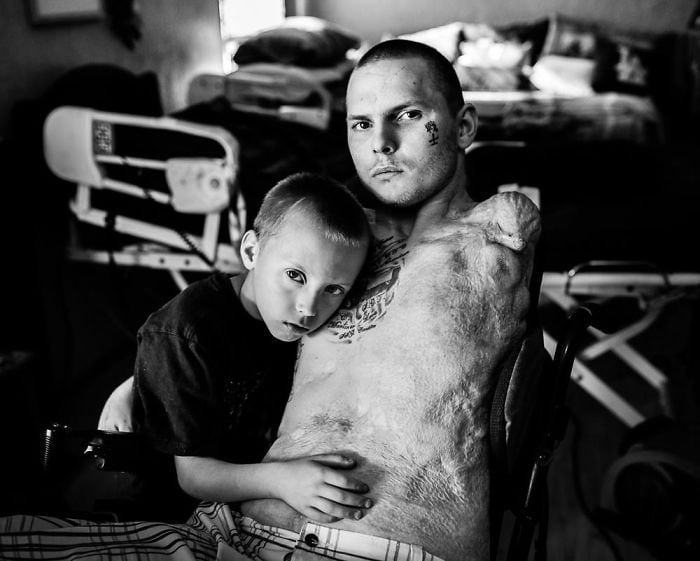
James Nachtwey is an American photojournalist known for black-and-white and color images of war, famine, and political violence made in close proximity to danger. Born in 1948 in Syracuse, New York, and raised in Massachusetts, he became one of the most influential conflict photographers of the late 20th and early 21st centuries through work in Central America, the Balkans, Rwanda, Iraq, Afghanistan, and other crisis zones. His photographs focus less on battlefield spectacle than on the physical and emotional cost of violence.
| Born | March 14, 1948, Syracuse, New York, United States |
|---|---|
| Nationality | American |
| Field | Photojournalism, war photography |
| Education | Dartmouth College, Art History and Political Science |
| Known for | Intense, closely observed images of conflict, suffering, and aftermath |
| Major recognition | Multiple Robert Capa Gold Medals from the Overseas Press Club |
What makes Nachtwey’s work distinct?
Nachtwey’s pictures are built from proximity, patience, and restraint. He often uses a straightforward documentary style: natural light, tight framing, and compositions that keep attention on gesture, wound, exhaustion, and grief. The images rarely feel theatrical. Instead, they are made to register how war enters ordinary bodies and spaces, from a ruined street to a hospital bed to a refugee camp.
That approach places him in the tradition of humanist photojournalism, but his work is more severe than sentimental. He does not soften violence with symbolism or broad context alone; he shows consequences directly. This directness has made his photographs useful to editors, historians, and advocates, but it also raises hard questions about witnessing, risk, and the limits of looking at suffering from a safe distance.
How did he become a major war photographer?
Nachtwey studied at Dartmouth College and later worked in newspaper and magazine photography, where he developed the disciplined field habits that would define his career. He came to prominence in the 1980s, covering conflicts in Central America and Northern Ireland, then expanded his reach through long-term coverage of war and crisis across the world. His reputation grew not from a single famous image but from sustained reporting over decades.
He worked for major publications including Time and also contributed to long-form documentary projects. In 2003, while serving as a Time contributing correspondent in Baghdad, he was injured by a grenade attack on his convoy and later recovered fully. That episode reinforced the physical danger built into his practice: his photographs are not made from a distance or in controlled conditions, but in environments where the photographer is also exposed.
Why does his photography matter?
Nachtwey helped define how war has been seen in magazines, books, exhibitions, and digital archives for several decades. His work gave visual form to events that might otherwise be reduced to statistics or political summaries. A famine, massacre, or siege becomes legible through faces, bodies, clothing, buildings, and the condition of the ground itself.
He also changed expectations of what a war photograph can do. Rather than chase only decisive action, he often photographs aftermath: mourning, displacement, treatment, and survival. That makes his archive important for visual culture because it shows the material residue of conflict, not just the moment of attack. The result is less about heroics than about endurance and damage.
What does his work look like in practice?
Nachtwey’s photographs usually share a tight, controlled visual language. He tends to isolate subjects against cluttered but readable backgrounds, so that a hand, a bandage, a uniform, or a shattered wall carries narrative weight. His images often use strong contrast and clear geometry, but they remain grounded in evidence rather than style for its own sake.
In practical terms, that means a viewer often sees the tools and textures of conflict as much as the people in it: dust, blood, smoke, rubble, medical gauze, military fabric, and the temporary shelters of displaced lives. This attention to material detail is part of what makes the work so durable. The photographs do not only record events; they record the conditions under which people survive them.
Frequently Asked Questions
Is James Nachtwey a photojournalist or an artist?
He is first known as a photojournalist and war photographer, but his work is also studied in museums and art contexts. That crossover happens because his photographs are both documentary evidence and highly considered visual constructions. The images serve news reporting, historical memory, and visual analysis at the same time.
What subjects does he photograph besides war?
Although conflict is his central subject, Nachtwey has also photographed famine, displacement, disease, and other forms of human crisis. These projects follow the same commitment to long-term, close observation. The common thread is not war alone, but vulnerability under extreme pressure.
Why is he associated with Robert Capa?
The Overseas Press Club’s Robert Capa Gold Medal honors exceptionally courageous and distinguished war photography, and Nachtwey has won it multiple times. The link to Capa places him in a lineage of photographers who work in dangerous settings to document conflict firsthand. The award reflects both the quality of his images and the risks involved in making them.
Articles mentioning James Nachtwey