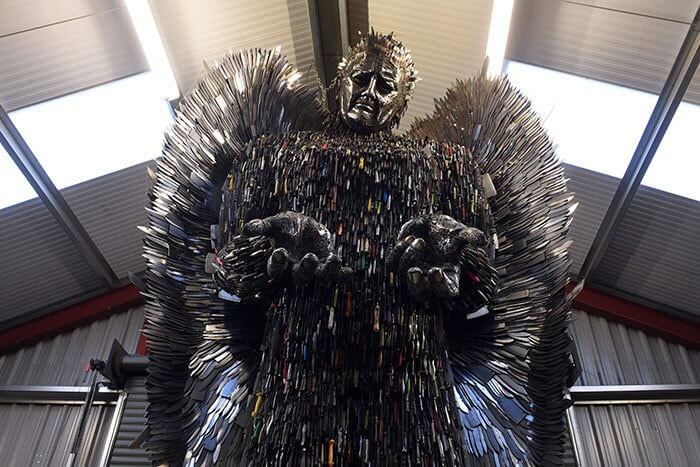
Alfie Radley is a contemporary sculptor known for making large-scale figurative works from decommissioned weapons and other salvaged metal objects. His practice turns guns, knives, and scrap steel into public-facing sculptures that read at once as memorials, warnings, and feats of fabrication.
| Field | Sculpture |
|---|---|
| Known for | Monumental assemblage works made from discarded or decommissioned weapons |
| Materials | Guns, knives, scrap metal, welded steel armatures |
| Working method | Collection, sorting, cutting, welding, and assembly |
| Subject matter | Angels, human figures, symbolic forms, anti-violence imagery |
What kind of artist is Alfie Radley?
Radley works in sculpture, but his projects depend as much on industrial process as on form. The basic structure usually begins with a welded armature, then accumulates thousands of individual metal pieces until the final figure becomes visible. That makes his work part fabrication, part image-making: the viewer reads the silhouette first, then notices the source material.
His best-known pieces use weapons as raw material, which gives the finished work a double meaning. From a distance the sculpture can appear devotional or monumental; up close, the inventory of knives, pistols, and rifle parts makes the message harder to ignore. The material is not decorative. It is the subject.
Why does he use guns and knives?
Radley’s choice of material gives his sculpture moral and political force. A gun or knife carries an immediate association with harm, so when those objects are gathered into an angel or guardian figure, the work stages a reversal: instruments of violence become an image of protection, grief, or warning. That contrast is the core of the work’s visual impact.
The approach also ties the finished object to the world it comments on. Salvaged weapons are not neutral studio stock; they come with prior use, legal control, and public controversy. By incorporating them directly, Radley avoids an abstract anti-violence message and instead builds the argument into the material itself.
How are these sculptures made?
These works depend on a labor-intensive process of acquisition, sorting, and assembly. Weapons and scrap pieces have to be collected, made safe, and then organized by size and shape so they can be welded or fixed into place. Large sculptural forms often need a hidden internal structure to carry the weight of the metal and keep the outline stable.
In practice, the surface texture comes from repetition. Hundreds or thousands of similar objects are layered to create density, shadow, and volume. From near by, the work reads as a constructed surface made of distinct parts; from farther away, those parts collapse into a single legible figure. That shift in scale is one reason the sculptures feel so forceful in exhibition spaces and public installations.
Why does Alfie Radley matter?
Radley matters because he works in a mode of sculpture that is immediately legible to general audiences without becoming simplistic. The pieces use recognizable objects, but the craft involved is real and visible: metalwork, structural engineering, and patient assembly are all part of the meaning. The result is not just a symbol made from debris; it is a carefully built object that changes how the debris is seen.
His work also fits a broader contemporary interest in reuse and transformation. In a period shaped by mass production, gun culture, and public debate over violence, turning weapons into sculpture creates a strong visual counterimage. The finished work can function as memorial, protest, and technical demonstration at the same time.
Frequently Asked Questions
Is Alfie Radley’s work always made from weapons?
No. Weapons are the most striking material associated with his work, but the broader practice belongs to assemblage sculpture and salvage-based fabrication. The central idea is transformation through reuse, so other metal objects can also play a role when they support the form or message.
What makes the sculptures look so detailed?
Detail comes from scale and repetition. Many separate components are welded or fastened together so that each piece remains visible while also contributing to a larger image. That method creates a surface that feels busy and exact, even when the overall shape is simple.
Is the work meant as activism or as art?
It is both, though the balance can shift from piece to piece. The sculptures carry a clear anti-violence charge, but they also depend on composition, engineering, and craft to work as art objects. Their power comes from keeping those functions together instead of separating them.
Articles mentioning Alfie Radley