
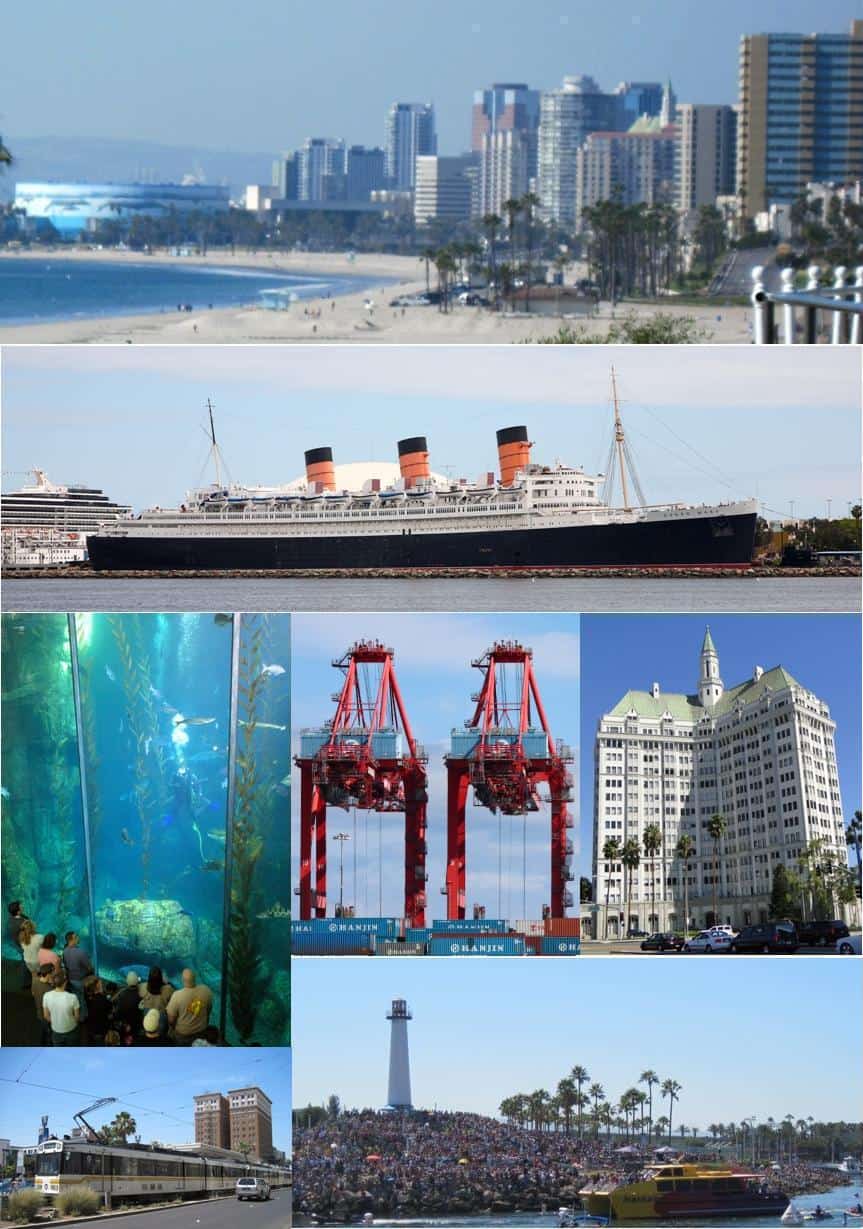
Long Beach, California is a coastal city in southern Los Angeles County, on the Pacific edge of the Los Angeles metropolitan area. It is one of the region’s largest cities and a major maritime centre, shaped by its port, industrial shoreline, and dense urban fabric.
| Fact | Detail |
|---|---|
| Type | City |
| Location | Los Angeles County, Southern California, United States |
| Coast | Pacific Ocean |
| Population | 462,257 (2010 census) |
| Regional role | Principal city in the Los Angeles–Long Beach–Santa Ana metropolitan area |
| Known for | Port operations, shipping, aerospace, and a large urban arts scene |
Where is Long Beach, and what gives it its shape?
Long Beach sits where Los Angeles County meets the Pacific, south of downtown Los Angeles and north of Orange County’s coastal cities. Its geography matters: the city combines beach frontage, a working harbour, container terminals, freeways, rail corridors, and broad residential districts. That mix makes it feel less like a resort town than a city built around movement, logistics, and the edge between land and water.
Its port has had an enormous effect on the city’s development. The Port of Long Beach handles large volumes of international cargo and anchors a landscape of cranes, warehouses, refineries, and ship channels. That industrial presence sits beside neighborhoods, commercial strips, and cultural institutions, so the city often reads as a place where commerce and public life occupy the same frame.
How did Long Beach become important?
Long Beach grew from a coastal settlement into an urban centre in the late nineteenth and early twentieth centuries, helped by rail connections, real estate development, and the expansion of the Southern California economy. The discovery and extraction of oil in the early twentieth century also shaped the city’s growth, especially in the surrounding harbour and adjacent districts. Later, the port and the aerospace industry gave it national weight.
Today, Long Beach matters because it links Southern California to global trade. It is part of the busiest port complex in the United States, and that status affects employment, land use, air quality, and the city’s visual character. Cranes, stacked shipping containers, breakwaters, and dock infrastructure are not background details here; they are part of the city’s identity.
What does Long Beach look like in practice?
Long Beach has a layered urban texture. Downtown contains tall buildings, convention spaces, galleries, and waterfront development, while other districts hold mid-century housing, small commercial corridors, and industrial land. Street life can shift quickly from beach promenades and civic plazas to freight infrastructure and arterial roads.
For artists and designers, that variety matters. Large walls, underpasses, and warehouse districts create surfaces suited to murals and street art, while the city’s public-facing buildings and open spaces support festivals, exhibitions, and community arts projects. The built environment often encourages large-scale work, direct colour, and imagery that responds to motion, labour, and coastal weathering.
Why does Long Beach matter to visual culture?
Long Beach has long been attractive to practitioners who work at scale. Its industrial architecture offers long blank facades, and its civic spaces can accommodate ambitious public art. The city’s identity is not confined to its postcard coastline; it also comes from the visual language of shipping, infrastructure, and mixed-use urban density.
That makes Long Beach a useful place to think about how cities host art outside formal institutions. Murals there often sit beside loading bays, transit routes, and older commercial buildings, which changes how they read. The work feels embedded in the city’s everyday rhythms rather than isolated from them.
Frequently Asked Questions
Is Long Beach part of Los Angeles?
Long Beach is an independent city, but it is part of Los Angeles County and the broader Los Angeles metropolitan area. It functions as one of the region’s major urban centres rather than a neighbourhood of Los Angeles. Its identity is distinct, especially because of the port and the city’s own civic institutions.
What is Long Beach best known for?
Long Beach is best known for its port, its coastal setting, and its role in Southern California’s economy. It also has strong associations with shipping, aerospace history, and a visible public arts scene. Those elements give it a character that is both industrial and coastal.
Why would an arts publication mention Long Beach?
Long Beach matters to visual culture because it offers large walls, industrial surfaces, and public spaces where art can be seen at city scale. The city’s mix of port infrastructure, neighbourhood streets, and waterfront development creates a setting where murals and other public works become part of the urban landscape. That context often shapes the look and placement of the work as much as the artist’s style does.
At a glance
- Coordinates
- 33.768333, -118.19556
Articles mentioning Long Beach, California
