
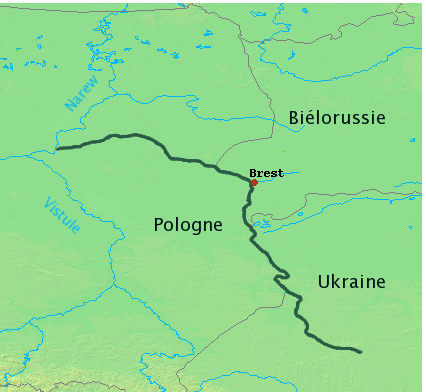
The Bug River is a major river in eastern Europe that rises in western Ukraine, runs along parts of the Ukraine–Poland and Poland–Belarus borders, and then flows into Poland before joining the Narew near Serock. It is a left tributary of the Narew and part of the wider Vistula drainage basin, which eventually reaches the Baltic Sea. In Polish usage, the section between the river and the Vistula is sometimes called Bugo-Narew.
| Essential fact | Detail |
|---|---|
| Type | River |
| Course | Western Ukraine through border regions into eastern Poland |
| Receives into | Narew River near Serock |
| Drainage basin | Vistula River system |
| Names | Ukrainian: Західний Буг; Belarusian: Захо́дні Буг; Russian: Западный Буг |
Where the river runs
The Bug begins in central or western Ukraine, then turns north and west through a broad lowland landscape. For long stretches it forms an international boundary, first between Ukraine and Poland and then between Poland and Belarus. After entering Poland proper, it continues toward the Narew, meeting it near Serock in the east of the country.
This border course makes the river geographically important even where it is not especially large in the public imagination. Rivers that trace national edges often become reference points for transport, settlement, customs zones, and historical memory. The Bug is one of those rivers: its banks mark a line on the map, but also a corridor through which people, goods, and armies have moved for centuries.
What does the Bug River connect to?
The Bug is part of the Narew–Vistula system, which drains much of central and eastern Poland before reaching the Baltic Sea. The Narew, into which the Bug flows, is itself a significant river in the region, so the Bug contributes to a larger hydrological network rather than ending as an isolated local waterway. That relationship matters in geography, flood management, and regional planning.
The name Bugo-Narew is used for the section where the Bug and Narew are treated together as a single waterway corridor. Such compound names appear when one river’s identity blends into another in practical use: navigation, settlement patterns, and floodplains do not always respect a clean naming line. The Bug’s course has been shaped by these lowland conditions, with broad valleys and flood-prone stretches typical of rivers in the North European Plain.
Why does it matter historically?
The Bug River has long been a frontier river. Border rivers tend to acquire political weight because they can separate jurisdictions, customs regimes, and military zones, while also serving as routes of exchange. In the case of the Bug, that role has shifted over time as borders in eastern Europe changed repeatedly in the 19th and 20th centuries.
That history gives the river a place in the political geography of the region even when it is mentioned in passing. For many readers, the Bug is less a scenic landmark than a frame for contested territory, migration, and national boundary-making. Its significance comes from persistence: the river remained in place while states around it changed shape.
How is it seen and used today?
Today the Bug is treated as both a natural feature and an administrative line. It defines sections of the border between countries, supports local ecosystems, and belongs to a river basin managed through modern environmental and flood-control concerns. Like other lowland rivers, it can overflow into wide floodplains, so water management is a practical issue as much as a cartographic one.
In landscape terms, the Bug is not known for dramatic falls or narrow gorges. Its character comes from breadth, slow bends, and a borderland setting. That makes it a river of edges rather than spectacle: useful for defining territory, important for ecology, and persistent in the geography of eastern Europe.
Frequently Asked Questions
Is the Bug River the same as the Western Bug?
Yes. “Western Bug” is the common English rendering of the river’s Ukrainian and regional name, used to distinguish it from other similarly named waterways. The river is also referred to in Belarusian and Russian with equivalent forms meaning Western Bug.
What larger river system does it belong to?
The Bug flows into the Narew, which then joins the Vistula. The Vistula is Poland’s main river and ultimately drains into the Baltic Sea, so the Bug is part of one of the most important river systems in the region. Its waters therefore travel through a major northward drainage network rather than ending at the border.
Why is the Bug River often mentioned in political history?
Because it has served as a boundary in a region where borders changed frequently. Rivers are often used as natural separators, and the Bug’s position between Poland, Belarus, and Ukraine made it a meaningful line in maps and treaties. Its historical role is tied less to the water itself than to the territory it divides and connects.
At a glance
- Address
- Volyn Oblast, Poland
- Coordinates
- 49.8927, 25.0166