

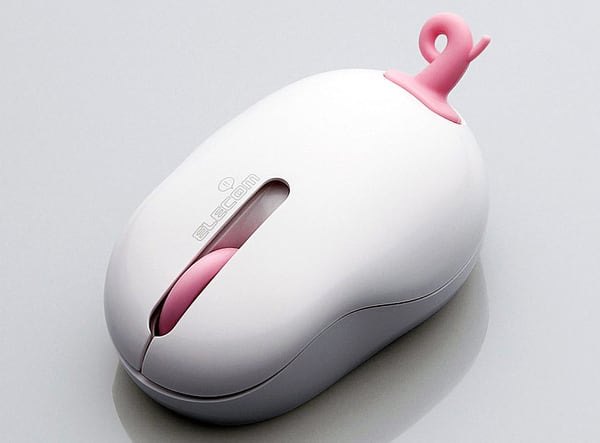
Japanese electronics manufacturer Elecom, in collaboration with the design studio Nendo, introduced one of the more charming pieces of computer peripheral design in recent memory: the Oppopet Mouse, a series of wireless mice shaped like small animals, each one complete with a USB receiver disguised as the creature’s tail.
The Detail That Makes the Design
The Oppopet series includes a bear, a rabbit, a cat, and several other animals rendered in smooth, compact silhouettes scaled to fit comfortably in the hand. Each figure functions as a fully operational wireless mouse, but the defining feature is the USB nano-receiver, which is integrated into the tail. To connect, you simply pull the tail free from the body of the mouse and insert it into your computer’s USB port. When not in use, it clips back into place, keeping the figure intact and the receiver protected.
Nendo’s approach here is characteristically restrained. The studio — led by designer Oki Sato — is known for finding the one surprising detail that reframes an otherwise ordinary object. With Oppopet, that detail is the tail-as-receiver: a functional solution that also completes the animal metaphor, giving each mouse a small physical narrative. The result is an object that is easy to use and genuinely delightful to encounter.
Elecom and the Culture of Kawaii Hardware
Elecom is a significant player in the Japanese consumer electronics market, with a product range that spans professional peripherals and design-oriented accessories. The Oppopet collaboration with Nendo sits at the creative end of the company’s output — a series more likely to be found as a desk companion than as a serious productivity tool, though it functions perfectly well as both.
The Oppopet Mouse fits squarely within Japan’s long tradition of applying aesthetic care and conceptual wit to everyday technology. It treats the desk as a domestic environment worthy of thoughtful objects, and the computer peripheral as something that might earn a place in that environment not only through utility but through personality. As a piece of product design, it remains a clean example of how functional constraints — the need to store a USB receiver — can become the generative premise of an entire design idea.
More in
Art
All Art


