
Adam Hillman is an American artist known for arranging everyday objects into tightly ordered, brightly colored compositions that read as abstract images. His best-known body of work, the Arrangement series, uses things such as clothing, candy, fruit, pasta, and other ordinary materials to build optical patterns that depend on repetition, alignment, and color contrast.
Adam Hillman on FreeYork
About Adam Hillman
| Field | Detail |
|---|---|
| Profession | Artist |
| Known for | Arrangement series of object-based compositions |
| Materials | Everyday items including food, clothing, and packaged goods |
| Style | Abstract, pattern-driven, optical |
| Influences | American abstraction, including Piet Mondrian |
What makes Adam Hillman’s work distinctive?
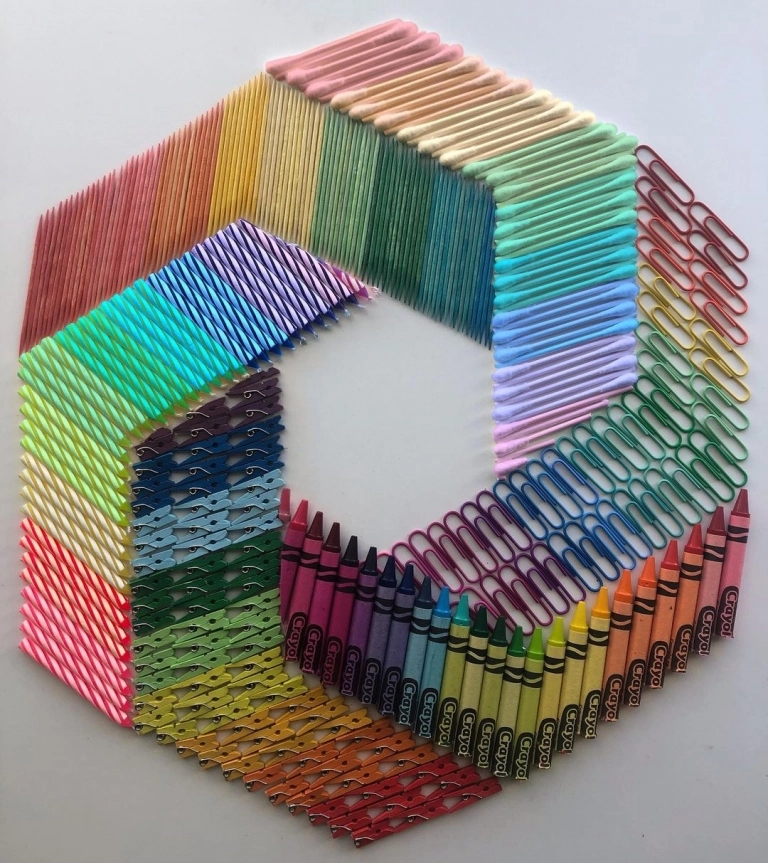
Hillman’s work turns found objects into a disciplined visual system. He does not simply photograph a pile of things; he sorts them by hue, shape, and scale, then lays them out so the final image behaves like a painting or a graphic design exercise. The result is often flat and frontal, with the object’s original use partly hidden beneath the strength of the pattern.
The visual effect depends on precision. A row of socks, a spread of sweets, or a field of small packaged items can become a grid, gradient, spiral, or block of repeated forms. The objects remain recognizable, but their practical meaning gives way to rhythm and surface.
How did he develop this approach?
Hillman’s earlier work was more abstract, but his process changed in the 2000s when mobile-phone photography became part of his working method. That shift mattered because it made quick documentation, testing, and sequencing easier. Instead of treating the camera as a distant recorder, he used it as part of the studio process, building compositions for the image rather than for an exhibition object alone.
The move toward photographed arrangements also aligned his work with a broader contemporary interest in making and displaying art through social media-friendly formats. His compositions are highly legible at first glance, but they reward close looking because the logic of the arrangement often reveals itself only after the eye traces the repeated units across the frame.
Why do the materials matter?
Hillman’s choice of materials gives the work its tension. Clothing, food, and household products are all functional, familiar, and disposable, yet in his hands they become formal elements: color swatches, modules, and shapes. That shift from use-value to visual value is central to the work’s appeal.
The materials also help anchor the work in ordinary life. Rather than relying on rare pigments or traditional studio supplies, Hillman works with things already present in domestic and commercial spaces. That makes the arrangements feel immediate and accessible, while also exposing how much design, branding, and mass production shape the look of everyday objects.
How does he fit into modern abstraction?
Hillman’s art sits beside a long history of abstraction that values order, geometry, and color relationships. The influence of Piet Mondrian is especially clear in the attention to structure and the reduction of visual noise. Like earlier abstractionists, Hillman uses composition to produce meaning without narrative.
At the same time, his work is less about purity than about mediation. It depends on photography, digital circulation, and consumer goods, so the abstraction is built from the material culture of the present. That combination of strict pattern and everyday residue is what gives the work its contemporary identity.
Questions
Is Adam Hillman mainly a photographer or an object-based artist?
He works across both areas, but the defining act is arranging objects. Photography captures and completes the work, while the composition itself is built in physical space before it is recorded. The image is important, but it documents a sculptural process rather than replacing it.
What is the Arrangement series?
The Arrangement series is Hillman’s signature body of work in which everyday objects are sorted into precise visual patterns. The objects may be lined up by color, packed into grids, or shaped into larger fields that resemble abstract painting. The series made his method widely recognized because it shows how ordinary items can be transformed through order.
Why is Piet Mondrian relevant to his work?
Mondrian matters because Hillman shares an interest in balance, structure, and the expressive power of simple forms. The connection is not one of direct imitation; Hillman replaces Mondrian’s painted geometry with found objects and photographic presentation. That difference makes the reference visible without making the work feel historical or nostalgic.