
Alain Robert is a French free solo climber and high-rise climber known for scaling skyscrapers, cliffs, and other tall structures without ropes or safety gear. He became widely known after climbing the Eiffel Tower in 1988 and later repeated the feat on buildings around the world, earning the nickname “the Human Spider.” His climbs sit between sport, performance, and public spectacle, and they are usually carried out with only climbing shoes and chalk.
Stories from Alain Robert
1 story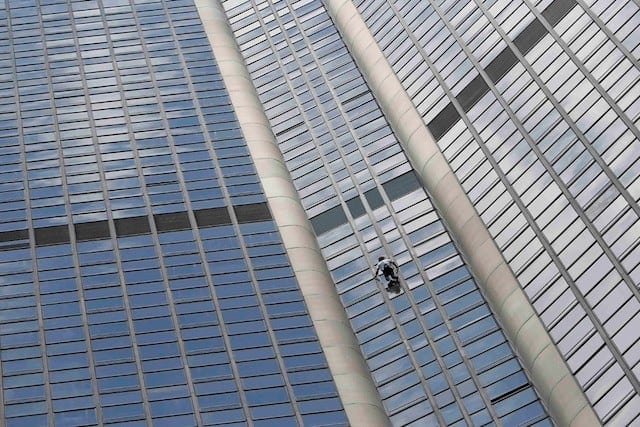
About Alain Robert
- French climber born in 1962
- Specialises in free solo ascents of buildings and cliffs
- Known for climbing without ropes, harnesses, or protective equipment
- Uses chalk to improve grip on rock and building surfaces
- His climbs often attract media attention and raise safety, legal, and ethical questions
Read the full overviewWho is Alain Robert?, What makes his climbing different?, Why are his climbs controversial?, How should his work be understood today?
Who is Alain Robert?
Alain Robert began as a rock climber and turned into one of the best-known figures in urban climbing. He built his reputation on ascents that look impossible from the ground: sheer glass towers, stone facades, and exposed rock faces climbed by hand and foot alone. The Eiffel Tower climb in 1988 made him famous, but it also established the pattern that has defined his career since then: public, risky, carefully planned climbs that rely on nerve, balance, and intimate knowledge of surfaces.
His work matters because it sits at the edge of several disciplines. It is climbing, but not in the usual mountain sense. It is also a kind of live performance, because the setting is often a city skyline and the audience includes passers-by, police, journalists, and cameras. In that sense, Robert is as much a public figure as an athlete.
What makes his climbing different?
Robert climbs with no rope, no harness, and no mechanical protection. That places his ascents in the category of free solo climbing, where a fall would be fatal or severely injurious. He often uses climbing shoes for friction and a chalk bag to dry his hands, but he does not rely on anchors or fixed lines. The skill lies in reading the surface quickly, finding micro-edges, and moving with enough economy that panic does not take over.
That style gives his climbs a stark visual quality. On stone, he looks like a traditional climber stretched vertically across a wall. On glass and steel, the body reads differently: small against the architecture, almost pasted onto the side of a tower. Buildings such as the Shard in London or other skyscrapers he has climbed become the stage, while the climb itself becomes a brief interruption in the normal life of the city.
Why are his climbs controversial?
Robert’s ascents attract attention because they are illegal or unauthorized more often than not. Building managers, police, and emergency services may not welcome a person on the exterior of a tower, especially in a crowded urban area. The climbs can trigger evacuations, arrests, or safety responses, and the publicity around them often raises the question of whether the stunt is reckless or artistically justified.
There is also a broader debate about celebrity risk. Robert’s fame depends on danger, but that danger is not abstract: it is built into the method. Supporters see discipline and mastery; critics see publicity by provocation. Both readings are part of his legacy, and both explain why he remains a reference point whenever extreme climbing moves from mountain terrain into the city.
How should his work be understood today?
Robert helped popularise urban climbing as a recognisable form of spectacle, though few climbers attempt anything close to his scale or visibility. His career shows how climbing can shift from private athletic pursuit into a highly mediated act that depends on architecture, law, media, and public reaction. In that sense, the surface he climbs is only part of the subject; the city itself becomes part of the performance.
His most memorable ascents are not defined by height alone but by the contrast between fragile human grip and engineered mass. A tower, which normally appears fixed and monumental, becomes temporary and climbable. That reversal is what gives his best-known climbs their force: they make modern architecture look vulnerable for a few minutes.
Frequently Asked Questions
Is Alain Robert a mountaineer or a stunt performer?
He is primarily a climber, specifically a free solo and urban climber. His public profile also overlaps with performance and stunt work because the climbs are staged in visible places and often covered by the media. The label changes depending on whether the focus is athletic skill, risk, or spectacle.
Does he really climb without any equipment?
He typically climbs without ropes, harnesses, or safety gear. He may use climbing shoes and chalk, which are standard tools for improving grip. The defining feature of his method is the absence of protection against a fall.
Why do people keep talking about him?
Because his climbs combine physical danger, unusual settings, and strong images. A lone climber on a skyscraper is easy to photograph and hard to forget. The result is a career that keeps returning to public attention whenever he chooses a new tower or landmark.