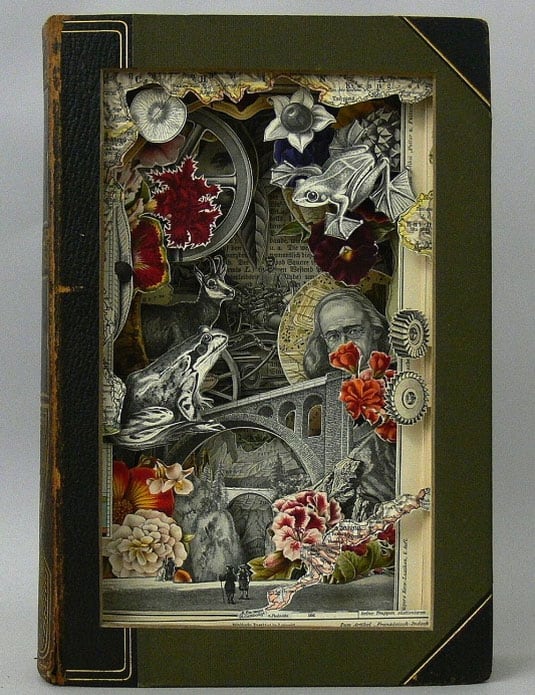
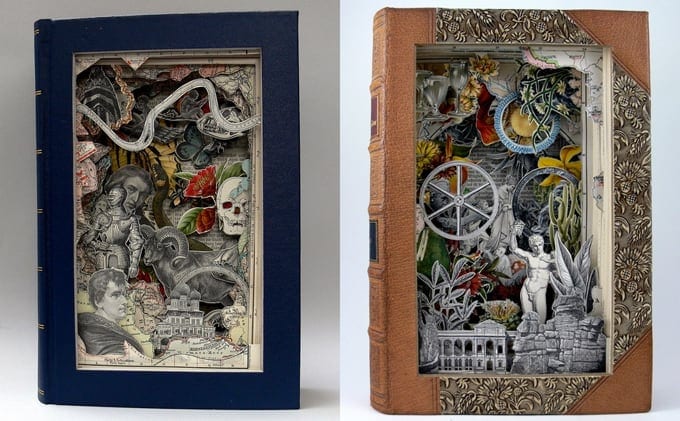
Alexander Korzer-Robinson is a British artist known for making collage-based book sculptures from second-hand encyclopedias, atlases, and other printed volumes. He cuts directly into the pages, reworking existing illustrations into miniature scenes that feel like dioramas, cabinets of curiosity, or private dream worlds.
- He works with pre-owned books rather than blank paper, using the original structure of the volume as part of the artwork.
- His images are built from material already present in the book, not from added drawings or pasted-in elements.
- The finished pieces often compress landscapes, rooms, animals, and figures into dense, story-like scenes at a small scale.
- His practice turns reference books into sculptural objects, shifting them from sources of information into physical artworks.
- The work reflects memory, loss, and the selective way images and histories are assembled.
How does Alexander Korzer-Robinson make book art?
Korzer-Robinson’s method begins with an existing book, often one that has outlived its practical use. He works page by page, cutting away sections with precision so that selected fragments line up across the spine and reveal a new image inside the book block. Because he does not add outside imagery, the final scene comes entirely from the book’s own printed material.
This gives the work a strong sense of constraint. The page count, paper stock, illustrations, and original layout all shape what is possible. That limitation is central to the finished object: the book remains a book, but it also becomes a sculptural composition.
Why use old encyclopedias and second-hand books?
Old reference books carry a particular visual authority. Their illustrations were originally meant to explain the world, but in Korzer-Robinson’s hands they become raw material for imagining it differently. Encyclopedias, in particular, offer a wide range of images that can be recombined into scenes with strange internal logic.
The choice of used books also matters conceptually. A worn volume already contains traces of prior ownership and use, so the artwork begins with a history rather than a neutral support. That historical residue fits his larger interest in how memory works: in fragments, in omissions, and in surprising combinations.
What do the finished works look like?
The finished pieces are small and intricate, often with a sense of depth created by layers of cut paper receding into the spine. They can resemble miniature theatre sets, fantastical landscapes, or enclosed worlds seen through a frame. Figures, architecture, animals, and foliage may appear, but they feel assembled rather than illustrated in a conventional way.
Because the source images come from older books, the palette often carries the muted, printed look of mid-century reproduction. That gives the works a slightly nostalgic tone without making them sentimental. The result is both precise and uncanny: a book that seems to remember something and invent something at the same time.
Why does his work matter?
Korzer-Robinson’s practice sits at the meeting point of collage, sculpture, and artist’s book. It shows how a familiar printed object can be transformed without losing its identity. The book remains readable as an object, but its function changes completely once the pages are cut into an image-bearing structure.
The work also speaks to broader concerns in visual culture: reuse, archive, authorship, and the afterlife of obsolete media. In an age when information is often dematerialised, his pieces insist on the physical page, the knife cut, the printed image, and the slow labor of selection. That material process is not decorative; it is the meaning of the work.
Frequently Asked Questions
Is Alexander Korzer-Robinson a collage artist or a sculptor?
He is best understood as both. His works use collage principles because they assemble images from existing printed matter, but the finished objects are physical book sculptures rather than flat collages. The page stack, spine, and cut edges are essential to the piece.
Does he draw or add new images to the books?
No. His process depends on finding and isolating imagery already printed inside the book. The artistry comes from selection, cutting, and composition, not from adding new marks or pasted elements.
What makes his book sculptures distinctive?
The key distinction is that the source material and the finished image are the same object. He does not simply illustrate a book or alter its cover; he builds the artwork from within the book’s own pages. That creates a tight connection between form, content, and material history.
Articles mentioning Alexander Korzer-Robinson