
Andy Yeung is a Hong Kong photographer known for aerial, landscape and architectural images, especially drone photographs that recast dense urban space as pattern, texture and form. His work gained wide attention through series such as Urban Jungle and through fog-shrouded and 360-degree views of Hong Kong that circulated widely online.
Andy Yeung on FreeYork

About Andy Yeung
- He photographs cityscapes, architecture and landscapes, with a strong focus on Hong Kong.
- He became widely known after turning to aerial photography and drones.
- His images often flatten crowded streets, towers and rooftops into graphic compositions.
- He has worked with major outlets and brands, including BBC, CNN and DJI.
- His work matters because it shows familiar urban environments from a distance that changes how they read.
What does Andy Yeung photograph?
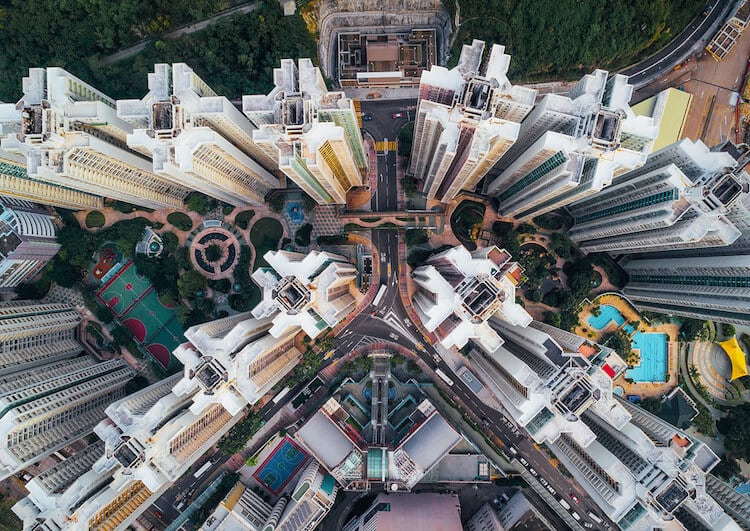
Yeung’s best-known images look down on Hong Kong from above. He uses aerial vantage points to show the city as a dense field of towers, roads, harbour edges and rooftop infrastructure. The effect is not documentary in a simple sense; it is a way of organising visual chaos into repeated lines, grids and clusters. Fog, haze and low cloud often play a major role, softening the hard geometry of the city and turning buildings into silhouettes or layered planes.
His subject matter comes from close observation of an over-photographed city. Rather than avoid recognisable views, he returns to them with a different toolset and scale. That shift matters: the drone camera does not just add height, it changes what counts as a detail. Rooftop water tanks, construction sites, balcony patterns and traffic systems become the visual material of the image.
How did he become known?
Yeung began photographing in 2005 and built his practice around landscape, architecture and urban imagery. A major change came when he took up aerial photography and started making series that were designed for online circulation as well as editorial use. Urban Jungle was especially important because it framed Hong Kong’s built environment as a living mass of surfaces and repetition, and it drew international attention beyond the local photography scene.
His rise also reflects the way photography now travels. Images such as his 360-degree photographs spread quickly on social platforms, where striking scale and novelty can reach a very large audience. At the same time, work by outlets such as BBC and CNN helped place him within a broader photojournalistic and commercial context, where aerial imagery is valued for both its aesthetic force and its ability to summarise a place quickly.
Why does his work stand out?
Yeung’s images stand out because they make density legible. Hong Kong is often described as crowded, vertical and compressed, but his photographs give those descriptions a visual structure. Towers become repetitions, streets become seams, and entire neighbourhoods read as one continuous built surface. That approach can make the city seem almost abstract, yet the subject remains concrete: real housing blocks, real infrastructure and real weather.
His work also belongs to a wider shift in contemporary image-making, where drones changed access and point of view. Aerial photography used to require aircraft, expensive logistics or institutional backing. Small consumer drones made that vantage point easier to reach, and Yeung used that change to make images with a cleaner, more controlled sense of composition. The result is less about spectacle for its own sake than about re-seeing ordinary urban material.
What does his practice look like in use?
In practice, Yeung’s photography sits between art, editorial image-making and platform-friendly visual culture. A single frame can function as an art photograph, a record of a place, and a shareable image shaped by strong contrast and immediate graphic impact. That flexibility has helped his work move between exhibition, press publication and social media circulation.
The materials of the practice are straightforward: camera, drone, software for editing and stitching where needed, and the weather itself. Fog, cloud cover and changing light are not background conditions but active parts of the composition. In Yeung’s case, the process of making the image matters as much as the finished view, because the aerial position, timing and atmosphere all determine whether Hong Kong appears legible, uncanny or almost completely dissolved.
Questions
Is Andy Yeung mainly a drone photographer?
Yes, that is the field most people associate with him, especially because his aerial Hong Kong images brought him the widest attention. He also identifies as a landscape and architecture photographer, so the drone is one tool within a broader visual practice. The aerial view matters because it lets him reorganise city form, not just photograph it from higher up.
What is Urban Jungle?
Urban Jungle is one of Yeung’s best-known aerial series. It presents Hong Kong as a dense, layered urban environment, with buildings and infrastructure packed so tightly that they begin to look like a single continuous texture. The series helped establish his name internationally.
Why do his Hong Kong images feel so distinctive?
They balance familiarity and distance. The city is clearly Hong Kong, but the aerial angle, weather conditions and tight framing turn recognisable places into patterns of colour, concrete and haze. That combination makes the images feel both descriptive and abstract.
}{