
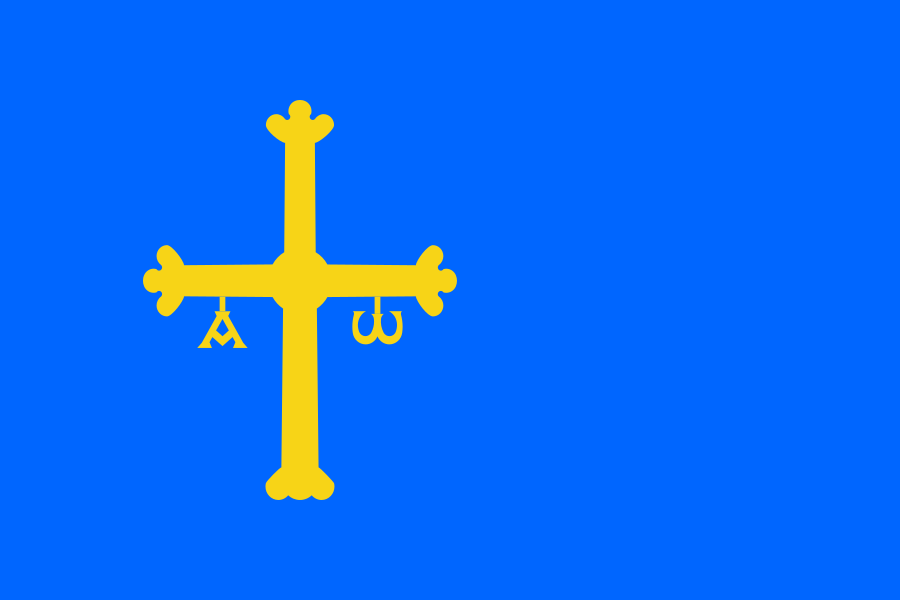
Asturias is an autonomous community and province in northern Spain, on the Bay of Biscay. It is known for its steep green coastline, mountain interior, and a regional history that reaches back to the medieval Kingdom of Asturias, whose territory it mostly covers today.
| Essential fact | Detail |
|---|---|
| Type | Autonomous community and province |
| Country | Spain |
| Capital | Oviedo |
| Geography | Coastal strip on the Bay of Biscay with the Cantabrian Mountains inland |
| Neighbouring regions | Cantabria, Castile and León, and Galicia |
Where is Asturias, and what defines it?
Asturias sits between the sea and the mountains. Its northern edge meets the Bay of Biscay, while the south rises into the Cantabrian range, giving the region a compact geography with short distances between port towns, industrial valleys, and rural highland settlements. The climate is wetter and greener than much of Spain, which has shaped both its landscape and its building traditions.
The region is officially the Principality of Asturias, a title that comes from the Crown of Spain rather than from any separate political status. In practice, the name usually refers to both the autonomous community and the province, which are coextensive. That makes Asturias unusually simple on the map compared with larger Spanish regions split into several provinces.
Why does Asturias matter historically?
Asturias matters because it preserves the memory of one of the earliest Christian kingdoms in medieval Iberia. The Kingdom of Asturias emerged in the 8th century after the Muslim conquest of most of the peninsula, and later expanded into the Kingdom of León. Many histories of Spanish state formation start here because the kingdom became a political and symbolic origin point for later northern Christian rule.
That history is visible in architecture, pilgrimage routes, and religious sites. Romanesque churches, pre-Romanesque monuments around Oviedo and nearby areas, and restored civic buildings all speak to a region that has long been tied to identity, inheritance, and preservation. In cultural terms, Asturias often appears as a place where regional continuity carries real weight.
What does Asturias look like in practice?
Asturias is not a single visual type. The coast includes fishing towns, cliffs, beaches, and industrial harbour zones; inland areas shift quickly into dairy country, forests, and stone villages. Slate roofs, thick masonry walls, and compact settlements are common responses to rain, slope, and older building stock.
That mix gives the region a strong presence in contemporary visual culture. Old churches, mills, barns, and civic structures are often reused rather than erased, and artists working in Asturias frequently respond to this layered built environment. In the case of murals, adaptive reuse, and public art, the region’s older architecture can become a surface for new work without losing its historical character.
How is Asturias used in art, design, and architecture?
Asturias often functions as both setting and material reference. Designers and artists work with its churches, stone surfaces, industrial ruins, and village buildings as existing frames for intervention. A disused structure in Asturias can carry several identities at once: sacred, communal, architectural, and contemporary.
This matters in projects that convert old buildings into public cultural spaces. Rather than treating heritage as static, such work uses the existing shell, texture, and proportions of a place. Asturias is a useful example of how regional architecture can support reuse, from conservation-minded restoration to more experimental forms of transformation.
Frequently Asked Questions
Is Asturias a city or a region?
Asturias is a region, not a city. It is one of Spain’s autonomous communities and also a province, with Oviedo as its capital. The name can refer to the territory as a whole rather than to a single urban centre.
Why is Asturias called a principality?
The title “Principality of Asturias” is ceremonial and historical. It is linked to the heir to the Spanish throne, who traditionally holds the title Prince or Princess of Asturias. The title does not mean Asturias is an independent principality in the political sense.
What is Asturias known for visually?
Asturias is known for its green landscape, rugged coastline, and dense historic architecture. Romanesque and pre-Romanesque buildings, stone villages, and repurposed industrial sites are all part of its visual identity. The region often reads as layered and weathered rather than polished.