
The Balkans is a geographic and cultural region in southeastern Europe, not a single country or a sharply bounded peninsula. Its borders shift depending on who is drawing them, but the region is usually understood through a mix of geography, history, language, and empire rather than a strict map line.
Stories from Balkans
6 stories


About Balkans
- The Balkans spans parts of southeastern Europe and overlaps with the older label “Balkan Peninsula.”
- It is defined as much by history and culture as by physical geography.
- Several language families meet there, including Slavic, Romance, Hellenic, Albanian, and Turkic.
- Religious traditions in the region include Orthodox Christianity, Catholic Christianity, and Sunni Islam.
- The term can be descriptive, but it can also carry political and historical baggage.
Read the full overviewWhat does “the Balkans” mean?, Why is the region so culturally mixed?, Why does the Balkans matter in visual culture?, How is “the Balkans” used today?
What does “the Balkans” mean?
The Balkans names a region of southeastern Europe that includes countries and territories with intertwined histories, languages, and borders. The word is often used for the Balkan Peninsula, though the two are not exactly the same thing, and “Southeast Europe” is now also used as a broader, sometimes less loaded alternative.
In practice, the region is understood less by one fixed outline than by a cluster of shared conditions: mountain ranges, coastal corridors, Ottoman and Austro-Hungarian legacies, and long periods of migration and border change. That makes the Balkans a useful regional term, but also a slippery one.
Why is the region so culturally mixed?
The Balkans sits at a crossroads between Central Europe, the Mediterranean, and western Asia. That position has made it a route for trade, conquest, settlement, and religious change for centuries. As a result, the region contains communities speaking Slavic, Romance, Hellenic, Albanian, and Turkic languages, often in close proximity.
Religion reflects that same layered history. Orthodox Christianity is the largest tradition in many parts of the region, alongside Catholic communities and Sunni Muslim populations. Churches, mosques, monasteries, cemeteries, and civic buildings often stand near one another, and the built environment regularly shows those overlaps in stone, tile, ornament, and urban form.
Why does the Balkans matter in visual culture?
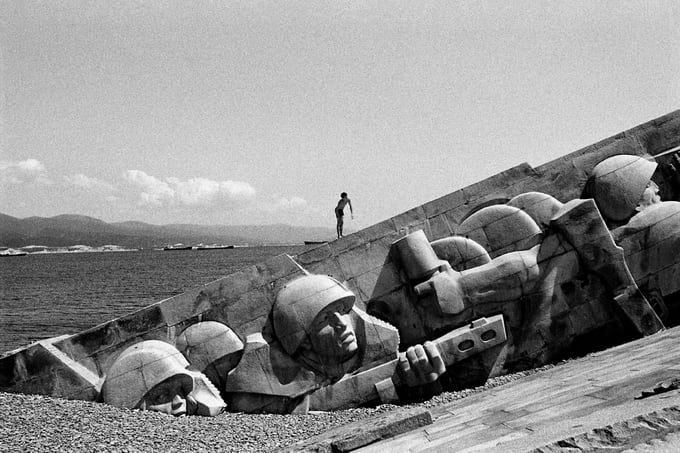
For photographers, designers, and filmmakers, the Balkans offers a dense visual field shaped by transition and repair. Cities may show Ottoman-era bazaars beside socialist apartment blocks, Austro-Hungarian facades beside concrete memorials, or new commercial signage layered over older street patterns. That visual friction is part of the region’s identity, not an accident.
The Balkans also appears often in work that explores memory, borders, nationalism, and abandonment. A landscape or monument can read as scenic at first glance and then reveal a more complicated story of war, migration, or ideological change. Artists working there often document that tension directly, using documentary photography, typology, and architectural observation rather than polished scenic views alone.
How is “the Balkans” used today?
Modern usage depends on context. In travel writing, the term may refer to a set of nearby destinations with shared historical textures and relatively easy overland movement between them. In politics and history, it can be more sensitive, because “Balkan” has sometimes been used pejoratively to imply fragmentation or instability.
That is why some writers prefer “Southeast Europe,” which feels more neutral and more exact in some contexts. Still, “the Balkans” remains widely used because it captures a real region of overlap: languages, cuisines, religious traditions, and architectural forms that continue across national borders.
Frequently Asked Questions
Are the Balkans the same as the Balkan Peninsula?
Not exactly. The Balkan Peninsula is a geographic idea, while the Balkans is a broader regional term that can include cultural and historical associations beyond strict geography. In practice, the two are often used interchangeably, but not every definition lines up perfectly.
Which countries are in the Balkans?
There is no single universally accepted list. Different definitions include different combinations of countries such as Bulgaria, Serbia, Croatia, Bosnia and Herzegovina, Montenegro, Albania, North Macedonia, Greece, Slovenia, Romania, Kosovo, and parts of Turkey. The boundaries depend on whether the focus is geography, history, or politics.
Why can the word “Balkan” sound negative?
The term has sometimes been used in Western European discourse to suggest division, volatility, or underdevelopment. That usage reflects political prejudice as much as regional reality. In careful writing, the word can still be descriptive, but it benefits from context rather than stereotype.