
Brad Pitt is an American actor and film producer whose screen career has ranged from early supporting parts to high-profile leading roles and production work. He first drew wide attention in Thelma & Louise (1991), then built a durable studio-era fame through mainstream films, awards-season projects, and a carefully managed public image that often sat alongside discussion of his appearance.
Stories from Brad Pitt
6 stories


About Brad Pitt
| Born | December 18, 1963, in Shawnee, Oklahoma, United States |
|---|---|
| Known for | Acting in film; producing through his company Plan B Entertainment |
| Breakthrough | Rising visibility from Thelma & Louise (1991) |
| Awards | Academy Award nominations and a Golden Globe win among other major nominations |
| Public image | Frequently covered as a Hollywood style figure and celebrity subject |
Read the full overviewWhy Brad Pitt matters, How did Brad Pitt become famous?, What does his public image look like in practice?, What kind of actor and producer is he?
Why Brad Pitt matters
Pitt matters because he became one of the most visible film stars of the late 20th and early 21st centuries, a performer whose fame crossed from box office success into editorial fashion, celebrity portraiture, and magazine cover culture. His image has been used as shorthand for Hollywood handsomeness, but that visibility also supported a more practical career: he moved between star vehicles, ensemble work, and prestige productions with unusual ease.
As a producer, he also helped shape the kinds of films that reach audiences and awards voters. Plan B Entertainment has backed projects with strong directors and serious subject matter, giving Pitt a role behind the camera as well as in front of it. That matters in visual culture because it places him within the system that decides which stories get polished, packaged, and circulated.
How did Brad Pitt become famous?
Pitt’s breakthrough came with a brief but memorable appearance as a charming hitchhiker in Ridley Scott’s Thelma & Louise. The scene made him instantly legible as a new kind of star: relaxed, physical, and photogenic, with a performance style that looked effortless even when it was carefully controlled. After that, he moved quickly into larger roles that tested whether the initial attention could become something more durable.
He did not stay only in the lane of romantic or decorative roles. Films such as Legends of the Fall, Seven, Fight Club, Ocean’s Eleven, and Moneyball showed different uses of his screen presence: melancholy, volatility, polish, understatement. That variety helped turn him from a breakout face into an actor whose name alone could carry marketing, press coverage, and audience expectation.
What does his public image look like in practice?
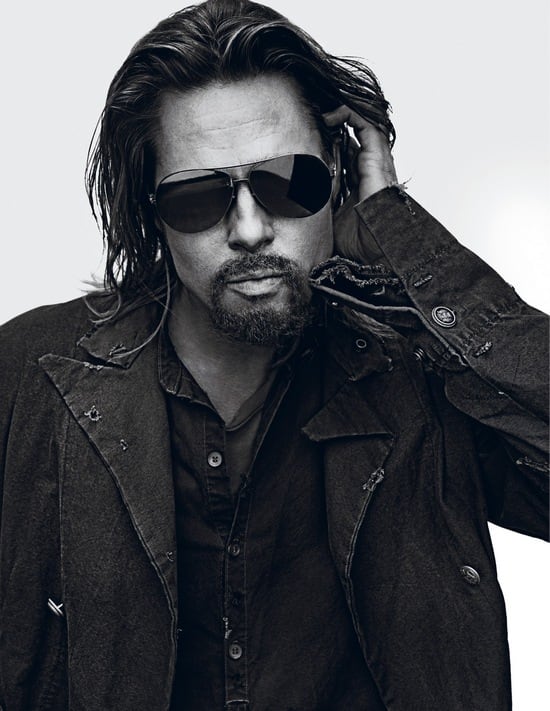
Pitt’s public image has always been tightly bound to photographs. Magazine profiles, fashion editorials, and celebrity portraits often present him as controlled but informal: open-neck shirts, tailored jackets, sun-faded textures, and a face that reads well in both glossy and harsh light. That kind of image work matters because celebrity culture is partly built from repeatable visual codes, not just performances.
He has also been cast in contrasts. Some images emphasize polish and luxury; others lean into weathered masculinity, road-movie looseness, or a sort of tired glamour. That range makes him useful to editors and photographers, who can frame him as approachable, ironic, aspirational, or aged without losing recognisability. In practice, Pitt functions as a highly adaptable visual subject.
What kind of actor and producer is he?
As an actor, Pitt often works through restraint rather than overt transformation. He can play vanity, charm, menace, or weariness with a small shift in timing or posture, which is part of why he has remained useful across genres. He is not known for disappearing into roles so much as for bending his star persona until it serves the film.
As a producer, he has helped finance and promote films that rely on strong writing, directors with a clear style, and a finish that reads as serious rather than disposable. That behind-the-scenes work extends his influence beyond performance. It also places him among the celebrities whose fame has become infrastructure: not just a face on posters, but a name attached to the making of the film itself.
Frequently Asked Questions
Is Brad Pitt mainly known as an actor or a producer?
He is still best known as an actor, because that is where his fame began and where most audiences encounter him. Production has become an equally important part of his career, especially through Plan B Entertainment. That second role gives him influence over what gets made, not only how a finished film is sold.
Why is Brad Pitt so often discussed in fashion and magazines?
His face and body have long been treated as media assets, which made him a frequent subject for portraiture, cover stories, and style pages. He photographs well in both polished and casual settings, so editors can use him to signal luxury, modern masculinity, or cultural relevance. That visibility helped turn him into more than a movie star; it made him a recurring reference point in celebrity imagery.
What was his breakthrough role?
His breakthrough came with the hitchhiker in Thelma & Louise (1991). The role is small, but it established the charisma that later roles expanded. It remains one of the clearest examples of how a brief screen appearance can launch a major career.