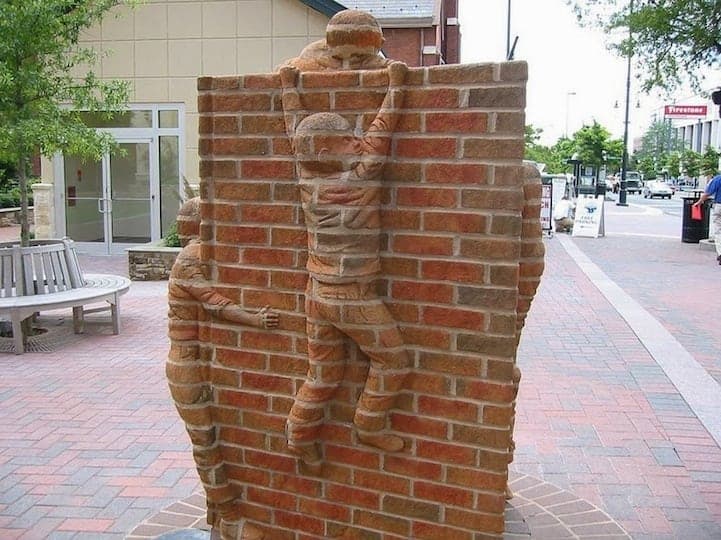
Brad Spencer is an American stone sculptor and brick artist known for reliefs and sculptural work that draw on masonry, architecture, and hand carving. His practice turns building materials into figurative and decorative forms, using traditional tools to make work that feels both structural and ornamental.
- He works primarily in stone and brick, with a strong interest in the visual language of masonry.
- A relief carving called The Spirit of Reidsville helped shape his interest in sculpture for architecture.
- He studied at Western Carolina University.
- His process relies on hand tools such as hammers and chisels rather than power equipment.
- Access to local clay deposits has influenced his material choices.
What kind of sculptor is Brad Spencer?
Spencer belongs to a small corner of sculpture that sits close to building craft. His work is not about cast bronze monuments or gallery-only abstraction. It is closer to the traditions of stonemasonry, carved ornament, and brick relief, where the surface of a wall or block becomes the site of an image. That makes his work legible in two ways at once: as art and as architecture.
This kind of practice depends on a strong understanding of material. Stone resists differently from brick; clay behaves differently again when it is shaped, fired, or incorporated into a structure. Spencer’s work makes those differences visible instead of hiding them, which is part of its appeal.
Where did his approach come from?
Spencer has said that his fascination with sculpture in architecture began when he encountered a relief carving on an old school building near where he grew up, called The Spirit of Reidsville. The experience showed him that buildings could carry art as part of their skin, not just as decoration added later. That kind of early encounter often matters in a craft-based career, because it links memory to technique and turns a local landmark into a model for later work.
His education at Western Carolina University gave that interest a more formal direction, but the underlying pull remained architectural. Rather than moving away from masonry, he built a practice around it. The result is work that feels grounded in place and in physical labor, not in studio process alone.
How are Spencer’s sculptures made?
Spencer typically makes his pieces with hand tools, especially hammers and chisels. That matters because the marks left by those tools are part of the final surface. Hand carving slows the work down and leaves visible evidence of pressure, strike, and removal, which gives the finished piece a sense of touch and time.
His use of stone and brick also means the work is shaped by weight, fracture, and joinery. These materials do not permit the same freedom as clay or resin. A sculptor working this way has to think like a mason as well as an artist: how a form holds together, how an edge meets another surface, and how the piece will sit within a wall, plinth, or architectural setting.
Why does Brad Spencer matter?
Spencer matters because he keeps a traditional material language active. Stone carving and brick ornament can seem old-fashioned when compared with digital fabrication or cast materials, yet they still produce some of the most durable and site-specific work in visual culture. His sculptures show that those older methods are not obsolete; they still offer a direct, expressive way to make images in public space.
He also represents a line of making that connects regional materials, local landmarks, and inherited craft. That combination gives his work a clear identity. It is not just sculpture placed near architecture, but sculpture that thinks through architecture from the start.
Frequently Asked Questions
Is Brad Spencer mainly a stone carver or a brick artist?
He is both. His practice includes stone sculpture and brick-based work, and the two overlap through his interest in masonry and architectural relief. The common thread is not a single material but a way of working that treats building materials as sculptural.
Does he use modern fabrication methods?
His process is rooted in hand work rather than power-driven fabrication. Hammers and chisels are central to how he shapes his pieces, which gives the work a visible carved surface. That approach aligns his practice with older masonry traditions.
Why is architecture so important to his work?
Architecture gave him an early model for how art can live on a building and shape how a place is seen. The relief carving that influenced him showed sculpture functioning as part of a structure, not as a separate object. That lesson continues to shape the way he uses stone and brick.
Articles mentioning Brad Spencer