
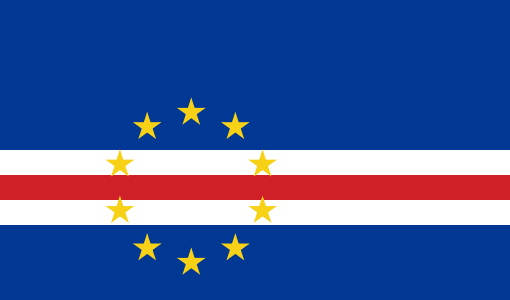
Cape Verde is an island country in the central Atlantic Ocean, off the west coast of Africa. It consists of ten volcanic islands and several islets, with a small land area, a dry climate, and a landscape that ranges from bare rock and lava fields to sandy beaches and greener mountain slopes.
| Fact | Detail |
|---|---|
| Official name | Republic of Cabo Verde |
| Location | Central Atlantic Ocean, about 570 km off Western Africa |
| Geography | Volcanic archipelago of 10 islands |
| Area | Just over 4,000 square kilometres |
| Capital | Praia |
| Language | Portuguese is official; Cape Verdean Creole is widely spoken |
What kind of place is Cape Verde?
Cape Verde sits on a cluster of islands formed by volcanic activity on the ocean floor. Some islands, such as Sal, Boa Vista and Maio, are low and sandy, while others, including Santo Antão, Fogo and Santiago, rise into steep ridges and volcanic peaks. That contrast shapes everyday life: fishing, small-scale farming, tourism and transport all adapt to terrain that can change quickly from coastal plain to dry interior.
The country’s position in the Atlantic has long made it a crossroads. Winds, currents and shipping routes linked the islands to West Africa, Europe and the Americas, which helped produce a mixed population and a culture shaped by movement, migration and exchange. Cape Verde also carries a strong diasporic identity; more Cape Verdeans live abroad than on the islands themselves.
How did Cape Verde become a country?
When Portuguese sailors reached the islands in the 15th century, they found an uninhabited volcanic archipelago. Portugal colonised the islands and used them as a hub in the Atlantic slave trade, especially on Santiago. Over time, Cape Verde became a Creole society, with African and European influences combining in language, religion, food and music.
Cape Verde achieved independence from Portugal in 1975, after a long anti-colonial struggle tied to liberation movements in both Cape Verde and Guinea-Bissau. Since independence, the country has remained stable by regional standards, with multi-party democracy and a political life shaped by the practical demands of water scarcity, limited farmland and dependence on imports.
What does Cape Verde look like in practice?
The islands are known for harsh light, dry air and dramatic coastal edges. Some places feel almost lunar: black lava rock, pale dust, sparse shrubs and deep blue water. Other areas show more cultivation, especially where water can be captured in higher elevations or in volcanic soil pockets. The built environment tends toward low-rise concrete, painted facades and harbours that serve as lifelines for inter-island travel.
Culture in Cape Verde is often expressed through sound as much as image. Music genres such as morna, coladeira and funaná carry stories of longing, migration and island life, and they have become major markers of national identity. That same sense of distance and circulation shows up in craft, shipping, foodways and the everyday improvisation required by an archipelago with limited natural resources.
Why does Cape Verde matter?
Cape Verde matters because it is a small country with a large cultural reach. Its music, migration history and Creole society have influenced Atlantic culture far beyond the islands. At the same time, it offers a clear example of how geography shapes a society: volcanic terrain, scarce water and isolation have all shaped settlement patterns, architecture and economy.
For visual culture, Cape Verde is notable for its strong environmental contrast. Satellite images show a place where geology, climate and human settlement remain tightly bound together. The islands are easy to describe as remote, but they are also deeply connected, both through the sea routes around them and through the people who have carried Cape Verdean culture across the world.
Frequently Asked Questions
Is it Cape Verde or Cabo Verde?
Both names appear, but Cabo Verde is the country’s official Portuguese name. Cape Verde remains common in English, especially in older references and general writing. The shift in official usage reflects the country’s preference for its Portuguese form.
Why is Cape Verde so dry?
The islands lie in the dry belt of the eastern Atlantic, and they receive limited rainfall. Their volcanic terrain also creates steep, rocky landscapes that hold water poorly. As a result, agriculture depends on small pockets of moisture, irrigation and imported food.
What is Cape Verde best known for?
Cape Verde is best known for its music, its Creole culture and its Atlantic island landscape. Morna, in particular, has become closely associated with the country’s national identity. The islands are also known as a stable democracy with a large global diaspora.
At a glance
- Address
- Cape Verde
- Coordinates
- 15.111111, -23.616667
Articles mentioning Cape Verde

