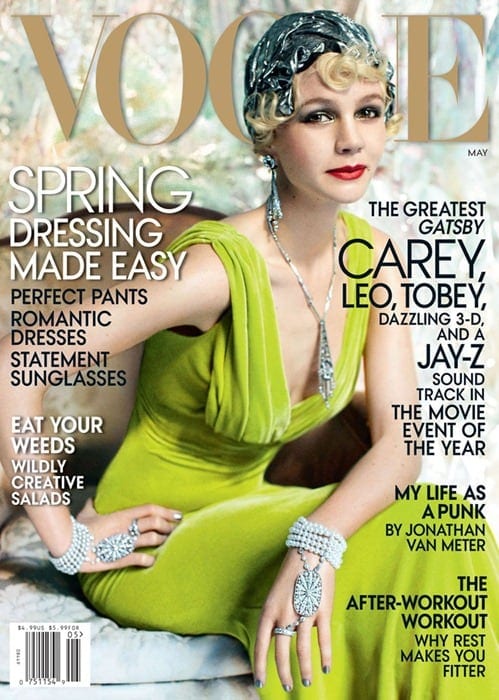
Carey Mulligan is an English actor known for sharply observed performances in film, television, and theatre. She began her screen career in the mid-2000s, moved quickly into leading roles, and became known for playing women whose restraint hides intelligence, anger, or vulnerability.
- Born in London in 1985, she trained for performance from a young age and entered professional acting in her late teens.
- Her breakout came with An Education (2009), which established her as a major screen presence.
- She has worked across period drama, contemporary film, stage, and prestige television.
- Her roles often depend on precise voice work, stillness, and controlled emotional shifts rather than broad gesture.
- She has also become a visible figure in fashion editorials and cover portraits, where her image is often styled with the same clarity as her screen work.
How did Carey Mulligan become known?
Mulligan first appeared on film as Kitty Bennet in Joe Wright’s Pride & Prejudice (2005), then took on a series of British television and stage roles that built her reputation. Her early work showed range rather than star wattage: she could play social poise, awkwardness, and moral force without pushing them into obvious display. That quality made her useful in ensemble casts and, soon after, central to stories that needed emotional precision.
Her breakthrough arrived with An Education, where she played a clever schoolgirl pulled between aspiration and compromise in 1960s London. The performance drew wide critical attention because it felt exact rather than showy. Mulligan’s face, diction, and timing carried much of the drama, and that style became a defining part of her screen identity.
What kind of roles does she usually play?
Mulligan often plays women at a point of pressure: daughters, wives, professionals, lovers, or artists caught between self-possession and social constraint. She has moved between literary adaptations, modern dramas, thrillers, and biographical roles, but the common thread is discipline. Her performances usually depend on detail—how a line lands, when a look breaks, how much feeling remains unspoken.
That approach has made her especially effective in films that value interiority. In stories about class, grief, ambition, or power, she can make a character feel private without making her opaque. Directors often cast her for the tension between vulnerability and steel, and costume, makeup, and lighting frequently reinforce that tension by keeping her appearance elegant but unforced.
Why does Carey Mulligan matter in film and fashion?
As a performer, Mulligan helped define a particular kind of contemporary British screen acting: understated, intelligent, and emotionally disciplined. She has won acclaim in roles that resist melodrama, which has made her valuable in an industry that often rewards louder performances. Her work also helped broaden the public image of leading women in film beyond glamour or overt charisma.
Her fashion presence matters for similar reasons. In editorial shoots and magazine features, she is often styled in a way that foregrounds structure, fabric, and silhouette rather than overt spectacle. That makes her a useful subject for visual culture: her images tend to read as carefully composed, with clothes, grooming, and posture doing as much work as expression.
What does her work look like on stage and screen?
On screen, Mulligan tends to work with small movements: a held breath, a clipped answer, a brief smile that does not fully arrive. In close-up, those choices register strongly, which is one reason she has been so effective in film. Her stage work, including The Seagull on Broadway, showed that the same control could expand to live performance without losing clarity.
Her public image is similarly restrained. Whether in a prestige drama still or a fashion portrait, the emphasis is usually on line, texture, and expression rather than excess styling. That consistency has made her one of the most recognisable faces of contemporary British acting, even when the roles themselves vary widely.
Frequently Asked Questions
What was Carey Mulligan’s breakout role?
Her breakout role was An Education (2009), in which she played Jenny Mellor. The film drew major attention to her because she carried the story with intelligence and emotional precision. It established the acting style that became associated with her work afterward.
Has Carey Mulligan worked in theatre?
Yes. She made her Broadway debut in The Seagull in 2008 and received strong critical notices. Theatre showed a different side of her practice, especially the control of voice and timing needed for live performance.
Why is Carey Mulligan often featured in fashion magazines?
Fashion editors often use her because her face and posture photograph well, and because she brings a sense of restraint that suits tailored clothes and clean styling. Her image works especially well in editorials that rely on silhouette, texture, and mood rather than theatrical glamour. That makes her a strong subject for magazine portraiture as well as for film promotion.
Articles mentioning Carey Mulligan