
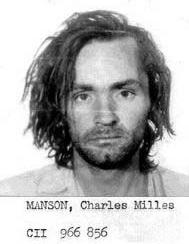
Charles Manson was an American criminal and would-be musician who led the Manson Family, a cult-like group that became notorious for a series of murders in California in 1969. His name is tied to the Tate-LaBianca murders, in which members of the group killed actress Sharon Tate and four others and later attacked Leno and Rosemary LaBianca. He mattered less as a maker than as a figure whose manipulation, apocalyptic rhetoric, and outlaw mythmaking became part of late-1960s American counterculture history.
- He turned personal charisma and coercion into group control.
- The Manson Family mixed communal living, drugs, and violent ideology.
- His trial turned him into a lasting media image, not just a defendant.
- His name still appears in art, music, and tattoo culture as a symbol of danger and infamy.
Who was Charles Manson?
Charles Manson was born in 1934 and spent much of his life moving through prisons, juvenile facilities, and unstable homes before gaining notoriety in California in the late 1960s. He built a following among young people drawn to communal living, music, and anti-establishment ideas, then reshaped that following into a closed group that obeyed him. He was not a major recording artist or a conventional public figure; his historical importance comes from the crimes carried out by his followers and the way he used language, fear, and spectacle to command them.
Manson also tried to sell himself as a musician. He recorded songs, associated with people in the Los Angeles music scene, and sought a place inside the counterculture he later came to symbolize in its darkest form. That musical ambition never became a real career, but it helped him move through a scene where image, performance, and authenticity mattered.
What was the Manson Family?
The Manson Family was a loosely organized commune in California that Manson shaped into a hierarchical group centered on his authority. Members lived together, followed his rules, and absorbed his interpretations of race, religion, sex, and violence. The group has been described as a cult because it depended on psychological control rather than shared belief alone.
Its everyday life mixed the aesthetics of hippie communalism with manipulation and abuse. People in the group drifted between ranches, desert camps, and borrowed houses, with music, drugs, and sexual freedom presented as part of a new way of life. Underneath that surface, Manson reinforced dependence and obedience, which made the group capable of acting on his instructions.
Why did his case become so famous?
The case became famous because the murders were brutal, the victims were well known, and the trial took place during a period of intense public anxiety about youth culture and social breakdown. Sharon Tate was a high-profile actress and the wife of film director Roman Polanski, which pushed the killings into national headlines immediately. The later attack on the LaBiancas deepened the sense that the crimes were random, theatrical, and terrifyingly intimate.
Media coverage also turned Manson into a symbol. His appearance, speech, and behavior in court created a visual shorthand for American evil in the late 20th century: the shaved head, the stare, the small gestures of contempt or performance. That image has been reproduced so often that it now carries as much cultural weight as the legal facts of the case.
How has Charles Manson appeared in visual culture?
Manson’s image has been repeatedly used in posters, album art, films, zines, tattoos, and fashion references because it condenses danger into a recognizable face. Tattoo culture in particular often treats notorious figures as emblems of rebellion, transgression, or morbid fascination, and Manson fits that logic easily. His face and name can function as shorthand for chaos, cult leadership, and the collapse of innocence.
This use is not admiration in any simple sense. It often reflects a desire to handle taboo imagery, to quote a famous criminal icon, or to use notoriety as a visual shock. The result is that Manson survives in culture not as a maker of objects or a designer of systems, but as an image copied and recirculated across subcultures.
Frequently Asked Questions
Was Charles Manson a musician?
He was a frustrated musician who recorded songs and tried to enter the Los Angeles music scene. He wrote and performed material, and he moved around people who worked in or near that world. His musical activity matters mainly because it helped him present himself as a creative outsider before his crimes made him infamous.
Did Manson personally kill anyone?
He was convicted for conspiracy related to the murders rather than for carrying out the killings himself. Members of the group committed the Tate-LaBianca murders at his direction, according to the prosecution and the court’s findings. His power lay in orchestration and coercion, not in direct participation at every scene.
Why is he still discussed today?
He remains a reference point for cult leadership, media spectacle, and the fear that violent ideology can hide inside ordinary social scenes. His case also shows how crime becomes image, especially once newspapers, television, film, and later internet culture keep reusing the same face and story. That is why his name still appears in discussions of art, fashion, music, and tattoo symbolism.