
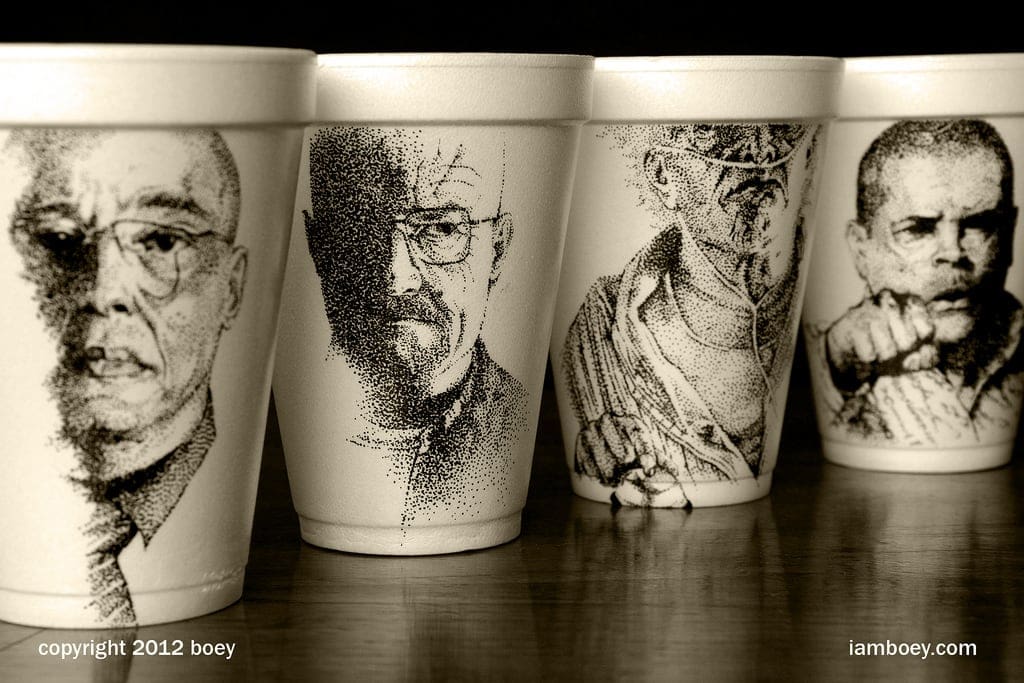
Cheeming Boey is a Malaysian artist known for drawing directly on disposable foam coffee cups, alongside his long-running webcomic I Am Boey and his autobiographical graphic novel When I Was A Kid. He has built a career around turning everyday, throwaway objects into keepsakes, using marker, pen, and line drawing to make casual surfaces feel deliberate and collectible.
- Malaysian-born artist active across illustration, comics, and object-based drawing
- Best known for artwork made on foam coffee cups
- Also creates autobiographical comics and daily webcomics
- His work often mixes humor, memory, and ordinary life
- Important to contemporary illustration because it treats packaging and disposable objects as a drawing surface
Why do foam coffee cups matter in his work?
Boey’s cup drawings are his most distinctive contribution. He takes the curved, insulating foam surface of a standard takeaway cup and treats it like a small sculptural canvas. The cup shape forces the drawing to wrap around a cylinder, so the image has to respond to seams, curvature, and the way the object is held in the hand. That makes the work feel intimate in a way a flat print does not.
The material matters. Foam coffee cups are cheap, mass-produced, and designed for disposal, which gives the drawings a sharp contrast between surface and subject. Boey’s approach turns a disposable container into an art object without hiding its origins. The result sits between illustration, design intervention, and street-level craft.
How does he work?
Boey usually draws with fine line and marker-based tools that suit the smooth foam surface. The imagery is recognizably comic: figures, faces, small scenes, and compact narratives built from economical marks. Because the cups are small, the work relies on clarity and speed rather than dense rendering. Every line has to do useful work.
His practice also depends on repetition. A coffee cup is an ordinary item that can be found anywhere, so each finished piece has the feeling of something made in passing. That repeatable format helped make his work shareable online and memorable in person. The cup becomes both a support and a signature.
What connects the cups to I Am Boey and When I Was A Kid?
The same qualities that shape the cup drawings also run through Boey’s comics: short-form storytelling, personal memory, and a direct, readable line. I Am Boey is a daily webcomic, which means it depends on consistency and concise observation. When I Was A Kid extends that method into a longer autobiographical form, using childhood memories as material for humor and self-portraiture.
Together, these works show an artist interested in making the ordinary legible. Whether the surface is a web page, a book page, or a coffee cup, Boey uses simple drawing to hold a fleeting moment in place. That makes his practice easy to recognize but not simplistic; the apparent casualness is built on strong control of line, timing, and image economy.
Why does Cheeming Boey matter?
Boey matters because he helped broaden what counts as a drawing surface. His cup work showed that illustration can live comfortably on disposable packaging without losing force or seriousness. For designers and illustrators, that idea matters because it links image-making to object-making, and it values the physical life of the thing being drawn on.
He also matters as part of a wider shift in comics and illustration toward personal, internet-friendly, and cross-platform practice. His work moves between gallery display, online circulation, and book publishing. That range has made him visible to audiences who might never have met the same work in one place, and it has helped define a mode of illustration that is casual in form but precise in execution.
Frequently Asked Questions
Is Cheeming Boey mainly a painter or a comics artist?
Boey is best understood as an illustrator and cartoonist who works across formats. His foam cup drawings are the most distinctive part of his public image, but they sit alongside comics, webcomics, and book work. The common thread is drawing, not a single medium.
Are the coffee cups meant to be functional?
They start as functional objects, but the artwork changes that status. Once drawn on, the cup shifts from packaging to display piece or collectible. The work depends on that tension between use and preservation.
What makes his cup drawings different from drawing on paper?
The curved foam surface changes both composition and viewing angle. A drawing on a cup has to survive seams, wraps, and the possibility that it will be held, photographed, or discarded. That gives the work a physical presence that flat paper does not have.
Articles mentioning Cheeming Boey
