
The Chinese Civil War was the long conflict between the Nationalist government of the Republic of China, led by the Kuomintang, and the Chinese Communist Party, which fought first for control of China and later for survival as a rival state. It began in 1927, broke into major phases, and ended in 1950 after the Communists had taken the mainland and the Nationalists had retreated to Taiwan.
Stories from Chinese Civil War
2 stories
About Chinese Civil War
- It started after the fragile Kuomintang–Communist alliance collapsed during the Northern Expedition.
- The war moved between city politics, rural guerrilla campaigns, and full-scale conventional battles.
- Japanese invasion interrupted the conflict, but it resumed at the end of World War II.
- The Communist victory reshaped modern China and separated the governments of mainland China and Taiwan.
- Its images, uniforms, propaganda, and mass mobilisations became enduring visual material in art and photography.
Read the full overviewHow the war began, What happened during the fighting?, Why does it matter?, How is the Chinese Civil War represented in art?
How the war began
The conflict opened in 1927, when Chiang Kai-shek and the Kuomintang turned against their Communist allies during the National Revolution. The two sides had briefly cooperated against warlords, but that alliance collapsed in a wave of purges and reprisals. From that point on, the war was not a single uninterrupted front line so much as a changing struggle for territory, legitimacy, and popular support.
In its early years, the Nationalists controlled the major cities and much of the state apparatus, while the Communists regrouped in rural bases. The Communists built their military strength through guerrilla warfare, land reform, and disciplined organisation, turning the countryside into both a refuge and a recruiting ground. This created a war that was as much political as military: control of land, food, and local institutions mattered as much as the capture of capitals.
What happened during the fighting?
The war changed sharply when Japan invaded China in 1937. Nationalists and Communists formed a second, uneasy united front to resist the Japanese, but their rivalry never disappeared. Large parts of China were devastated by occupation, bombing, famine, and displacement, and both Chinese parties used the anti-Japanese struggle to strengthen their own claims to authority.
After Japan’s surrender in 1945, open civil war resumed almost immediately. The Nationalists held the formal government and the larger conventional army, but they faced corruption, inflation, battlefield exhaustion, and declining public support. The Communists, by contrast, expanded their territory through better rural organisation and effective military campaigns. By 1949 they had taken Beijing, Shanghai, and most of the mainland; in 1950 the main active fighting had ended.
Why does it matter?
The war decided the political shape of modern China. The Communist victory led to the founding of the People’s Republic of China on the mainland, while the Nationalist government withdrew to Taiwan and continued to claim legitimacy as the Republic of China. That split still shapes East Asian politics, law, and identity.
It also left a deep visual legacy. The war produced photographs of soldiers, refugees, destroyed streets, propaganda posters, field uniforms, banners, and improvised equipment, all of which have shaped how later artists picture China in the twentieth century. For contemporary artists, the war often appears not as a single campaign but as a source of iconography: cardboard villages, toy soldiers, massed crowds, and other forms that echo displacement, ideology, and collective memory.
How is the Chinese Civil War represented in art?
Artists usually approach the war through aftermath rather than battle scenes. That means showing ruined architecture, peasant life, soldiers in ranks, or state imagery that signals mobilisation and authority. Materials matter here: cardboard, paint, found objects, and miniature figures can all stand in for the scale of the conflict while making its fragility visible.
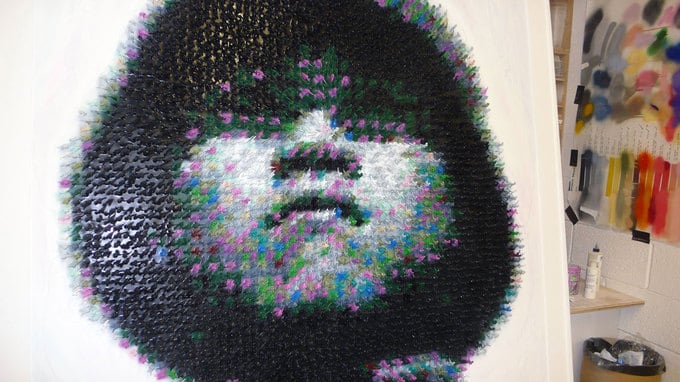
This is one reason the war appears in works that focus on ordinary Chinese people rather than generals. A sculpture of villagers, for example, can evoke the social world that war reorganised; a portrait assembled from toy soldiers can point to the mass, impersonal character of modern conflict. The subject is historical, but the artistic treatment often turns on texture, repetition, and scale.
Frequently Asked Questions
Was the Chinese Civil War one continuous war?
No. It began in 1927, but fighting changed form several times, especially after the Japanese invasion in 1937. The conflict paused in some regions, shifted into anti-Japanese resistance, and then resumed as a direct Nationalist–Communist war after 1945.
Who won the Chinese Civil War?
The Chinese Communist Party won on the mainland. The Nationalist government lost its major bases, withdrew to Taiwan in 1949, and continued there as the Republic of China.
Why do artists keep returning to it?
It produced strong visual symbols: uniforms, banners, crowds, refugee movement, and the contrast between state power and ordinary life. It also marked a profound break in Chinese history, so artists use it to think about memory, loss, ideology, and the scale of modern political violence.