
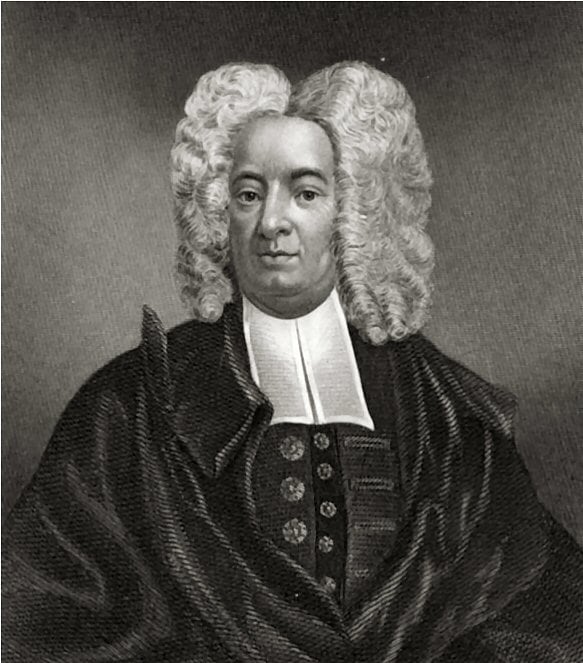
Cotton Mather was a New England Puritan minister, writer, and public intellectual whose sermons, pamphlets, and histories made him one of the most influential figures in colonial Boston. He is remembered today both for his wide-ranging learned writing and for his support of the Salem witch trials, which has made him a lasting symbol of Puritan power and anxiety. Born into a prominent clerical family, he inherited a world in which religion, politics, and print culture were closely tied together.
| Born | February 12, 1663, Boston, Massachusetts Bay Colony |
|---|---|
| Died | February 13, 1728, Boston |
| Known for | Puritan ministry, pamphlets, sermons, histories, commentary on the Salem witch trials |
| Family | Son of Increase Mather; grandson of John Cotton and Richard Mather |
| Education | Harvard College; honorary doctorate from the University of Glasgow |
Why Cotton Mather mattered
Mather mattered because he helped shape the religious and intellectual life of late 17th- and early 18th-century New England. As a minister, he preached to a literate urban congregation; as an author, he used print to circulate sermons, biographies, moral instruction, scientific curiosities, and political opinion. In a society where ministers often served as cultural authorities, his voice reached well beyond the pulpit.
He also mattered because his name became linked to one of colonial America’s most infamous episodes. During the Salem witch trials, Mather defended the reality of witchcraft and supported the proceedings, even as later generations condemned the trials as a failure of justice and evidence. That association still shapes how he is remembered.
What did he write and preach?
Mather wrote constantly. He produced sermons for ordinary worship, devotional manuals, historical accounts of New England, and treatises meant to instruct readers on conduct, providence, and the workings of God in daily life. His style mixed scripture, quotation, anecdote, and learned reference, reflecting both ministerial training and a hunger for wide reading.
Print was central to his influence. Pamphlets allowed him to intervene in controversies, defend church practice, and comment on events as they unfolded. His books were not private reflections; they were public instruments designed to persuade, warn, and organize religious life.
How is Cotton Mather usually remembered?
Modern memory often reduces Mather to a single role: the zealot of Salem. That image is not false, but it is incomplete. He was also a major colonial writer who tried to record the history of New England, explain disasters and successes through providential logic, and present Puritanism as intellectually serious as well as morally strict.
That complexity matters because his work shows how power operated in colonial print culture. Mather was not simply a preacher in a meetinghouse; he was a maker of texts, a curator of reputation, and a broker of authority. His books and pamphlets helped define what respectable knowledge looked like in his milieu.
What does his legacy look like in practice?
In practice, Mather’s legacy appears wherever Puritan New England is treated as both a religious culture and a print culture. Historians still read him for what he reveals about clerical authority, fear of disorder, and the language of providence. Artists and designers also return to him when they need the visual grammar of colonial solemnity: dark clothing, stern faces, paper, ink, and a world framed by moral discipline.
His legacy is also cautionary. Mather shows how intellectual authority can coexist with credulity, and how learned language can be used to justify injustice. That makes him important not only as a historical person but as a figure through whom later writers and image-makers think about persuasion, belief, and public responsibility.
Frequently Asked Questions
Was Cotton Mather involved in the Salem witch trials?
Yes. Mather supported the general premise that witchcraft was real and accepted the trials as a legitimate response to a spiritual threat. He did not single-handedly drive the prosecutions, but his stature as a minister gave the proceedings additional legitimacy.
Later critics have often treated him as a central villain because his name became attached to the trials in popular memory. The historical record is more complicated, but his role remains morally significant.
What kind of writer was he?
He was a prolific minister-author who wrote sermons, biographies, histories, religious instruction, and polemical pamphlets. His writing served a public purpose: to guide conduct, defend Puritan ideas, and interpret events through religion.
He was not a detached essayist. His work aimed to persuade and govern, and it used the forms available in colonial print culture to do so.
Why does he still matter to visual culture?
Mather matters because he helped create the textual image of Puritan New England that later artists, filmmakers, and designers continue to mine. His world provides a ready-made visual vocabulary: black garments, plain interiors, handwritten documents, and a severe moral atmosphere.
He also matters because Salem remains a potent cultural reference. Any image of colonial fear, theological certainty, or witch-trial spectacle often passes through the historical shadow he helped cast.
Articles mentioning Cotton Mather
