
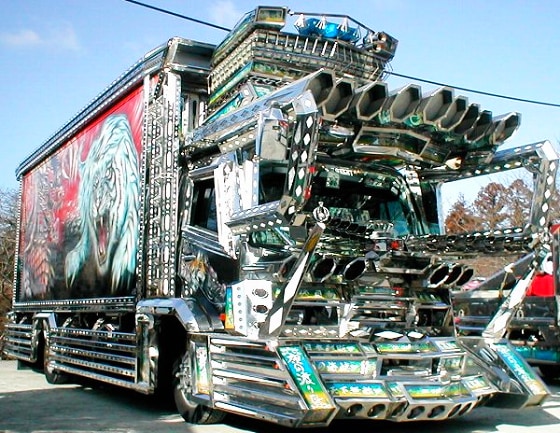
Dekotora are heavily decorated Japanese trucks, usually built by drivers or hobbyists who transform working vehicles into mobile displays of chrome, paint, light, and custom bodywork. The name is short for “decoration truck,” and the style combines transport, self-expression, and a very public kind of craft. Dekotora can be seen on commercial lorries, but also at meets and special events, where the truck itself becomes the object of attention.
- Japanese custom truck culture built around ornament, shine, and spectacle.
- Often uses neon or ultraviolet lighting, metallic paint, and polished stainless-steel or gold-toned parts.
- Can be made from working trucks, not just show vehicles.
- Related to the broader label art truck (ātotorakku).
- Values improvisation, personal style, and dense surface detail.
Where did Dekotora come from?
Dekotora emerged in Japan in the decades after the Second World War, as trucking expanded and roadside culture became more visible. Its roots are often linked to transport drivers who began modifying their vehicles in the 1970s, influenced in part by popular culture, racing aesthetics, and the bold signage of American trucks seen in films and magazines. What started as individual customization grew into a recognisable visual language with shared motifs.
The style developed alongside a broader interest in making industrial objects more expressive. Rather than hiding the truck’s function, Dekotora exaggerates it. The vehicle remains a tool of labour, but it is also treated as a surface for decoration, a platform for identity, and sometimes a showpiece.
What makes a Dekotora look like a Dekotora?
A Dekotora usually announces itself through brightness and excess. Builders add rows of lamps, glowing signage, mirror finishes, sculpted chrome, decorative bars, and paint schemes that can range from candy-bright colours to deeply layered graphics. Some trucks carry illuminated panels or interior cabins trimmed as carefully as the exterior, with patterned upholstery, metal accents, and display objects arranged in the cab.
The look is not just about adding parts but about layering them until the truck reads as a single designed surface. Stainless-steel guards, golden trim, and custom spoilers can change the silhouette, while light gives the truck a night-time presence that is central to the style. On the road or in photographs, the vehicles often appear theatrical, almost architectural.
Why do people make them?
Dekotora can be an expression of pride in work, craft, and individuality. Some are built by professional drivers who customize their own trucks over time; others come from enthusiasts who treat truck building as a hobby and a form of design practice. Events and gatherings give owners a place to display the vehicles, compare detail, and share parts, techniques, and references.
The culture matters because it turns a utilitarian machine into a personal statement without losing its function. That tension is part of the appeal: a Dekotora may still haul goods, but it also performs in public. The truck becomes a moving sign of taste, labour, and technical skill.
How is Dekotora used in art and photography?
Dekotora attracts photographers, filmmakers, and designers because it offers intense surface detail and strong colour under artificial light. The trucks are especially striking at night, when neon, reflections, and chrome create dense compositions that reward close looking. Images of Dekotora often emphasise texture: rivets, lamps, mirror panels, and painted motifs that would be easy to miss in motion.
In visual culture, the style has become a shorthand for Japan’s taste for highly specific customisation and for the beauty of industrial excess. It sits somewhere between street culture, design, and folk ornament. That mixture makes it useful in photography and editorial work, where a single vehicle can stand for a larger set of ideas about labour, glamour, and subculture.
Frequently Asked Questions
Is Dekotora the same as an art truck?
Yes, broadly. “Art truck” is a common English gloss, and the Japanese term ātotorakku is used for this kind of vehicle culture. “Dekotora” specifically points to the decorative, custom-built style that became associated with Japanese trucks.
Are Dekotora only for shows?
No. Many Dekotora are based on working trucks and still operate as part of commercial transport. Others are built primarily for events, gatherings, or private collecting, but the style is rooted in vehicles that do real labour.
What materials matter most in Dekotora builds?
Chrome, stainless steel, gold-toned trim, custom paint, lighting fixtures, and interior upholstery are central materials. Builders often use reflective surfaces and layered lighting to create the signature nighttime effect. The result depends as much on finish and arrangement as on the original truck body.
Articles mentioning Dekotora
