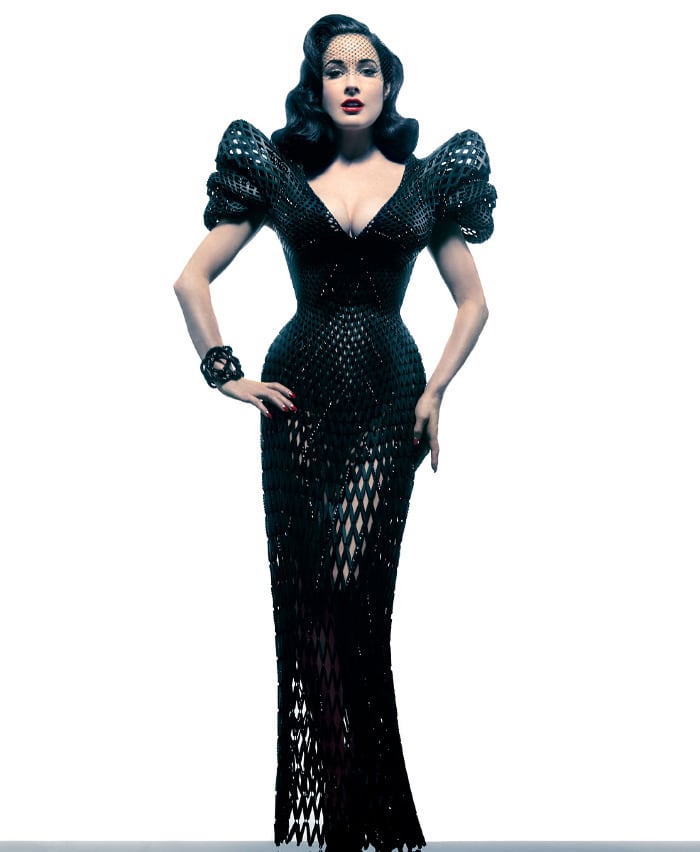
Dita Von Teese is an American burlesque performer, model, costume designer, and actress known for reviving interest in classic striptease, vintage glamour, and highly constructed stage costuming. Born Heather Renée Sweet in 1972, she built a public image around corsetry, satin, sequins, feather work, and the tightly choreographed forms of mid-century burlesque.
| Born | Heather Renée Sweet, 1972, Michigan, United States |
|---|---|
| Known for | Burlesque performance, modeling, costume design, screen appearances |
| Signature look | Corseted silhouettes, black lacquer hair, pale makeup, vintage lingerie, feathers and rhinestones |
| Cultural role | Major figure in the burlesque revival of the 1990s and 2000s |
Why Dita Von Teese mattered
Von Teese became a visible reference point for burlesque at a time when the form was often treated as a novelty rather than a craft. Her performances placed emphasis on precision, costume, and controlled reveal instead of improvisation or explicitness. That approach helped define modern burlesque for new audiences and gave the form a sharper visual identity.
She also helped connect burlesque to fashion, photography, and luxury branding. Designers, magazines, and image-makers drew on her mix of retro styling and theatrical polish. Her work made corsetry, glove work, and old-Hollywood styling feel contemporary rather than nostalgic costume.
What does her performance style look like?
Von Teese performance usually starts with tailoring and silhouette. Her costumes often rely on boning, lacing, structured bodices, and fabrics that catch light cleanly, such as silk satin, velvet, tulle, and embellished mesh. The effect is deliberate: the body is framed as much as it is revealed.
Her stage persona borrows from 1940s and 1950s pin-up imagery, but it is not a simple reproduction of period dress. Props such as champagne coupes, fans, gloves, parasols, giant feathers, and mirrored sets turn the act into a staged object lesson in glamour. The work depends on timing, costume mechanics, and visual control as much as on dance.
How did she shape modern burlesque?
The burlesque revival of the late 20th century drew on club culture, drag, performance art, and vintage collecting. Von Teese stood out because she treated burlesque as an authored visual practice, not only a nightclub act. She helped normalize the idea that burlesque could involve custom-made garments, historical research, and close attention to material detail.
That made her influential beyond the stage. She encouraged a market for corset makers, milliners, feather artisans, lingerie designers, and costume builders who specialized in performance wear. Her presence also helped shift burlesque from the margins of nightlife into mainstream fashion and entertainment reporting.
Why is she linked to fashion and unusual materials?
Von Teese often works at the intersection of costume and fashion, which makes her a useful subject when talking about experimental materials. Her public appearances have included garments made through advanced fabrication as well as traditional handwork, putting new processes beside old ones. That combination matters because burlesque depends on spectacle, and spectacle rewards visible surfaces.
When a performance figure like Von Teese wears a garment made with new production methods, the garment is not only clothing. It becomes part of a larger conversation about how bodies are presented, how surface effects are achieved, and how technology can serve theatrical image-making. In her case, material innovation does not replace tradition; it amplifies it.
Frequently Asked Questions
Is Dita Von Teese a burlesque dancer or a drag performer?
She is primarily a burlesque dancer and performance artist, not a drag performer. Her work draws on similar worlds of exaggeration, costume, and persona, but burlesque has its own history rooted in striptease, parody, and stage glamour. Von Teese’s identity as a performer is built around vintage femininity and theatrical reveal.
What makes her style recognisable?
Her style is built from contrast: very dark hair, very pale makeup, sharply shaped clothing, and ornate accessories. She often uses corsetry, gloves, stockings, and high-gloss fabrics to create a polished silhouette. The overall look feels strict, exact, and intentionally composed.
Why does she come up in discussions of design?
She matters to design because her career depends on costume construction, surface treatment, and visual branding. The garments associated with her often require specialist making, from corset engineering to embroidery and featherwork. Her image shows how performance can depend on material design just as much as on movement.
Articles mentioning Dita Von Teese