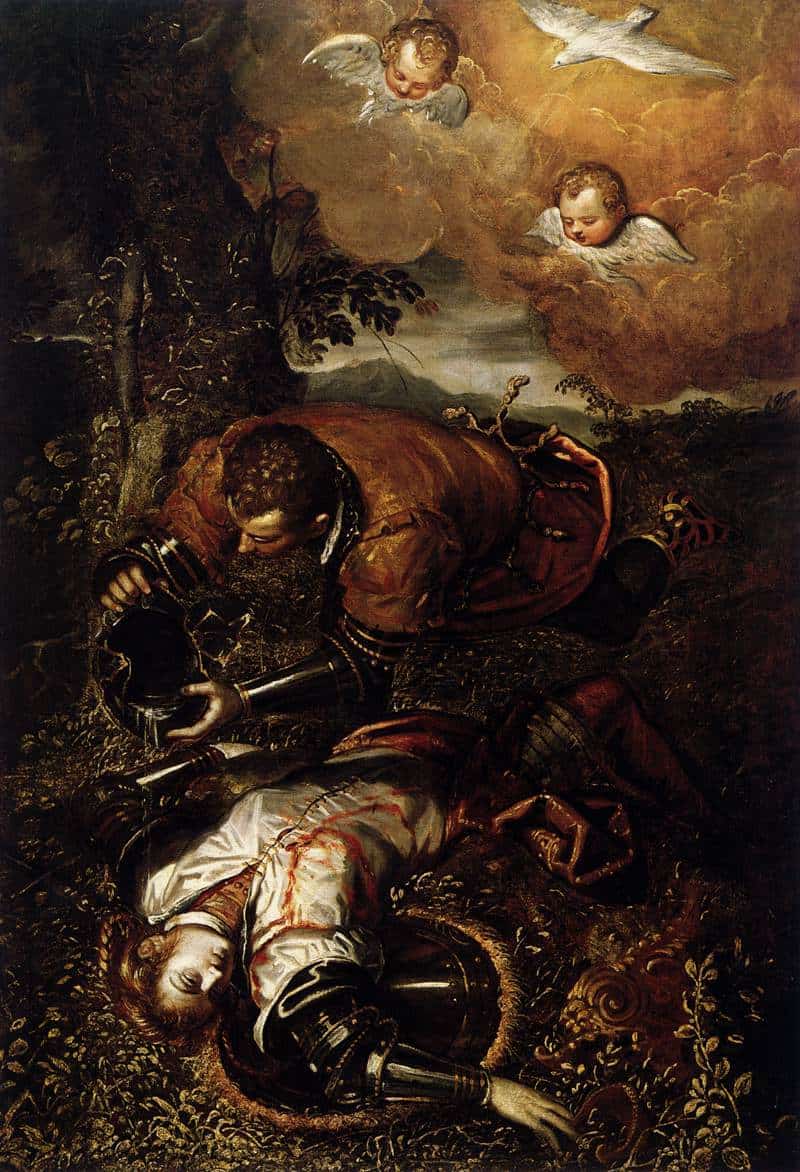
Domenico Tintoretto was an Italian Renaissance and Mannerist painter from Venice, best known for large-scale religious and civic paintings made in the late 16th and early 17th centuries. Born Domenico Robusti in 1560, he trained in the workshop of his father, Jacopo Tintoretto, and carried that Venetian pictorial style into a long career that ended in 1635.
| Fact | Detail |
|---|---|
| Full name | Domenico Robusti |
| Known as | Domenico Tintoretto |
| Born | 1560, Venice |
| Died | 17 May 1635 |
| Field | Painting |
| Training | Workshop of Jacopo Tintoretto |
Who was Domenico Tintoretto?
Domenico Tintoretto belonged to the generation that inherited Venice’s great painterly traditions after the high Renaissance. He worked in a city where churches, confraternities, government halls, and merchant families all needed images, so his career moved between altarpieces, portraits, and decorative cycles.
His name is attached to the Tintoretto workshop because his father’s influence shaped both his style and his professional life. Like many painters in Venice, he learned by doing: preparing panels and canvases, handling pigments, and helping to complete commissions at scale. That workshop training mattered as much as individual invention, because painting in Venice was often a collaborative craft.
What did he paint?
Domenico painted in oil on canvas, the medium most associated with Venetian art. His work often shows the dark grounds, fluent brushwork, and controlled drama linked to the Tintoretto family, with figures arranged for narrative clarity rather than quiet idealism. He produced religious subjects, mythological scenes, and portraits, adapting his manner to the demands of patrons and public spaces.
He is especially associated with the continuation of his father’s late style after Jacopo Tintoretto’s death. That meant handling complex compositions with crowded figures, strong diagonals, and theatrical light, but usually with a more measured surface and less explosive invention than the older Tintoretto. The result was work that could satisfy Venetian institutions that wanted grandeur without losing legibility.
Why does Domenico Tintoretto matter?
Domenico matters because he shows how an artistic legacy survives through workshop practice, not just through signed masterpieces. The Tintoretto name did not end with Jacopo; it became a working brand carried by Domenico in a city that valued continuity, speed, and reliable execution. His career helps explain how Venetian painting remained recognisable across generations.
He also matters for the history of portraiture. Late Venetian portrait painting depended on atmosphere, texture, and the handling of fabric and skin, and Domenico adapted those habits to elite sitters and courtly display. In practical terms, his paintings preserve the look of Venetian dress, costume, and status presentation at a moment when images were part record, part performance.
How did the Tintoretto workshop shape his style?
Workshop painting in Venice depended on repeatable procedures: transferring cartoons, blocking in underpaint, building flesh tones, and delegating sections of drapery or architecture. Domenico learned these methods inside a family shop that served demanding patrons and large interiors. That training gave him technical confidence and a recognisable visual vocabulary.
The family workshop also blurred the line between personal authorship and collective production. Some pictures were designed by Jacopo and completed by Domenico; others were fully Domenico’s but carried the family manner so closely that they read as part of the same lineage. For art history, that makes him important not just as an individual painter but as evidence of how Renaissance workshops actually functioned.
Frequently Asked Questions
Was Domenico Tintoretto as famous as his father?
No. Jacopo Tintoretto remains the more famous and more daring painter, while Domenico is usually treated as a capable inheritor rather than a revolutionary. That said, Domenico’s role was substantial because he sustained the workshop language that many Venetian patrons still wanted.
What style did Domenico Tintoretto use?
He worked in the Venetian tradition, with oil on canvas, warm colour, and a strong sense of drama in composition. His paintings often combine Tintoretto-family energy with a more restrained finish, especially in portraits and official commissions.
Why is he called Tintoretto?
The nickname came from his father, Jacopo Tintoretto, whose own surname is linked to dyeing or cloth-dyeing. Domenico used the family name professionally because it signalled lineage, workshop continuity, and artistic authority in Venice.
Articles mentioning Domenico Tintoretto