
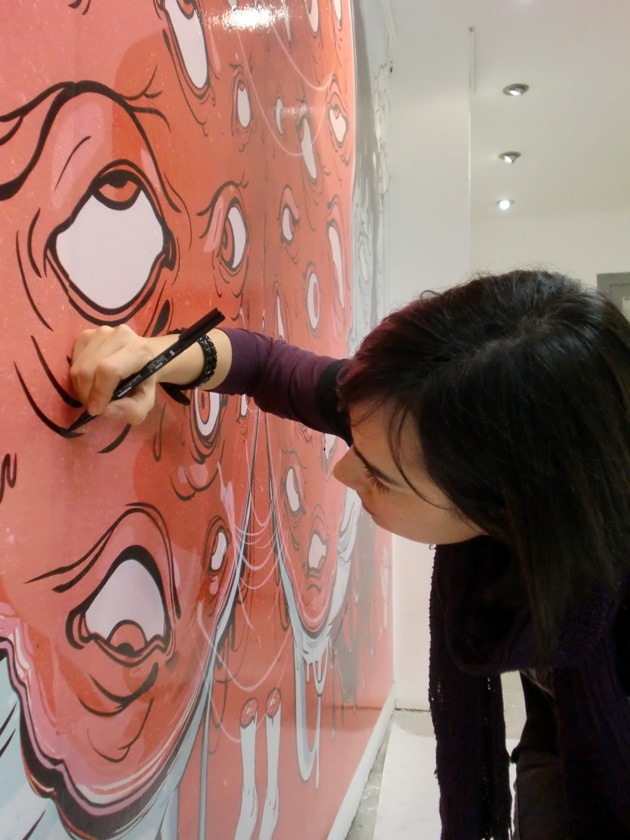
Elif Varol Ergen is a contemporary artist known for digitally produced images and hybrid prints that explore feminism, women’s identity, parent-child relationships, and the psychology of the body. Her work moves from grotesque infant figures and dark, distorted forms toward imagery shaped by divine femininity, mysticism, and the witch as a symbol of resistance.
| Field | Detail |
|---|---|
| Field | Contemporary visual art |
| Known for | Feminist imagery, uncanny figure drawing, witch and Wicca metaphors |
| Materials and processes | Digital print, digital imaging, CNC-machined production, ink, acrylic, silkscreen |
| Subject matter | Gender discrimination, motherhood, women’s rights, identity, mysticism |
| Visual language | High contrast black and red, deformation, sagging and melting forms, grotesque infant figures |
What her work deals with
Ergen’s art centers on the pressure placed on women by social expectation and male-dominated definitions of identity. Earlier work often used uncanny infants and childlike bodies to think about parent-child connection, fear, vulnerability, and the body as something unstable or threatened. Those images are not sentimental; they are tense, often severe, and frequently built around deformation, shadows, and a blunt grotesque quality.
Her later work keeps that critical edge but shifts toward explicit feminist symbolism. Themes of rebellion, divine femininity, and mysticism appear alongside figures associated with witches and Wicca. In her hands, those references function less as fantasy decoration than as a way to challenge ideas of femininity that society treats as fixed or obedient.
How are her images made?
Ergen works mainly through digital production methods, especially digital print and digital imaging. She also uses CNC-machined production, which brings a more engineered, cut, or routed surface into the work. That combination gives her practice a contemporary finish and allows her to move between image-making and object-like surfaces.
She occasionally combines these processes with traditional media such as ink, acrylic, and silkscreen. That layered approach matters because it keeps the work from feeling purely screen-based. The mix of mechanical and hand-applied methods helps reinforce the tension in her imagery: precise fabrication on one side, bodily distortion and psychological unease on the other.
Why do the witch and Wicca references matter?
In Ergen’s work, the witch is a figure of refusal. It stands for women who reject the roles assigned to them and behave outside accepted social norms. Wicca and related mystical imagery add a spiritual register to that refusal, linking female identity to intuition, ritual, and self-definition rather than obedience.
This is important because the symbol of the witch has a long history in feminist art and criticism. It can name fear, persecution, and outsider status, but it can also claim power. Ergen uses that double meaning to push against narrow ideas of womanhood and to present femininity as unruly, self-possessed, and hard to contain.
What does her style look like in practice?
Ergen’s earlier images are marked by mild-faced but unsettling infants, sharp teeth, and heavy shadows. Black and red dominate many of these works, producing a harsh contrast that intensifies the sense of menace. Forms sag, melt, and merge, which makes bodies appear unstable, as if identity itself were softening or slipping.
In the later work, the imagery becomes more explicitly symbolic while keeping the same visual intensity. Female figures and signs of feminine power are often presented with a mystical or rebellious charge rather than a naturalistic one. The result is work that reads as psychological and political at the same time: stylized enough to carry myth, direct enough to confront social control.
Frequently Asked Questions
Is Elif Varol Ergen a digital artist?
Yes, but that label is incomplete on its own. Digital imaging and digital print are central to her practice, and CNC-machined production also plays a role. She often mixes those methods with ink, acrylic, and silkscreen, so the work sits between digital fabrication and hands-on printmaking.
What themes appear most often in her work?
Her most persistent themes are feminism, women’s identity, gender discrimination, and the relationship between parent and child. Human psychology also runs through the imagery, especially in the earlier grotesque figures. More recent work brings in mysticism, divine femininity, and the witch as a feminist symbol.
Why are her figures often described as uncanny or grotesque?
That language fits the way her images distort bodies and expressions. The infants and figures can look tender at first glance, but sharp teeth, sagging forms, heavy shadows, and melting contours turn them unsettling. The effect is deliberate: it makes the body feel vulnerable, unstable, and charged with emotion.
Articles mentioning Elif Varol Ergen
