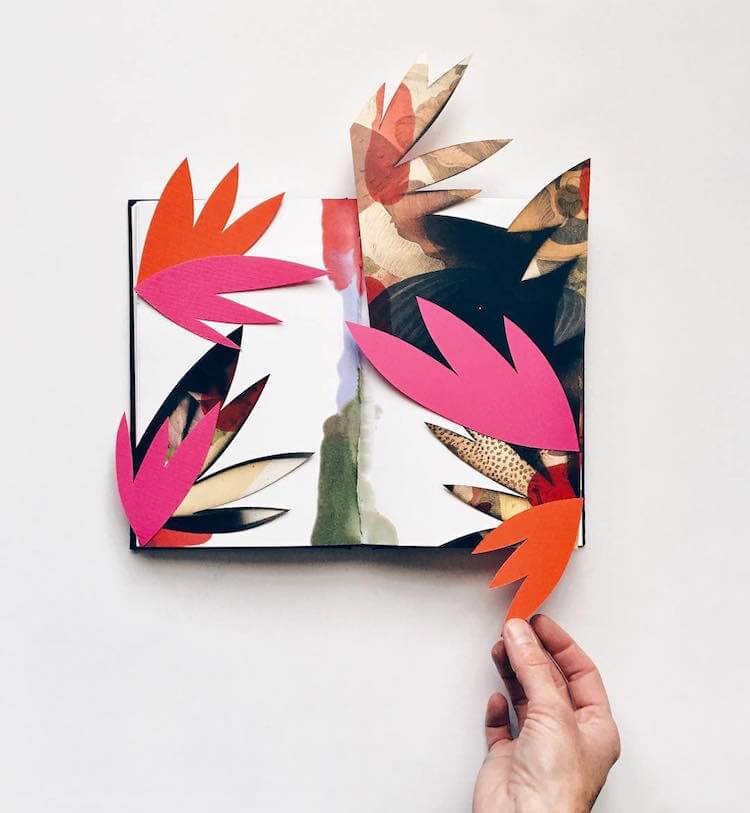
Eva Magill-Oliver is a contemporary artist and designer known for bold collage work that moves between sketchbook practice, print, pattern, and textiles. Her work often uses cut-paper forms, layered colour, and floral or botanical motifs to build images that feel both hand-made and sharply composed.
| Essential fact | Detail |
|---|---|
| Field | Artist and designer |
| Known for | Collage, sketchbook imagery, pattern-led compositions |
| Materials | Paper, cut shapes, painted marks, printed surfaces |
| Visual language | Layered blocks of colour, plants, ornaments, and rhythmic repetition |
| Context | Contemporary visual culture, especially image-making that crosses fine art and design |
What kind of work does Eva Magill-Oliver make?
Magill-Oliver works in collage and related paper-based processes, building images from separate shapes rather than drawing everything in one continuous line. That approach gives her work a cut-and-assembled look: edges stay visible, colour arrives in flat blocks, and forms overlap instead of blending smoothly. The result is often vivid and decorative, but not merely ornamental; the structure of the collage is part of the image’s meaning.
Her imagery frequently draws on flowers, leaves, stems, and other botanical forms. These motifs are not presented as naturalistic studies. They are simplified, repeated, and rearranged to make patterns that sit between sketchbook experiments and finished design work.
Where does her practice come from?
Magill-Oliver’s work belongs to a broader tradition of artists who treat the sketchbook as a site of invention rather than preparation alone. In that setting, a page can hold fragments, tests, and compositional ideas at once. Collage is especially well suited to this mode because it allows chance, revision, and layering to stay visible in the final surface.
Her work also sits close to textile and surface design, where repeat, palette, and pattern matter as much as subject matter. The border between illustration, collage, and decorative design is useful here. A flower can act as an image, a motif, or a unit within a larger pattern system, and her practice moves easily among those roles.
Why does Eva Magill-Oliver matter?
Magill-Oliver matters because her work shows how collage can stay lively and immediate while still feeling carefully resolved. Collage can sometimes seem rough or provisional. Her images demonstrate the opposite: that cut paper, layered colour, and simple forms can create compositions with clarity, warmth, and pace.
She is also part of a current interest in hand-made visual language that does not reject design values. Many contemporary artists use collage to keep evidence of the maker’s hand while also thinking in terms of pattern, reproduction, and surface. Magill-Oliver’s practice makes that overlap easy to see.
What does her work look like in practice?
In practical terms, the work tends to begin with small elements: painted papers, cut shapes, sketchbook fragments, or other pieces that can be moved around and tested against one another. Those parts are then arranged into compositions where rhythm matters. A repeated petal, a dense cluster of leaves, or a strong block of colour can hold the whole page together.
Because collage keeps each piece distinct, the finished image often retains a sense of construction. Flat colour patches meet textured marks; organic shapes sit against crisp edges; botanical references become signs and patterns. That combination gives the work its character: playful but controlled, compact but layered.
Frequently Asked Questions
Is Eva Magill-Oliver mainly an artist or a designer?
She can be understood as both. Her work uses the visual tools of design, especially pattern, composition, and colour planning, while also retaining the open-ended quality of studio art. That cross-over is part of what makes the work readable in more than one context.
What materials are associated with her work?
Paper is central, especially in cut-and-layered collage. Her images also depend on painted marks, printed surfaces, and other pieces that can be assembled into a final composition. Even when the result looks polished, the material logic remains visible.
Why are flowers and plants so common in her imagery?
Botanical forms give the work a flexible visual vocabulary. A leaf or flower can become a repeated motif, a structural device, or a simple cue to decoration. In Magill-Oliver’s hands, plants are not just subjects; they are building blocks for rhythm, shape, and colour.
Articles mentioning Eva Magill-Oliver