
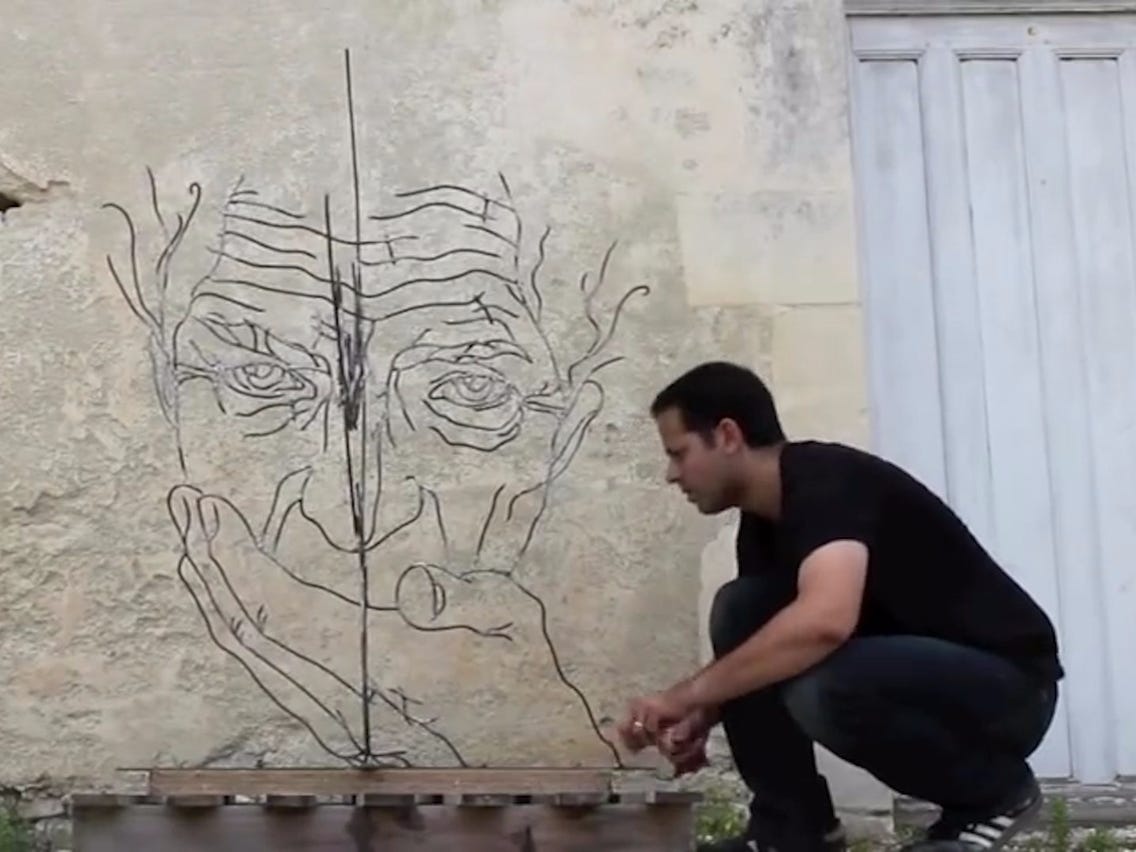
Gavin Worth is a Zimbabwe-born sculptor known for airy wire drawings that turn line into three-dimensional form. He works primarily with steel wire, bending, layering, and joining it so that a figure or object seems to appear in space with almost no mass. His practice sits between drawing, sculpture, and installation, and it has been used for gallery works, public art, and commercial commissions.
- Born in Zimbabwe in 1981 and raised in Las Cruces, New Mexico.
- Self-taught as a visual artist after early work in acting and music.
- Known for sculptures made from steel wire that read like sketches in the air.
- Has produced large-scale public works and brand commissions for Tiffany & Co., Lexus, and Ralph Lauren.
- Lives and works in Lausanne, Switzerland.
How did he start making wire sculpture?
Worth did not begin as a classically trained sculptor. After college he worked as an actor and musician with Shakespeare companies in Santa Fe, San Francisco, and California, then spent a decade in San Francisco before shifting into the visual arts. He has described his interest in making as long-standing, shaped by early encounters with drawing, painting, and sculpture, including a memory of seeing Michelangelo’s Head of Leda in a library book.
That background helps explain the looseness and theatricality in his work. His sculptures often feel like they have been paused mid-gesture, as if a line drawing had been lifted off the page and held in the air. The result is not heavy or monolithic sculpture, but forms that depend on silhouette, shadow, and the viewer’s movement around them.
What does Gavin Worth make with steel wire?
Worth’s signature works are built from steel wire, which he bends into continuous contours and interconnected outlines. In practice, that means choosing wire gauge, shaping it by hand, and creating structural joins that can hold a form without closing it into a solid surface. The material matters: steel gives him strength and tension, while the open framework leaves negative space visible as part of the image.
The finished pieces often resemble figures, faces, animals, or abstract gestures. Because the object is mostly line rather than volume, the work changes as light shifts. From one angle it can look almost invisible; from another, the outline snaps into clarity. That instability is central to the effect and separates his work from more conventional figurative sculpture.
Why does his work matter?
Worth’s sculptures sit in a useful place between drawing and object-making. They use the language of sketching, but they occupy real space and cast real shadows. That makes them legible to viewers who may not usually spend time with contemporary sculpture, while still rewarding close looking and movement around the piece.
He has also taken the approach into different contexts. Beyond studio works, he has created large-scale public sculptures on multiple continents and produced display concepts for luxury brands. Those projects show how a line-based sculptural language can shift from intimate wall works to architectural installations without losing its identity.
Where has his work appeared?
Worth has shown and collected internationally, and his commissions have included projects for Lexus, Tiffany & Co., and Ralph Lauren. The Tiffany work involved custom pieces for Valentine’s Day window displays, where his ability to make elegant, minimal forms out of wire suited a retail setting that depends on visual clarity and spectacle. For Ralph Lauren, he was asked to develop sculptural jewelry display ideas that were modern and restrained rather than ornate.
He was also a finalist for the 2014 TED Fellowship, which points to the educational and communicative side of his practice. His work often succeeds because it can be read quickly at a distance and then reconsidered up close, a useful quality in both public space and commercial display.
Frequently Asked Questions
Is Gavin Worth mainly a sculptor or a draughtsman?
He is a sculptor, but drawing is built into the method. His steel-wire works behave like drawings made in space, using line to describe form rather than filling it with mass. That is why his practice often gets described as sketch-like or airborne.
What materials does he use?
Steel wire is the core material in his best-known work. The wire can be bent, layered, and joined to create outlines that hold their shape while staying visually light. In some commissions, the same logic extends into display structures and larger installation frameworks.
What makes his sculptures distinct from other wire art?
His work tends to keep the line clean and readable, with forms that feel deliberately sparse. Instead of building dense wire meshes, he uses contour and spacing to make the object look drawn rather than woven. That emphasis on silhouette and negative space gives the work its clarity.
Articles mentioning Gavin Worth
