
George Washington was an American military commander, constitutional presiding officer, and the first president of the United States. He helped lead the break from British rule, then shaped the new federal government in the years after independence. His image later became a fixed part of U.S. political iconography, appearing on currency, monuments, and official portraiture.
Stories from George Washington
2 stories
About George Washington
| Born | February 22, 1732 |
|---|---|
| Died | December 14, 1799 |
| Known for | Commander-in-chief of the Continental Army; presiding over the Constitutional Convention; first President of the United States |
| Historical role | Founder and early national leader of the United States |
| Visual legacy | Frequently depicted in painted portraits, engraved banknotes, coins, and civic monuments |
Read the full overviewWhy George Washington matters, How did Washington become a national symbol?, What did he actually do?, Why does his image show up so often in art and money?
Why George Washington matters
Washington matters because he helped define the shape of American power at two crucial moments: war and government. During the Revolutionary War, he led the Continental Army against Britain, a role that made him a symbol of military discipline and republican leadership. After the war, he did not withdraw from public life; instead, he presided over the convention that produced the U.S. Constitution, helping replace the weaker Articles of Confederation with a sturdier federal system.
He also set precedents that outlived him. As the first president, he established habits of office that later presidents treated as tradition, including the dignity of the title itself and the expectation that executive power should be restrained by law and ceremony. That combination of military victory, constitutional authority, and personal restraint made him a foundational figure in American civic culture.
How did Washington become a national symbol?
Washington became a national symbol while he was still alive. His contemporaries treated him less as a routine politician than as a figure who could embody the republic without seeming monarchical. Portrait painters, engravers, medal makers, and sculptors repeated his likeness in controlled, formal poses: upright posture, plain military dress or dark civilian coat, steady gaze, and little ornament. Those visual conventions helped turn him into an image of order and legitimacy.
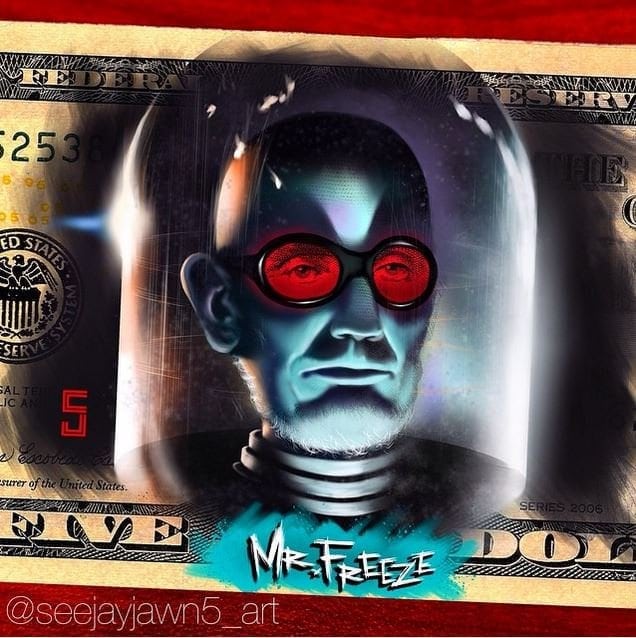
That visual afterlife continued through banknotes, coins, postage, and public statuary. In engraving and print, Washington’s portrait is often adapted to fit a field of patriotic symbolism: eagles, seals, banners, and classical devices. His face became so familiar that later artists could alter it, parody it, or recast it as a superhero or villain and still keep him instantly recognizable.
What did he actually do?
Washington came from Virginia landowning society and built status through surveying, plantation management, and military service. He served in the French and Indian War before becoming a central figure in the colonial resistance to British policy. When the Revolution began, the Continental Congress appointed him commander-in-chief, and he led a long war of attrition that depended on supply, endurance, and coordination as much as battlefield success.
After independence, he returned to public service when the nation faced political instability. At the Constitutional Convention in Philadelphia, he acted as presiding officer rather than principal drafter, but his presence lent authority to the proceedings. Once elected president in 1789, he worked with a cabinet, set protocols for federal authority, and chose not to pursue permanent office, leaving the precedent of voluntary departure after two terms.
Why does his image show up so often in art and money?
Washington’s face became a shorthand for the United States because it promised continuity. Currency design, especially engraving, depends on recognizable portraits that can be reproduced cleanly at small scale and repeated across issues. Washington’s profile and bust portraits provided exactly that kind of stable visual form, which is why he appears on bills, coins, and commemorative prints more often than almost any other American historical figure.
Artists have also used him as raw material for satire, remix, and political commentary. A portrait of Washington can be softened into nostalgia, sharpened into criticism, or turned into pop iconography without losing its civic charge. That flexibility explains why his likeness remains common in graphic design, from classroom posters to experimental banknote transformations.
Frequently Asked Questions
Was George Washington the first president of the United States?
Yes. He was the first president under the U.S. Constitution, taking office in 1789. Earlier confederation leaders existed under the Articles of Confederation, but Washington was the first to hold the modern executive office.
Did Washington write the Constitution?
No. He did not write it, but he presided over the Constitutional Convention that drafted it. His role was political and symbolic rather than authorial, though his authority helped hold the process together.
Why is Washington often shown on banknotes and coins?
His image signals national legitimacy and historical continuity. Designers favor his portrait because it is widely recognized, easy to reproduce, and strongly associated with the founding of the United States. That makes him useful for currency, where trust and stability matter as much as appearance.