
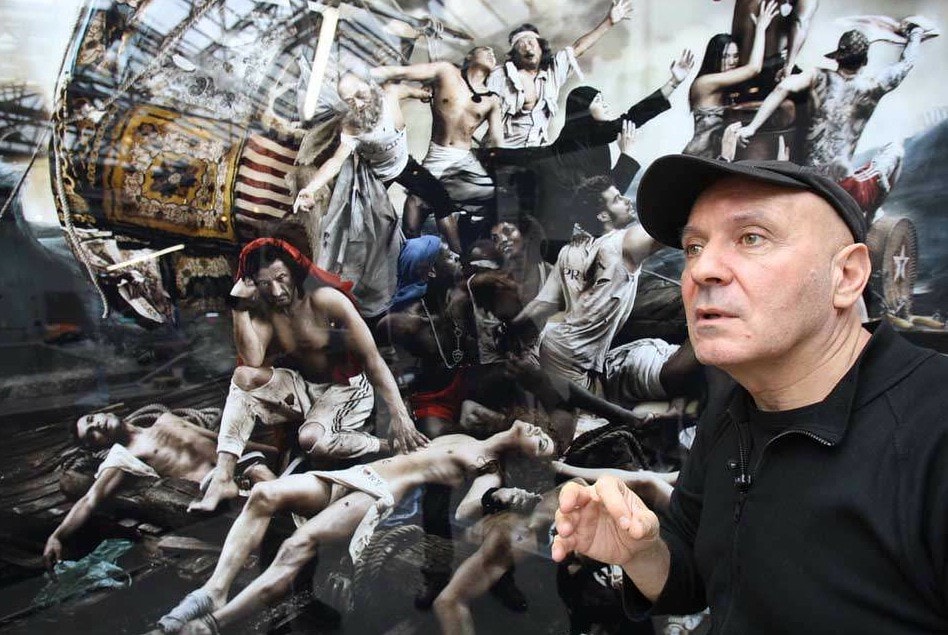
Gérard Rancinan is a French photographer known for moving from press photography into staged, large-scale image-making that blends news, satire, and social commentary. Born in Talence, near Bordeaux, he began at the Sygma press agency and later became widely published in magazines such as Sports Illustrated, Time, and Life.
- French photographer born in Talence, in south-west France.
- Started in press photography at the Sygma agency.
- Published internationally in major magazines and news titles.
- Won four World Press Awards.
- Became one of France’s highest-ranked photographers at a 2008 Drouot auction.
How did Gérard Rancinan become known?
Rancinan built his reputation first through photojournalism. Working at Sygma, one of the major agencies in international press photography, he learned to work quickly, to frame events cleanly, and to produce images that could travel across newspapers and magazines. That background matters because his later work keeps a press photographer’s eye for timing and legibility, even when the scenes are constructed rather than found.
His pictures appeared in publications with a huge audience, which helped establish him beyond France. Four World Press Awards marked him as a photographer with serious standing in the news photography world. That level of recognition also helps explain why his name later carried weight in the art market, where editorial photographers are often treated very differently from artists who begin in galleries.
What kind of photography does he make?
Rancinan is best known for images that look like news photographs but are often carefully staged, lit, and arranged. He uses photography to build scenes that comment on power, spectacle, media, and the body. The result can feel theatrical, but the visual language usually stays close to the realism of reportage: direct frontality, vivid detail, and a strong sense that something significant has just happened.
That mix of documentary authority and constructed imagery is part of his appeal. It allows the work to borrow the credibility of press photography while challenging the viewer to read beyond the surface. In practice, that means large tableaux, carefully directed subjects, and polished printing that turns a photograph into a finished object rather than a simple record.
Why does his background in press agencies matter?
A press agency trains photographers to deliver images that are immediate, clear, and usable under deadline. Sygma belonged to a generation of agencies that supplied images to international magazines at scale, and that environment shaped Rancinan’s sense of how pictures circulate. He did not start in a studio culture; he started in a system built for speed, assignment work, and editorial impact.
That origin helps explain why his later art photographs retain a public, worldly tone. Even when the work becomes conceptual or satirical, it still feels tied to current events, celebrity culture, and the visual habits of the magazine page. His career shows how press photography can evolve into art without losing its appetite for narrative and social observation.
What made him significant in France?
Rancinan’s prominence grew from both critical recognition and market success. The World Press Awards gave him international credibility, while the 2008 Etude Million auction at Drouot signaled strong commercial value in France. Being described as one of the highest-ranked photographers in the country placed him among the best-known names in French photography at that time.
He also represents a recognisable French path from reportage to staged photographic work. For a public familiar with the authority of photojournalism, his images offered something more ambitious: pictures that comment on the modern world using the visual grammar of the press. That combination has kept his work visible in discussions of contemporary photography, particularly where journalism and art overlap.
Frequently Asked Questions
Is Gérard Rancinan a photojournalist or an artist?
He began as a photojournalist and agency photographer, but much of the work he is known for later belongs to fine-art or staged photography. The distinction is not strict in his case, because his images keep the look and force of reportage even when they are constructed. That hybrid position is central to his reputation.
What are Gérard Rancinan’s best-known achievements?
He is known for publication in major international magazines, four World Press Awards, and strong auction recognition in France. Those achievements show success in both the editorial and art markets. Together, they made him a notable figure in contemporary French photography.
Where did Gérard Rancinan start his career?
He started at the Sygma press agency, a major name in international photojournalism. That early experience gave him professional discipline and access to the networks that circulate editorial photography. It also shaped the crisp, immediate style that still marks his later work.
Articles mentioning Gérard Rancinan
