Gioacchino Passini is an Italian figurative painter known for large, carefully observed paintings of ordinary subjects, especially flowers and everyday objects. His work combines realist technique with a reflective, memory-based mood, and it often recalls the atmosphere associated with the Novecento tradition in Italian painting.
- Born in Italy in 1956.
- Held his first solo exhibition at 17 in his hometown.
- Studied music at the Conservatory of Bologna while continuing to paint and exhibit.
- Paints figurative subjects with strong emphasis on surface detail, atmosphere, and emotional suggestion.
- His practice bridges disciplined drawing, close observation, and a nostalgic, Italian realist sensibility.
Who is Gioacchino Passini?
Passini belongs to a line of painters who treat visible reality as a starting point rather than a limit. His subjects are often simple: roses, objects from daily life, and scenes stripped down so that shape, light, and texture carry most of the meaning. The result is not documentary realism, but painting that turns familiar things into carriers of mood and memory.
He emerged early. Born in 1956, he had his first one-man exhibition at 17, which suggests both precocity and a strong local recognition. He later continued to show in solo and group exhibitions while studying music in Bologna, a parallel training that may help explain the measured, composed quality often felt in his work.
What does his painting look like?
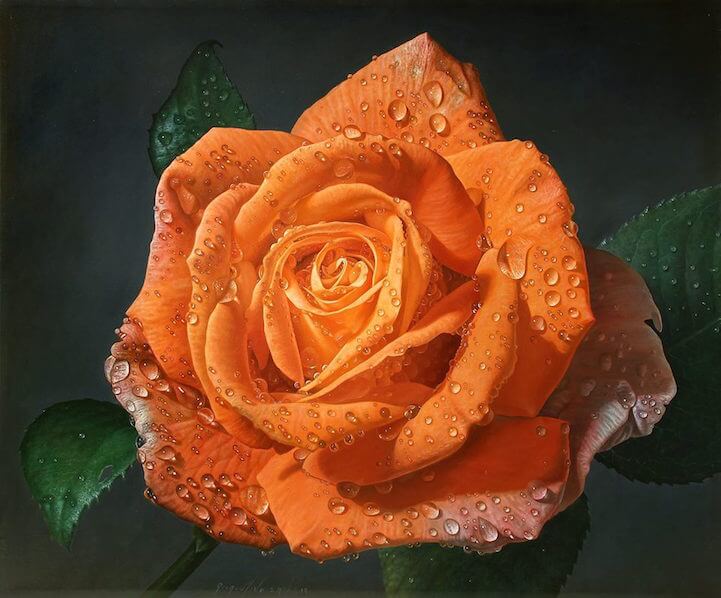
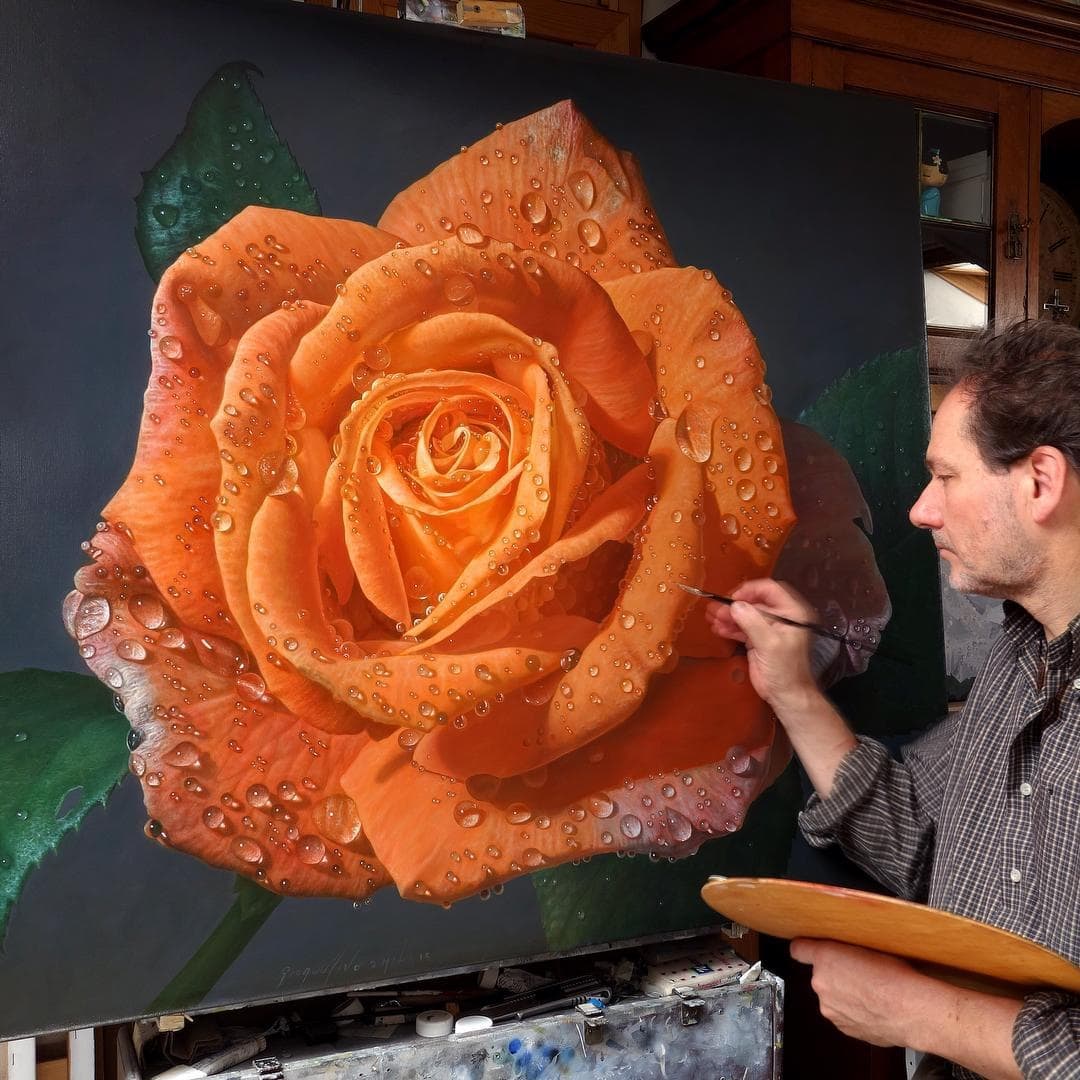
Passini’s paintings tend to be precise, polished, and slow-looking. Surfaces are handled with care, and details such as petals, dew, or the grain of an object are rendered so clearly that the image can feel almost tactile. This close attention does not flatten the subject; instead, it gives ordinary things a heightened presence.
His work relies on figurative painting as a way to produce emotion through recognition. A rose, a bowl, or another simple object can stand for memory, time, or private association without becoming symbolic in a heavy-handed way. The language remains realistic, but the effect reaches beyond description.
Why does his work matter?
Passini matters because he keeps figurative painting active as a contemporary language. In an art climate that often prizes concept, speed, or visible experimentation, his practice insists on craft, repetition, and the disciplined study of appearance. That approach can look traditional, but it is also exacting: it requires control over composition, light, and the smallest shifts in tone.
His paintings also show how realism can still be expansive. Rather than treating objects as inert, he lets them hold atmosphere. The everyday becomes strange, intimate, and emotionally charged. That is one reason his work fits so well with an article about rose paintings covered in dewdrops: he paints not just what something is, but what it feels like to look at it for a long time.
How is he connected to the Novecento tradition?
Passini’s work is often described as recalling the atmosphere of the Novecento, the Italian movement that looked back toward order, clarity, and a renewed monumentality in painting. In practice, that means a respect for structure, legibility, and the stability of the image. His paintings do not chase fragmentation or irony; they build a composed visual field where the subject can settle and speak plainly.
This connection is about sensibility more than imitation. Passini is not simply repeating historic models. He adapts a classical, Italian realist discipline to subjects that are quieter and more intimate, using technique to make stillness feel alive rather than static.
Frequently Asked Questions
Is Gioacchino Passini mainly a still-life painter?
Still life is an important part of his work, but it is not the whole of it. He is best understood as a figurative painter who often uses flowers and everyday objects because they offer clear forms and strong emotional possibilities. Those subjects let him focus on surface, light, and atmosphere.
Did his musical studies affect his art?
He studied at the Conservatory of Bologna while building his painting career, so music formed part of his education and daily discipline. The connection is not presented as a direct influence on style, but it is reasonable to read his work as controlled and structured in a way that parallels musical training. His paintings often feel composed rather than improvised.
Why are dewdrops and flowers such a fitting subject for him?
Dewdrops and flowers let Passini display technical precision without losing emotional depth. They demand careful handling of transparency, reflection, and texture, which suits his patient realism. At the same time, they carry associations of fragility, passing time, and memory, all of which align with the reflective quality in his work.
Articles mentioning Gioacchino Passini