
The Grand Palais is a vast exhibition hall and museum complex in Paris, built for the Exposition Universelle of 1900 and known for its huge glass-and-steel nave beneath a monumental stone facade. It stands on the Champs-Élysées in the 8th arrondissement, next to the Petit Palais and near the Pont Alexandre III. The building has served as a site for art exhibitions, fairs, fashion shows, and large-scale installations, making it one of Paris’s most flexible display spaces.
Stories from Grand Palais
8 stories


About Grand Palais
- Opened in 1900 for the Universal Exposition
- Located on the Champs-Élysées in central Paris
- Combines Beaux-Arts stonework with an iron-and-glass roof structure
- Used for exhibitions, cultural events, and temporary installations
- Often treated as both a landmark and an event venue
Read the full overviewWhy was the Grand Palais built?, What does the Grand Palais look like?, Why does the Grand Palais matter for art and design?, How is it used today?
Why was the Grand Palais built?
The Grand Palais rose from the city’s drive to stage the 1900 Exposition Universelle, a world’s fair meant to present France as modern, inventive, and artistically authoritative. It replaced the Palais de l’Industrie, an older exhibition building that no longer matched the scale of the event or the ambitions behind it. The project was part of a larger urban ensemble that also produced the Petit Palais and Pont Alexandre III, giving the area a deliberately ceremonial character.
Its construction also reflected a shift in exhibition architecture. Paris needed a building that could host major public gatherings, but it also wanted a structure that looked dignified in the urban landscape. The result was a hybrid: a formal stone monument on the outside, and a technologically advanced iron frame and glazed roof inside.
What does the Grand Palais look like?
The most distinctive feature is the central nave, a long, soaring interior space covered by a massive glass roof. That roof floods the hall with daylight and gives the building its unusual sense of scale. The metal structure is not hidden; it is part of the visual identity of the building, visible in the arches, trusses, and supports that carry the roof.
Outside, the Grand Palais is much more classical. Its facade uses the vocabulary of French Beaux-Arts architecture: symmetry, sculpture, heavy stone mass, and an emphatic monumentality. This contrast between exterior and interior matters. From the street, the building reads as official and ceremonial. Inside, it becomes a machine for display.
Why does the Grand Palais matter for art and design?
The Grand Palais matters because it offers a rare kind of space: large enough for ambitious public work, but historically charged enough to affect how that work is read. Artists and curators have used its scale, height, and light as active materials. Installations placed there do not sit neutrally; they compete with the building’s architecture and often draw power from that competition.
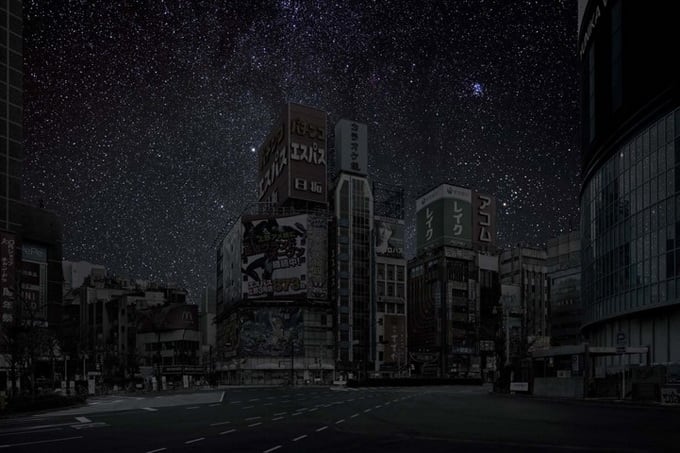
That is why the hall appears so often in contemporary art photography and installation practice. Leandro Erlich used it for an illusionistic environment that relied on architectural perception. Eva Jospin’s cardboard grottos gained force from the contrast between fragile hand-built surfaces and the monumental setting. Thierry Cohen’s city images also benefit from the Grand Palais’s role as a public stage for visual experiment. The building helps turn temporary works into events.
How is it used today?
Today the Grand Palais functions as a multipurpose cultural venue. It hosts major exhibitions, fairs, runway shows, and large-scale commissions, often requiring temporary construction, lighting systems, and environmental controls tailored to each event. Because the building is historic, each use has to negotiate preservation and adaptation at the same time.
That tension is part of its appeal. The Grand Palais is not a neutral white cube; it is a place where architecture remains visible and active. Artists and designers work with its marble, iron, glass, and volume rather than trying to erase them, which is why the building continues to attract projects that depend on spatial drama.
Frequently Asked Questions
Is the Grand Palais a museum?
Not exactly. It is an exhibition complex that can host museum shows, but it is also used for fairs, performances, fashion events, and temporary installations. Its role changes from project to project.
Why is the Grand Palais important in architecture?
It shows how late nineteenth-century architecture combined monumentality with industrial technology. The stone facade presents the building as civic and ceremonial, while the iron-and-glass nave demonstrates the structural possibilities of modern engineering. That combination became influential for later exhibition spaces.
What makes it attractive to artists?
Its scale, light, and history create strong visual conditions for installation art. Works placed inside the Grand Palais must respond to an interior that already feels theatrical, so the building becomes part of the artwork’s meaning. That is especially useful for projects that depend on illusion, fragility, or spatial contrast.