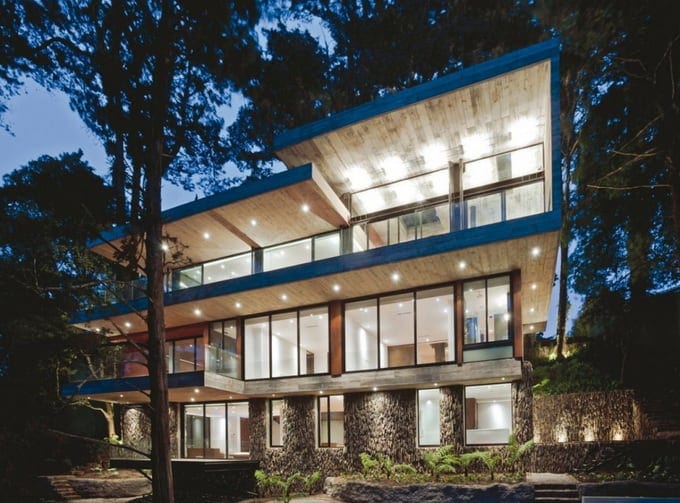
Guatemala is a Central American country whose landscapes range from Pacific coast and Caribbean shoreline to volcanic highlands, cloud forests, and lowland jungle. Its capital is Guatemala City, and its population is shaped by a large Indigenous Maya presence alongside mestizo, European, and other communities. For visual culture, Guatemala matters because architecture, craft, textiles, and landscape all appear there with unusual intensity: carved volcanic stone, woven huipiles, painted churches, volcanic basalt, and brightly finished modern interiors sit close together.
- Location: Central America, between Mexico and the northern edge of South America’s cultural sphere, with coasts on the Pacific and Caribbean.
- Capital: Guatemala City, officially Nueva Guatemala de la Asunción.
- Material culture: Known for Maya weaving traditions, ceramic work, timber craft, volcanic stone, and painted surface decoration.
- Built environment: Colonial ruins, seismic masonry, modernist housing, and hotel and residential design shaped by earthquakes and volcanic geology.
- Visual identity: Strong color, dense pattern, and highland landscape dominate much of its craft and photographic appeal.
What makes Guatemala visually distinctive?
Guatemala’s visual identity comes from the meeting of Indigenous continuity, Spanish colonial history, and a difficult physical setting. Earthquakes and volcanoes have shaped how buildings are made, encouraging low-rise construction, thick masonry walls, and a careful relationship to structure and ground. In the cities, that often means stuccoed facades, courtyards, tiled floors, and restrained geometries; in the highlands, it means adobe, stone, and timber used in ways that respond to climate and seismic risk.
The country is also known for surfaces that carry meaning. Maya textiles, especially huipiles and cortes, use woven pattern, symbolic color, and regional variations to signal community and identity. Those fabrics are not decorative extras; they are working garments, cultural records, and finely made objects of design. That same visual density appears in markets, ceramics, altars, church interiors, and painted signage, giving Guatemala a layered and often highly saturated appearance.
How has geography shaped building and craft?
Guatemala’s geography has had a direct effect on materials and technique. Volcanic terrain supplies stone and mineral-rich soils, while the climate supports timber, reeds, palm, cotton, and dyestuffs used in traditional craft. In the highlands, weaving developed as a major design language because backstrap looms, cotton threads, and local dyes could produce durable cloth suited to daily life and ceremonial use. In the lowlands and coastal zones, lighter building materials and open-air forms are more common.
Seismic activity has also influenced architecture. Builders have long favored simpler masses, flexible joins, and repairable finishes over brittle ornament that can fail in an earthquake. In contemporary interiors and hospitality design, designers often combine local materials such as volcanic stone, handwoven textiles, terracotta, and wood with cleaner modern lines. The result is a style that reads as contemporary but remains anchored in place.
Why does Guatemala matter in design and photography?
Guatemala offers a concentrated field for photographers because it compresses several kinds of image into one country: volcanic drama, colonial streets, dense markets, lakes, rituals, and textiles. Places such as Antigua, Lake Atitlán, and the highland villages around it are especially photogenic because architecture, clothing, and landscape all carry strong color and form. That makes Guatemala a frequent subject in travel photography and editorial features about beauty, craft, and place.
It matters in design because its most recognizable visual systems are not imported styles but living traditions. Indigenous weaving, ceramic traditions, religious processions, and vernacular construction continue to inform contemporary work. Designers who draw from Guatemala often borrow pattern logic, material tactility, and saturated color rather than merely repeating folk motifs. The strongest examples respect that these forms come from use, labor, and community, not from surface styling alone.
What does Guatemalan craft look like in practice?
Guatemalan craft is often labor-intensive and highly localized. Textiles are among the most visible examples: a single garment can encode village, language group, status, and ceremonial context through stitch, motif, and palette. Weaving on the backstrap loom produces narrow panels that are joined into larger garments, a process that rewards precision and repetition. Embroidery, appliqué, beadwork, wood carving, and pottery add to this handmade vocabulary.
In interiors and product design, the same principles appear through material contrast. Raw wood may sit beside polished stone; handwoven cloth may soften a hard architectural shell; unglazed ceramic may balance painted plaster. The best work does not flatten these objects into tourist imagery. It treats them as functional materials with specific origins, techniques, and social meanings.
Frequently Asked Questions
Is Guatemala mostly known for ancient Maya history?
Ancient Maya history is central to Guatemala, but it is only one part of the country’s identity. Maya languages, textiles, farming systems, and ritual practices remain present in daily life, especially in the highlands. Guatemala is also a contemporary nation with modern cities, design work, and active debates about heritage, land, and labor.
Why do so many articles about Guatemala mention volcanoes?
Volcanoes are one of the most visible parts of the landscape, and they shape both scenery and settlement. Their cones, ash, and surrounding soils create a dramatic visual frame that photographers and designers often find compelling. They also affect building practice, since seismic and volcanic risk influences construction choices.
What materials are most associated with Guatemalan design?
Textiles, wood, volcanic stone, clay, and stucco are among the most common materials associated with Guatemalan design. Handwoven fabric is especially important because it carries both functional and symbolic value. In architecture and interiors, these materials often appear together rather than separately, producing spaces that feel grounded and tactile.
At a glance
- Address
- Guatemala
- Coordinates
- 14.633333, -90.5
Articles mentioning Guatemala