
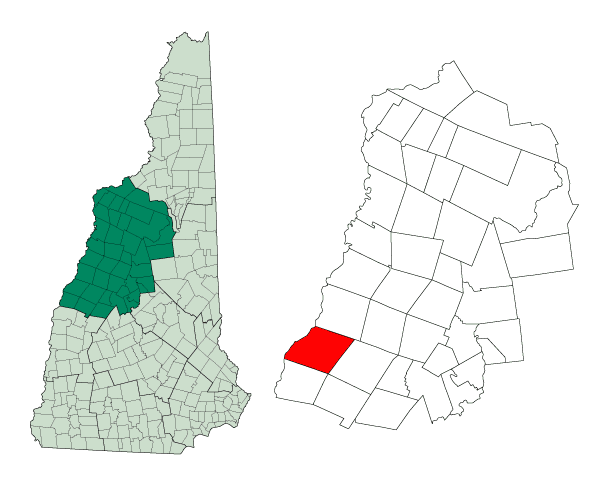
Hanover is a town in Grafton County, New Hampshire, on the Connecticut River and best known as the home of Dartmouth College. It is a compact New England place with a strong academic, civic, and outdoor identity, shaped by the college, the river valley, and the surrounding Upper Valley region. For artists, students, researchers, and hikers, Hanover often functions less like a small town in isolation and more like a working crossroads.
| Fact | Detail |
|---|---|
| Location | Grafton County, western New Hampshire, on the Connecticut River |
| Known for | Dartmouth College; the Appalachian Trail; the Cold Regions Research and Engineering Laboratory |
| Population | 11,260 at the 2010 census |
| Character | College town, river town, and regional service center |
Where is Hanover, and what kind of place is it?
Hanover sits near New Hampshire’s western edge, facing Vermont across the Connecticut River. The town belongs to the Upper Valley, a region linked by the river corridor and by daily movement between towns on both sides of the state line. Its scale is modest, but its influence is larger than its population suggests because Dartmouth College brings students, faculty, visitors, exhibitions, lectures, and a steady flow of academic work.
The town center is walkable and set up around campus life, local businesses, civic buildings, and residential streets. That combination gives Hanover a distinct visual character: clapboard houses, brick institutional buildings, trees, cold-season light, and a landscape that shifts quickly from a compact downtown to wooded hills and river valleys.
Why does Hanover matter in culture and research?
Hanover matters because Dartmouth College gives it institutional weight. The college shapes the town’s calendar, economy, and public life, and it also draws artists, designers, scientists, and visiting speakers. A town of this size rarely hosts such a dense concentration of academic and cultural activity, which makes Hanover an active site for ideas rather than a quiet backdrop.
The US Army Corps of Engineers Cold Regions Research and Engineering Laboratory is also located there, linking Hanover to the study of snow, ice, frozen ground, and cold-weather infrastructure. That matters in a region where climate and terrain are not decorative features but practical conditions that affect building, transport, and daily life. The presence of the lab adds a technical dimension to a town often identified primarily with education.
What does Hanover look like in practice?
In practice, Hanover feels like a town organized around movement between a few dense points: the college, the main commercial streets, nearby neighborhoods, and the river landscape beyond. Seasonal weather changes the experience sharply. Winter brings snow and deep cold; spring and fall sharpen the contrast between built form and the surrounding terrain; summer fills the town with pedestrians, cyclists, and visitors.
Its built environment reflects a long New England settlement pattern rather than a single master plan. Historic houses and academic buildings sit near practical contemporary structures, and the town’s identity comes from how those forms coexist. The Appalachian Trail crossing town reinforces that sense of overlap: Hanover is not only a place of residence and study, but also a point on a much longer route through the landscape.
How has Hanover been represented and rated?
Hanover has often appeared in national rankings of desirable places to live, including placements by CNN and Money magazine that pushed it into the upper tier of their lists in the 2000s and 2011. Those rankings reflect a combination of factors: education, safety, scenery, public services, and access to cultural life. They also point to the town’s unusual balance between small-scale living and high institutional presence.
That reputation can flatten the town if taken too literally. Hanover is not only an attractive address or a college postcard. It is a working place shaped by academic labor, municipal life, scientific research, and the ordinary routines of a community that also hosts one of the country’s better-known universities.
Frequently Asked Questions
Is Hanover the same thing as Dartmouth College?
No. Dartmouth College is a private university within the town of Hanover, and it strongly influences the place, but the town has its own government, residents, and civic life. The college is central to Hanover’s identity, yet the town existed before and continues beyond the institution.
Is Hanover a river town or a mountain town?
It is primarily a river town, since it sits on the Connecticut River. At the same time, the surrounding terrain rises into wooded hills and broader upland country, so the landscape feels more layered than a simple riverside settlement. That mix is part of its visual and cultural appeal.
Why does Hanover come up in stories about art and design?
Hanover appears in art and design contexts because Dartmouth College brings exhibitions, makers, scholars, and public programming into the town. Its setting also makes it a useful place to think about the relation between institutions and landscape. In practice, Hanover offers both an academic network and a distinctive New England setting, which is often enough to place it in the background of creative work.