
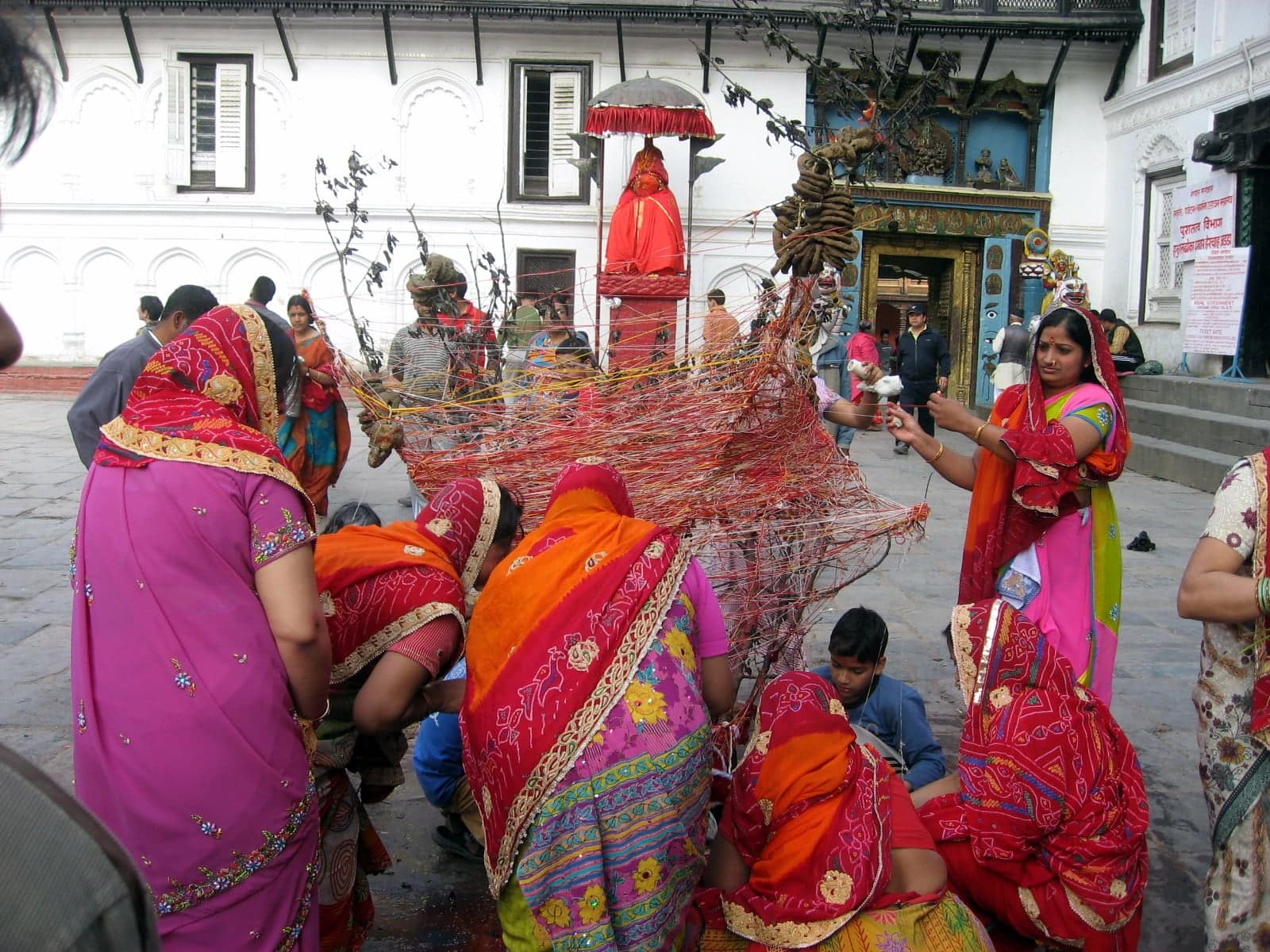
Holika is a demoness from Hindu scripture whose death is remembered in the story behind Holi, the spring festival marked by bonfires, color, and communal celebration. In the most common telling, she is the sister of the tyrant king Hiranyakashipu and the accomplice in his attempt to kill his devotee-son Prahlad. The story ends with Holika burned while Prahlad survives, making her a figure of destructive power defeated by devotion and divine protection.
- Holika belongs to the mythic cycle around Hiranyakashipu, Prahlad, and the god Vishnu.
- Her burning is central to the ritual bonfire known as Holika Dahan, held on the eve of Holi.
- The story is used to frame Holi as a festival of renewal, purification, and the defeat of arrogance.
- In visual culture, Holika often appears as an effigy, a fire-lit scene, or a painted episode in devotional storytelling.
Who was Holika in Hindu tradition?
Holika appears in later retellings of the Bhagavata Purana and related devotional literature. She is described as having a boon or protective garment that made her immune to fire, which she uses when she enters a blaze with Prahlad in her lap. The protection fails because she enters the fire with evil intent and because Prahlad’s devotion shields him; Holika is consumed instead.
The details vary by region and text. Some versions stress Brahma’s blessing, while others focus more strongly on Vishnu’s intervention through Prahlad’s faith. The core structure stays the same: a persecutor trusts a weaponized advantage, but that advantage collapses in the face of moral disorder.
Why does Holika matter to Holi?
Holika’s death gives Holi one of its oldest symbolic frames. The festival is not only about color and play; it also begins with a fire ritual that marks the destruction of harmful forces before the arrival of spring. In many communities, the bonfire is understood as Holika Dahan, a public burning that recalls her defeat and turns the myth into a shared civic act.
That link matters because it gives the festival a narrative spine. Fire clears away the old year, social tensions are loosened, and the next day of color becomes a kind of release after judgment. The story is moral, but it is also practical in ritual terms: it organizes a seasonal feast, a public gathering, and an image of purification through flame.
What does Holika look like in practice?
Holika seldom appears as a stable icon with fixed attributes. In performance, she is often reduced to an effigy made from straw, cloth, and combustible material, built to be burned in a public square or open ground. In painting and popular print, she may be shown as a crowned female figure carrying Prahlad toward flames, or as a scene of fire, prayer, and rescue.
Because the story belongs to ritual rather than to temple worship alone, its visual language is communal and temporary. The most common form is the bonfire itself: stacked wood, an effigy at the center or top, offerings placed in the fire, and a crowd gathered around it. This makes Holika less a static deity than a recurring event, staged each year through flame, smoke, ash, and the memory of survival.
How should Holika be understood today?
Holika is best understood as a mythic figure inside a larger festival system, not as an isolated villain. Her role is to embody the failure of violent power and the reversal of expected outcomes. For many people, especially in North India, her story remains inseparable from the social energy of Holi: neighborhood bonfires, ritual chanting, and the move from winter restraint into spring abundance.
At the same time, the figure can be interpreted differently across communities. Some read the story chiefly as a lesson in devotion, some as a triumph over tyranny, and some as a seasonal allegory for burning away impurities. Those meanings are carried by ritual practice, not by a single fixed image, which is why Holika survives as both a narrative and a yearly act.
Frequently Asked Questions
Was Holika a goddess?
No. Holika is usually described as a demoness or as a figure aligned with demonic power in the myth of Hiranyakashipu and Prahlad. She is not worshipped as a goddess in mainstream practice. Her importance comes from the role she plays in the story that explains Holi.
What is Holika Dahan?
Holika Dahan is the bonfire ritual held on the night before Holi. It commemorates Holika’s burning and the survival of Prahlad. Communities build a fire, often with an effigy, and gather around it as a sign of the defeat of evil and the clearing away of the old season.
Why did Holika burn if she had a protective boon?
Different texts explain this in different ways, but the usual moral is that the boon failed because Holika used it for wrongdoing. In some tellings, Prahlad’s devotion to Vishnu protected him, and Holika’s attempt to harm him caused the fire to turn against her. The story works as a reversal: the intended victim survives, and the aggressor is destroyed.
}