
Indian people are the citizens and nationals of India, a country in South Asia whose population includes hundreds of regional, linguistic, religious, and ethnic communities. The term can also appear more loosely as a shorthand for people from the Indian subcontinent, but in modern reference use it most often means people connected to the Republic of India.
Stories from Indian people
75 stories






About Indian people
- Nationality: Indian
- Country: India
- Region: South Asia
- Population: Over 1.4 billion people
- Identity: Multilingual and multiethnic, with no single cultural style or look
Read the full overviewWhat does “Indian people” mean?, How is Indian identity formed?, What do Indian people look like in art and media?, Why does the term matter in visual culture?
What does “Indian people” mean?
As a national term, “Indian people” refers to the citizens of India. India is not a single ethnic group but a modern state built around a large number of communities with distinct histories, languages, cuisines, dress traditions, and faiths. Hindi and English are used widely in public life, but the country also recognizes a long list of scheduled languages, and everyday speech shifts from region to region.
The word has an older and broader history as well. In colonial-era English, “Indian” was sometimes used imprecisely for many peoples of Asia or for Native Americans, which creates confusion in older texts. In contemporary usage, however, the term is specific: it names people from India, not a racial type or a single culture.
How is Indian identity formed?
Indian identity is shaped by a layered civic and cultural history. The modern state emerged from British colonial rule in 1947, but the land has long supported kingdoms, trade networks, pilgrim routes, and urban cultures that linked the subcontinent to West Asia, Central Asia, Southeast Asia, and the Indian Ocean world. That history left visible marks in architecture, textiles, food, ritual, and visual culture.
Because of that history, “Indian” functions as a political nationality first and a cultural identity second. A person from Kerala, Punjab, Assam, Gujarat, or Manipur may all be Indian while speaking different mother tongues, following different customs, and making different art forms. Any serious description of Indian people has to hold that variety in view rather than flattening it into a single style.
What do Indian people look like in art and media?
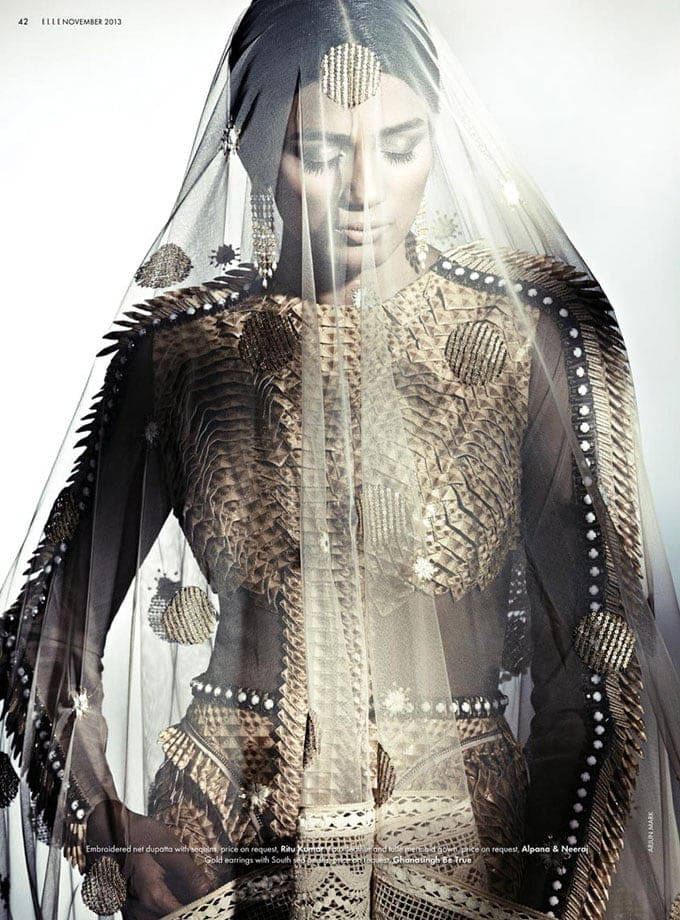
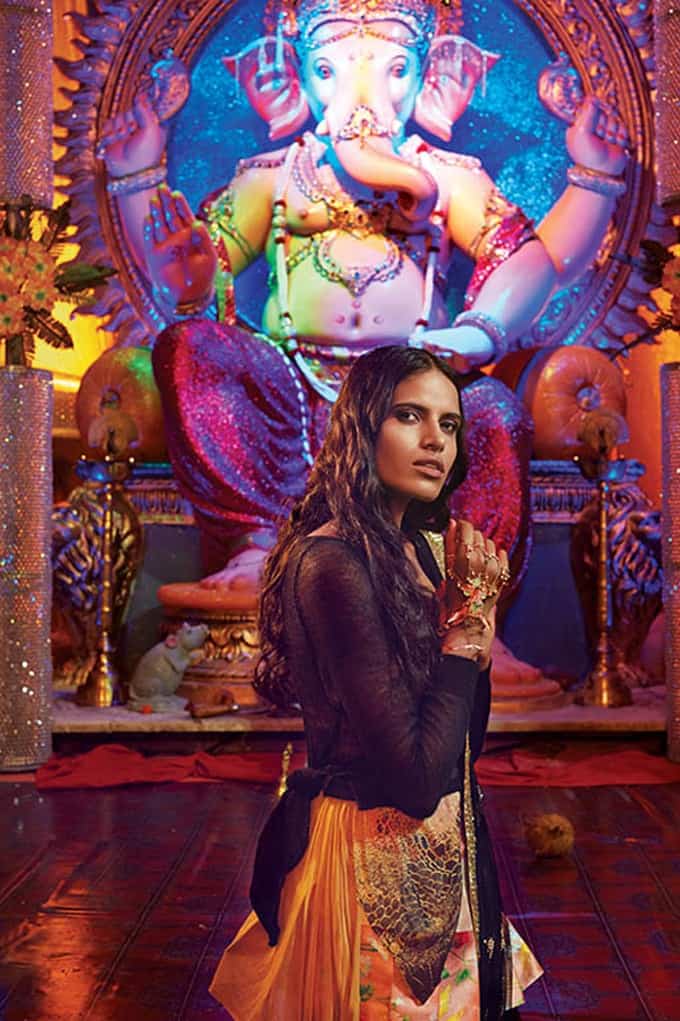
There is no single visual shorthand that accurately represents Indian people. In photographs, film, fashion, and illustration, Indian identity often appears through context instead of uniform appearance: regional dress, saris and salwar kameez, turbans, bindis, tilaks, mehndi, sarongs, shawls, temple jewelry, and contemporary streetwear all coexist. Skin tone, facial features, and body types vary widely, and media that treats “Indian” as a fixed look usually falls into stereotype.
Indian makers have also shaped the visual language of modern culture itself. Indian photography, cinema, textile design, advertising, and magazine culture often blend local craft traditions with global forms. In fashion photography and editorial portraiture, for example, Indian identity may be conveyed through fabric choice, ornament, posture, domestic interiors, or festival settings rather than through flags or slogans.
Why does the term matter in visual culture?
The term matters because it is frequently used too casually. A label like “Indian” can refer to citizenship, ancestry, language, religion, region, diaspora, or aesthetic influence, and those categories do not always overlap. For editors, curators, and designers, precision avoids erasing the differences between, say, a Sikh Punjabi family, a Tamil Hindu household, a Muslim Kashmiri community, or an Indian diaspora artist working in London or Toronto.
It also matters because India is often treated as a source of pattern, color, or spirituality without the people behind those forms being named. That approach turns living communities into style references. A better description starts with the makers and their specific materials and methods: handwoven cotton, block printing, silk embroidery, bronze casting, miniature painting, lens-based portraiture, or digital graphics shaped by local visual traditions.
Frequently Asked Questions
Are “Indian” and “Hindu” the same thing?
No. “Indian” is a nationality or country-based identity; “Hindu” is a religious identity. Many Indian people are Hindu, but many are Muslim, Christian, Sikh, Buddhist, Jain, Jewish, or secular.
Is “Indian” an ethnicity?
Sometimes it is used that way in everyday speech, but it is more accurate to call it a nationality. India contains many ethnic and ethnolinguistic communities rather than one ethnicity. In most careful writing, “Indian” names citizenship or national belonging, while the more specific community identity should be named separately.
Why can the term be confusing in older sources?
Older English-language sources often used “Indian” to mean different things in different places, including Native Americans and peoples of Asia more generally. That history comes from colonial misunderstanding and loose geographic naming. Modern reference writing should avoid that ambiguity by using the term only in its current, India-specific sense unless the historical context demands otherwise.