
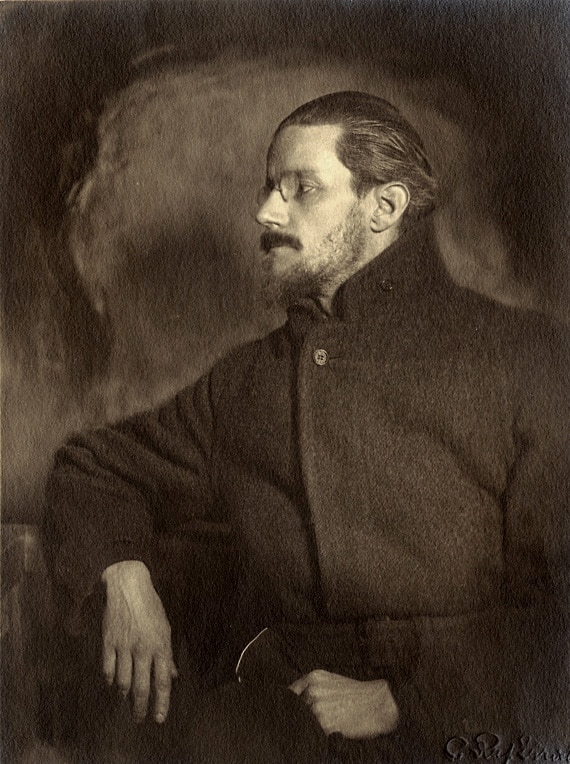
James Joyce was an Irish modernist writer whose novels, stories, and poems changed what prose could do with language, structure, and interior thought. Born in Dublin in 1882 and active mainly in Trieste, Zurich, and Paris, he built a reputation on writing that is formally exacting, densely allusive, and sharply attentive to ordinary urban life.
- Best known for Ulysses and Finnegans Wake
- Central to literary modernism and the development of stream of consciousness
- Drew heavily on Dublin streets, speech, Catholic ritual, and classical literature
- Worked through long revision, wordplay, parody, and layered quotation
- Influenced fiction, criticism, theatre, and later experimental writing
Why does James Joyce matter?
Joyce matters because he made the everyday feel structurally new. Rather than treating a novel as a straightforward account of events, he turned it into a machine for rhythm, perspective, allusion, and linguistic experiment. His work pushed English prose toward a freer handling of consciousness, so that thought, memory, sensation, and speech could appear on the page with little separation.
That shift had lasting consequences. Writers after Joyce borrowed his method of following a mind as it moves, hesitates, and contradicts itself. His influence also reached beyond literature into visual culture, editing, and design, where fragmentation, montage, quotation, and dense symbolic patterning became familiar tools.
What did he actually write?
Joyce began with Dubliners, a collection of stories about paralysis, disappointment, and social constraint in Dublin. A Portrait of the Artist as a Young Man follows a young writer’s intellectual and artistic formation, using language that changes as the character matures. Ulysses compresses a single day in Dublin into a sprawling structure based on Homer’s Odyssey, with each chapter taking on a different style, register, or narrative method.
Finnegans Wake goes further. It is built from multilingual puns, broken syntax, dream logic, and historical echoes, and it resists ordinary summary. Joyce also wrote poetry, criticism, and the play Exiles, but his novels are where his formal ambitions are most visible and where his methods had the biggest impact.
How did Joyce write?
Joyce worked by accumulation and revision. He took ordinary material—street names, advertisements, overheard speech, newspaper language, liturgical phrases—and folded it into complex patterns. He also used stylistic mimicry, shifting from parody to catechism, journalism, melodrama, and interior monologue within a single work. That variety gave his writing its texture: concrete detail sits beside high literary reference, and local Dublin life is placed under the pressure of world myth.
The result often looks difficult on the page because the difficulty is part of the method. Joyce did not write to hide meaning; he wrote to show how meaning is built from association, echo, and formal arrangement. His books reward close reading, annotation, and repeated return, which is why they still anchor discussion of modernist technique and experimental prose.
What does Joyce look like in practice?
In practice, Joyce means scenes built from consciousness rather than from clean exposition. A character may notice a smell, recall a phrase, misread a sign, or drift into memory, and the prose will follow that movement instead of correcting it. A page can hold comedy, erudition, embarrassment, and bodily detail at once. This is one reason his writing remains so visible in later fiction: the page becomes a record of thought as lived, not just thought as explained.
His work also shows how literature can carry design-like systems inside it. In Ulysses, episodes are organised by scheme, style, and formal constraint. In Finnegans Wake, words behave like collage material, fused and re-cut to create new surfaces of sound and sense. Joyce’s legacy lies partly in that combination of control and instability: the writing is tightly made, but it keeps breaking open.
Frequently Asked Questions
Was James Joyce part of the modernist movement?
Yes. Joyce is one of the key figures of literary modernism, alongside writers such as Virginia Woolf, T. S. Eliot, and Marcel Proust. Modernist writing often experiments with form, perspective, and language, and Joyce pushed all three further than most of his contemporaries.
Why is Ulysses so famous?
Ulysses is famous because it expanded what a novel could contain: ordinary life, classical structure, linguistic parody, and interior thought all appear in the same work. It is also famous for its technical ambition, especially its use of shifting styles across a single day in Dublin. The book became a benchmark for difficult, high-art fiction.
Is Joyce hard to read on purpose?
Often, yes. Joyce uses compression, allusion, multilingual wordplay, and formal experiments that can make the text resistant at first glance. That difficulty is not random; it comes from his attempt to represent how language actually works in the mind and in culture, where meanings overlap rather than arrive neatly.
Articles mentioning James Joyce

![Unusual Jobs of Famous Writers [Infographic]](https://freeyorkk.b-cdn.net/wp-content/uploads/2015/10/writers-weird-jobs2-scaled.png "James Joyce")