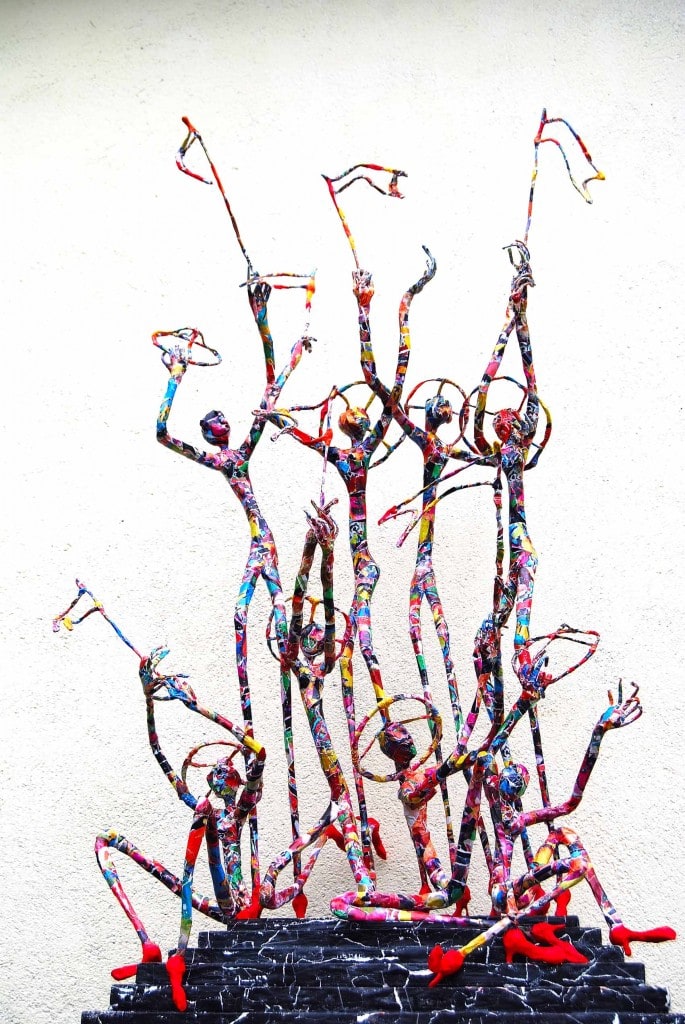
Jean-François Glabik is a paper sculptor known for making highly detailed three-dimensional forms from sheets of paper, often with a crisp, engineered look that shows off cutting, scoring, folding, and layering. His work belongs to the broader field of contemporary paper art, where humble materials are pushed into objects that mimic textiles, architecture, or organic forms while remaining unmistakably paper.
| Field | Paper sculpture |
|---|---|
| Medium | Paper, card, and related sheet materials |
| Known for | Intricate sculptural forms built from precision cuts, folds, and assemblies |
| Practice | Hand-built construction with a strong emphasis on surface detail and structure |
What kind of maker is Jean-François Glabik?
Glabik works as a paper sculptor, which means he uses paper not as a surface for drawing or printing but as the main structural material. That shift matters: paper becomes load-bearing, dimensional, and tactile. In skilled hands, it can hold sharp edges, complex curves, and fine repetitive patterns that catch light in a way other materials cannot.
His name appears most often in the context of astonishing paper sculpture because the work depends on close-looking. The appeal lies partly in the contradiction between the material and the result. Paper suggests fragility, yet the finished forms often feel precise, controlled, and architectonic.
How are paper sculptures like his made?
Paper sculpture usually begins with drawing, pattern-making, or maquette building. From there, the maker cuts sheets into components, scores lines to guide folds, and joins parts with glue or other adhesives. Some works rely on a single sheet manipulated into volume; others use many fragments assembled into a dense surface.
Glabik’s kind of practice depends on control of the edges. Clean cuts matter because they define shadow; accurate folds matter because they determine the geometry. In paper work, tiny errors multiply quickly, so the process is slow and methodical. The making is as visible in the seams and layers as in the final silhouette.
Why does paper sculpture matter?
Paper sculpture sits at the meeting point of craft, fine art, and design. It borrows from origami, model-making, book arts, and decorative arts, but it is not limited to any one of them. Artists like Glabik show that paper can carry serious sculptural ambition without losing its modest, everyday character.
The medium also rewards attention to process. Viewers can often read how a form was built by looking at folds, tabs, overlaps, and repeated modules. That transparency makes paper sculpture especially useful for publications about making: it reveals structure instead of hiding it.
What does his work look like in practice?
Paper sculpture can take many forms, from geometric panels to biomorphic forms with petal-like repetitions or feathered textures. In this area of practice, makers often exploit the contrast between rigid structure and soft visual effect. A work may appear lace-like from a distance, then reveal a disciplined system of cuts and bends up close.
Glabik’s work is associated with that tension between delicacy and precision. Whether the subject is abstract or figurative, the paper surface becomes the main event: folded ridges, layered strata, and sharp contours create depth without relying on paint or heavy materials. The result is sculpture that feels light, exact, and handmade all at once.
Frequently Asked Questions
Is Jean-François Glabik an origami artist?
Not necessarily. Origami usually refers to folding a single sheet without cuts, while paper sculpture can include cutting, layering, scoring, and assembling multiple pieces. Glabik’s work fits more comfortably under paper sculpture, which is broader and less rule-bound than origami.
What materials are used in paper sculpture?
Paper sculptors commonly use cardstock, archival paper, illustration board, and other stiff sheets, depending on the desired strength and surface quality. Adhesives, blades, scoring tools, and cutting mats are often as important as the paper itself. The exact combination shapes both the appearance and the durability of the finished piece.
Why is paper sculpture considered fine art?
Paper sculpture becomes fine art when the work is made for its own formal and conceptual qualities rather than only for decoration or packaging. Artists use paper to explore volume, pattern, fragility, and structure in ways that can be as rigorous as bronze, wood, or steel sculpture. The medium’s low cost does not limit its seriousness; it often sharpens it.
Articles mentioning Jean-François Glabik