
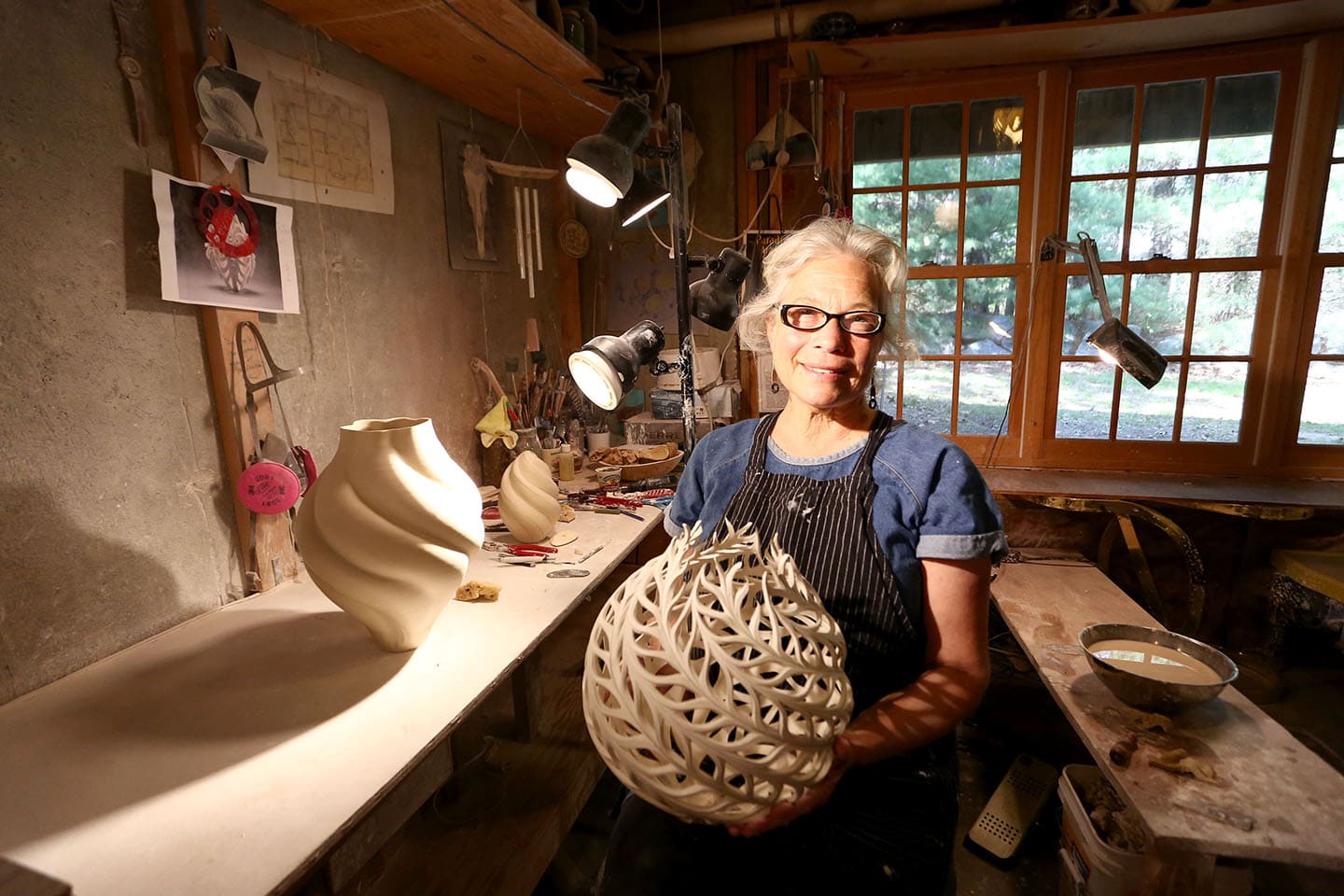
Jennifer McCurdy is an American ceramic artist known for porcelain sculptures and vessels that push the material toward extreme thinness, translucency, and structural precision. She has spent more than thirty years working in porcelain, especially high-fire forms that are cut, carved, and built to hold their shape while appearing fragile, light, and almost shell-like.
- Works primarily in porcelain, often fired to a high temperature for strength and refinement.
- Focuses on thin-walled construction, open cutaways, and delicate silhouettes.
- Makes vessels and sculptural forms inspired by ocean life, shells, and natural structures.
- Her work explores the tension between fragility and permanence.
- Known for surfaces that read as smooth, white, and luminous, with fine pierced or carved details.
What makes her porcelain different?
McCurdy’s work stands out because it treats porcelain not as a material for sturdy domestic ware, but as a medium for structural risk. She tests how far a wall can be thinned, where openings can be cut, and how much form can be removed before the piece loses balance. That approach gives her vessels an airy look while keeping them physically intact after firing.
Porcelain is a hard, refined clay body that becomes vitrified at high temperature. McCurdy uses those properties deliberately: the fired surface can be crisp and pale, and thin sections can glow with transmitted light. The result is work that often feels closer to bone, coral, or weathered shell than to ordinary pottery.
Where did her style come from?
McCurdy’s imagery draws heavily from the ocean. Many of her pieces suggest marine growth, tidal erosion, or the internal logic of shells and skeletons. That influence is not decorative in a surface-only sense; it shapes the way forms branch, open, and taper. The forms often seem found rather than invented, as if they were lifted from a shoreline and translated into ceramic.
Her practice also belongs to a lineage of studio pottery in which the maker’s hand remains visible in the finished object. Even when the forms look abstract, they carry evidence of slow throwing, cutting, joining, and refinement. The clay body is not hidden. Instead, the technical decisions become the subject.
How are her pieces made?
Her process depends on control at every stage. A porcelain body must be worked carefully because it shrinks substantially in the kiln and can slump or crack if walls are too uneven. To reach the thin, open structures associated with her work, she has to judge thickness, drying time, and firing behavior with great precision.
In practice, that means making strong underlying forms, then cutting away sections, piercing surfaces, or refining edges before firing. High-fire porcelain rewards this discipline by becoming dense and durable. The finished work often looks delicate enough to shatter at a touch, which makes the material achievement more striking: the form appears fragile while remaining solid ceramic.
Why does Jennifer McCurdy matter?
McCurdy matters because she shows how porcelain can move beyond utility into sculpture without losing its identity as a ceramic material. Her work keeps the technical demands of the medium visible, instead of disguising them under glaze effects or painterly decoration. That makes her pieces useful examples for understanding what porcelain can do when form, firing, and handwork are all treated as part of the design.
She also expands the visual language of ceramic sculpture. By combining natural references with exacting construction, she creates objects that sit between vessel, specimen, and abstract form. That hybrid quality helps explain her appeal in visual culture: the pieces are immediately legible as handmade objects, but they do not stay in one category for long.
Frequently Asked Questions
Is Jennifer McCurdy a potter or a sculptor?
She is best described as a ceramic artist. Her work takes the vessel form seriously, but it is not limited to functional pottery. Many of her pieces are sculptural, with openings, cutaways, and proportions that prioritize form and material over use.
What material does she use most often?
Porcelain is her main material. She uses its whiteness, translucency, and high-fire strength to build forms that can be very thin without losing integrity. Those qualities are central to the look of her work, not incidental.
What should be noticed first in her work?
The first thing to notice is the balance between delicacy and durability. The forms often seem eroded, hollowed, or perforated, yet they remain sharply resolved and physically stable. The second thing is how closely the surfaces and silhouettes echo natural structures such as shells, coral, and marine growth.
Articles mentioning Jennifer McCurdy

