Jim Morrison was an American singer, songwriter, and poet best known as the lead singer of The Doors. He became one of the defining figures of late-1960s rock, combining a deep voice, stage provocations, and literary ambitions into a public persona that still shapes how rock frontmen are imagined.
| Born | December 8, 1943, Melbourne, Florida, United States |
|---|---|
| Died | July 3, 1971, Paris, France |
| Known for | Lead singer and lyricist of The Doors; poet |
| Active years | Mid-1960s to 1971 |
| Associated with | The Doors; Los Angeles rock scene |
How Morrison became a rock figure
Morrison emerged during the mid-1960s when American rock was moving beyond dance music and simple pop structures into longer, darker, more experimental forms. The Doors formed in Los Angeles in 1965, with Morrison on vocals, Ray Manzarek on keyboards, Robby Krieger on guitar, and John Densmore on drums. Their sound relied on organ, electric guitar, and Morrison’s baritone delivery, which gave songs such as “Light My Fire,” “Break On Through,” and “The End” a theatrical intensity.
His appeal came from contrast. He projected control and vulnerability at the same time, reading poetry on stage while also pushing performances toward chaos. That mix helped The Doors stand out in an era crowded with charismatic singers. It also made Morrison easier to mythologize after his death, because the work and the image were already fused.
What did Jim Morrison actually make?
Morrison was not only a vocalist. He wrote lyrics, shaped stage performance, and published poetry, including The Lords / Notes on Vision and later posthumous collections of verse. His writing drew on Beat poetry, symbolism, blues imagery, classical literature, and film. The results were uneven, but they gave The Doors a distinctive literary edge compared with bands that treated lyrics as disposable filler.
On record, his voice and phrasing mattered as much as the words. He shifted between spoken cadence, chant, and a roughened croon, often stretching lines to ride over the band’s organ-driven arrangements. In practice, that meant The Doors’ songs were built around atmosphere and pacing, not just melody. His performances often depended on the stage as a live medium: eye contact, pauses, movement, and sudden outbursts all became part of the composition.
Why does Jim Morrison still matter?
Morrison matters because he helped define the idea of the rock frontman as a poet, rebel, and self-destructive star. Many later musicians borrowed that template, sometimes knowingly and sometimes through the broader culture he helped create. His image also shows how fame can outgrow the work that produced it, turning a singer into a symbol of excess, freedom, and risk.
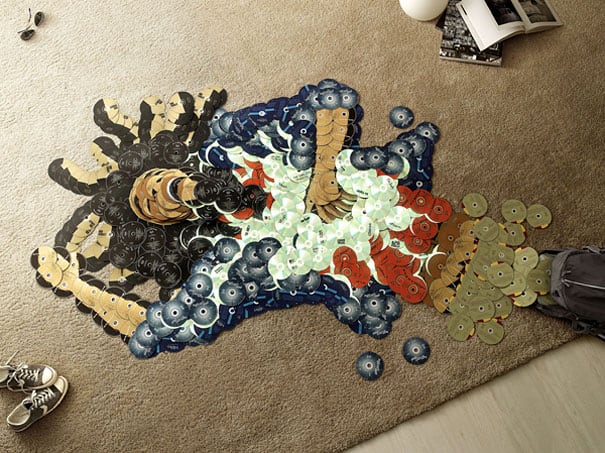
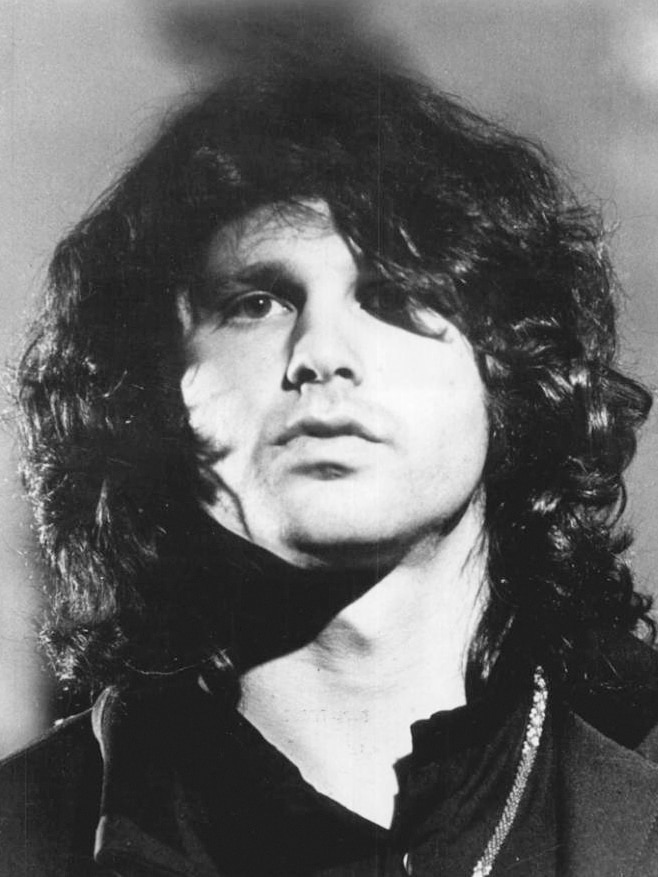
His legacy is not only musical. Visual artists, photographers, and designers continue to use Morrison’s face and body as shorthand for 1960s counterculture and masculine rock mythology. That makes him useful in collage, portraiture, poster design, and other forms that trade in iconographic recognition. His likeness carries strong visual associations: long hair, leather trousers, bare chest, half-closed eyes, and a confrontational stare.
How is Morrison represented in art and design?
In visual culture, Morrison appears less as a neutral historical person than as a ready-made image. Posters, album covers, editorial illustrations, and mixed-media portraits often emphasize contrast: glamour and decay, charisma and collapse, celebrity and mortality. Artists frequently pair his face with text fragments, concert ephemera, or psychedelic color schemes to underline the period’s mix of performance and disorientation.
That image is especially useful in work concerned with grief, memory, or loss. Morrison died at 27 in Paris, joining the group of musicians whose early deaths hardened into legend. The result is a figure who can stand for youthful intensity, but also for the limits of that myth. Any artwork that uses him has to manage both sides at once.
Frequently Asked Questions
Was Jim Morrison mainly a singer or a poet?
He was both, though the singing made him famous and the poetry shaped his image. The Doors were his most visible work, but he also wrote poems and prose influenced by modernist and Beat traditions. The two roles overlapped because his lyrics often read like compressed poems set to music.
Did Morrison write The Doors’ songs alone?
No. The Doors worked as a band, and songwriting credits were shared in different ways across the catalog. Morrison often contributed lyrics and ideas, while the music and arrangements came from the group. His role was central, but not solitary.
Why is Morrison often linked with excess and tragedy?
His public life included heavy drinking, escalating conflict with authorities and audiences, and a death at 27, all of which fed a dramatic story around him. That story became part of his posthumous identity and helped fix him as a symbol of rock’s dangerous glamour. The reality was less tidy than the myth, but the myth has lasted because it fits the image of the 1960s rock star.
Articles mentioning Jim Morrison