
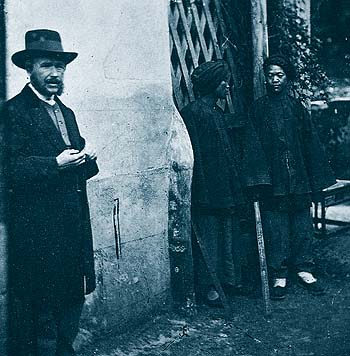
John Thomson was a Scottish photographer, geographer, and traveller who helped define both travel photography and social documentary in the nineteenth century. Born in 1837, he made early photographic trips to the Far East, then returned to Britain and turned his camera on the working poor of London, producing images that still shape ideas of documentary photography and photojournalism.
| Field | Photography, geography, travel writing |
|---|---|
| Born | 14 June 1837, Edinburgh, Scotland |
| Died | 29 September 1921, London, England |
| Known for | Early photography in East and Southeast Asia; Street Life in London |
| Working method | Large-format photography, printed albums, commissioned documentary work |
Why John Thomson matters
Thomson belongs to the first generation of photographers who treated the camera as a tool for seeing the world systematically. He travelled widely in Asia at a time when long-distance photography was still difficult, requiring heavy equipment, glass plates, chemical preparation, and the patience to work in changing heat, humidity, and travel conditions. His photographs of Cambodia, China, Singapore, and other places offered European audiences detailed images of architecture, dress, trade, and daily life.
His importance does not rest only on distance travelled. Thomson also used photography to describe urban poverty in London with unusual clarity and sympathy. Instead of picturesque scenes, he photographed hawkers, labourers, street sellers, and homeless people in their working surroundings. That shift from exotic travel subject to local social observation makes his work a bridge between nineteenth-century topographic photography and the later documentary tradition.
How did he work?
Thomson worked in the demanding technical conditions of wet-plate and albumen-era photography, when exposures were longer and the camera could not be used casually. For his Asian journeys he produced carefully composed images of monuments, markets, and street scenes, often alongside written descriptions that framed the pictures as evidence as well as illustration. The result was not spontaneous reportage in the modern sense, but carefully staged, observant documentary work.
In London, he collaborated with writer Adolphe Smith on Street Life in London (1877-78), a series of photographs and texts that recorded the lives of people who worked in the streets. The photographs were made with the same seriousness he brought to foreign travel, but the subject changed from imperial geography to industrial city life. Faces, clothing, tools, carts, and pavements all become part of the record.
What does his photography look like?
Thomson’s images are typically crisp, formally balanced, and informational. In Asia, buildings, figures, and objects are arranged so that the viewer can study surfaces and details: tiled roofs, carved stone, silk garments, baskets, boats, and ritual objects. His compositions often isolate the subject against a plain or controlled background, giving the photograph the clarity of a visual inventory.
The London street photographs are less grand but more socially charged. They show dustmen, fish sellers, chimney sweeps, organ-grinders, costermongers, and mendicants in direct daylight, often posed with the implements of their trade. Thomson avoided sentimental excess, but he also avoided caricature. That restraint is one reason the work still reads as documentary rather than as moral theatre.
Why does he still matter?
Thomson’s work helped establish the idea that photography could be both descriptive and argumentative. A photograph could show where a person lived, how they worked, what they carried, and how a city or empire was organised. Later documentary photographers inherited that ambition, along with the assumption that an image can serve as evidence, not just illustration.
He also matters because his work reveals the tension built into nineteenth-century documentary. In Asia, he photographed cultures that British audiences often viewed through imperial categories; in London, he turned those same methods toward the poor at home. The photographs therefore sit between curiosity, commerce, science, and reform. That complexity is part of their lasting force.
Frequently Asked Questions
Was John Thomson a photojournalist?
Not in the modern newspaper sense. He worked before photojournalism became a settled profession, but his street photography in London is often treated as an early model for it. He combined direct observation, captioning, and publication in a way that later documentary and journalistic photographers would recognize.
What is Street Life in London?
Street Life in London was a published series of photographs and texts made by John Thomson and Adolphe Smith in the late 1870s. It documented street workers and the urban poor in London through a sequence of carefully observed images and short written sketches. The project is one of the clearest early examples of social documentary photography.
Why are his Asia photographs important?
They are among the earliest substantial bodies of photographic work made by a Western traveller in the Far East. Beyond their historical novelty, they provide detailed visual records of places, people, and objects at a moment of rapid colonial and commercial change. They remain important both as images and as evidence of how nineteenth-century photography framed other cultures.