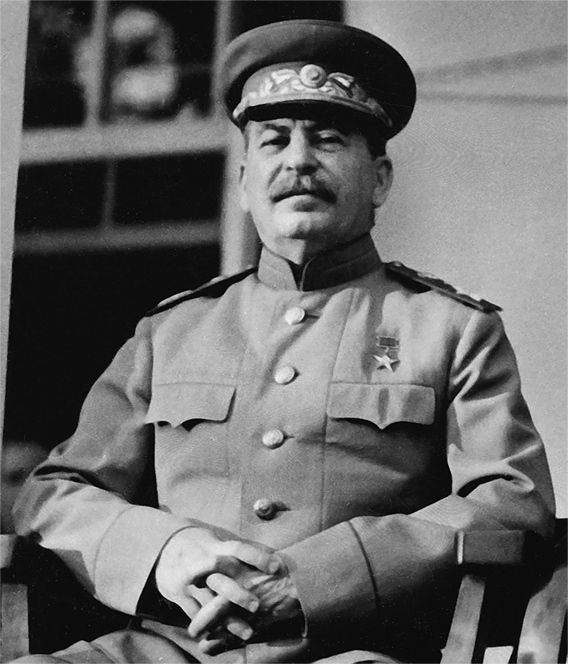
Joseph Stalin was the Soviet political leader who controlled the Soviet Union from the mid-1920s until his death in 1953. Born Iosif Dzhugashvili in Georgia, he rose from Bolshevik organiser and party administrator to dictator, shaping the state, its economy, and its visual culture through central planning, propaganda, and repression.
- He turned the General Secretary’s office into the main source of power in the Communist Party.
- His rule pushed rapid industrialisation, collectivised agriculture, and mass political terror.
- Stalinist culture favoured heroic realism, monumental scale, and images of the worker, farmer, and engineer.
- His name remains tied to both Soviet modernisation and severe state violence.
How Stalin came to power
Stalin was not the public face of the 1917 Revolution. Lenin, Trotsky, and other Bolshevik figures were more prominent, while Stalin worked inside the party machine, handling appointments, discipline, and internal disputes. When Lenin died, Stalin used those organisational roles to outmanoeuvre rivals and build personal control over the party and state.
That control depended on structure as much as ideology. Stalin placed loyal officials in key posts, managed who could rise through the bureaucracy, and isolated opponents one by one. By the late 1920s he had become the Soviet Union’s undisputed leader, though the system still presented itself as collective rule.
What did Stalinism change in everyday life?
Stalinism reshaped the Soviet economy through forced collectivisation of farms and five-year industrial plans. Cities filled with new factories, housing blocks, rail lines, and public buildings, while rural life was devastated by requisitioning, displacement, and famine. The state treated labour, production, and even consumption as political tools.
In visual terms, this produced a harsh but highly structured modernity. Architecture and graphics often used symmetry, massive forms, classical references, and triumphant slogans. Public art showed steelworkers, pilots, tractor drivers, and engineers as ideal Soviet subjects, all rendered with clarity and certainty rather than ambiguity.
Why does Stalin matter in visual culture?
Stalin matters because the Soviet image system under his rule was not decorative; it was an instrument of state power. Posters, photographs, exhibitions, film, architecture, and public monuments all helped project the promise of socialist progress while masking coercion and failure. The aesthetic of confidence often sat alongside censorship and forced silence.
Many of the materials associated with Stalin-era design still read as unmistakably Soviet: granite, bronze, marble, mosaics, polished wood, heavy typography, and vast interior spaces. Moscow’s metro stations, in particular, show how transport infrastructure became a ceremonial public interior, where utilitarian function met propaganda and monumental craft.
How should Stalin be understood now?
Stalin’s legacy is inseparable from mass arrests, labour camps, deportations, and the catastrophic human cost of his policies. Any account of his cultural impact has to hold that violence in view. The architecture and imagery of the period cannot be treated as neutral style, because they were built inside a system of fear.
At the same time, his era left a durable imprint on twentieth-century design and photography. American visitors, foreign correspondents, and later historians often approached Soviet spaces as evidence of a state trying to visualise modernity at scale. That makes Stalin a difficult but necessary figure for any history of modern images, because so much of the period’s built and printed world was shaped under his authority.
Frequently Asked Questions
Was Stalin a revolutionary artist or designer?
No. Stalin was a political operator, not an artist or designer. His importance for visual culture came from the system he controlled, which directed what could be built, photographed, printed, and shown in public.
What is Stalinist style?
Stalinist style usually refers to the monumental, state-directed aesthetic associated with the Soviet Union under Stalin. It appears in architecture, posters, interiors, and sculpture, often using classical orders, symmetrical layouts, and heroic imagery. The style aimed to make power look stable, modern, and inevitable.
Why do Soviet metro stations matter in a Stalin page?
Many famous Moscow metro stations were designed in the Stalin era as public showpieces as much as transport nodes. They combined marble, mosaic, bronze, chandeliers, and grand axial spaces to turn daily travel into a civic experience. That makes them a good example of how Stalin-era politics shaped built form.
Articles mentioning Joseph Stalin