
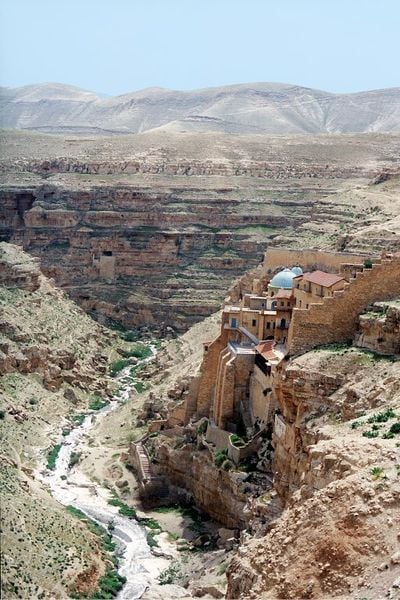
The Judaean Desert is an arid region in Israel and the West Bank, east of Jerusalem and sloping sharply toward the Dead Sea and the Jordan Valley. It forms a narrow, broken landscape of terraces, escarpments, and deep water-cut channels that links the higher limestone hills of the central highlands to one of the lowest places on earth. Its dry climate and abrupt topography have made it a place of retreat, survival, and geological exposure for thousands of years.
- It lies between Jerusalem and the Dead Sea, with its terrain falling steeply eastward.
- The landscape is cut by many wādis and nahals, which have carved deep channels through the rock.
- Its west-to-east descent ranges from higher plateau edges to the Dead Sea basin, creating stark changes in climate and vegetation.
- The desert has long mattered as a route, frontier, and place of settlement, worship, and concealment.
- Its salt, sun, wind, and mineral-rich drainage make it significant in contemporary art and material processes.
Where is the Judaean Desert?
The Judaean Desert occupies the eastern flank of the Judean Hills, extending from the northeastern Negev toward the area east of Beit El. It is not a flat expanse of sand dunes but a dissected limestone desert, where rainfall is sparse and seasonal runoff has cut gullies into the rock. The land drops in stages to a steep western edge above the Dead Sea, then falls again into the rift valley below.
This position gives the desert a strong regional identity. It sits at the seam between the inhabited highlands and the empty basin of the Dead Sea, so it has always been both connected and remote. The terrain can shift quickly from cultivated hill country to bare stone, broken slopes, and dry channel floors.
What does it look like on the ground?
The Judaean Desert is defined by terraces, cliffs, and a dense network of drainage lines. In Hebrew and Arabic geographic usage, these channels are often called nahals or wādis: dry riverbeds that carry water only after rain. Many of them run northeast to southeast, slicing through the desert in long, narrow cuts and making movement difficult across the landscape.
Because the region receives limited rainfall, vegetation appears in scattered patches rather than continuous cover. The slopes can look almost bare from a distance, but the rock faces, screes, and gullies create a complex surface. In places, the desert exposes sedimentary layers and weathered stone with unusual clarity, which is one reason it attracts geologists, archaeologists, and artists interested in erosion and mineral change.
Why does this desert matter historically?
The Judaean Desert has mattered as a frontier zone. It formed a natural barrier and a refuge, and both functions shaped its history. Communities, religious groups, and fugitives used its caves and ravines for shelter, while roads along its margins connected Jerusalem to Jericho, the Dead Sea, and points farther south and east.
The region also contains important archaeological remains, including cave sites, fortifications, and traces of monastic settlement. Its dry air preserved manuscripts, textiles, and organic materials that would have decayed elsewhere. That preservation has made the desert a critical site for the study of ancient religious life, trade, and craft.
How does the Judaean Desert appear in contemporary art and material practice?
Artists and designers are drawn to the Judaean Desert because it is a place where landscape acts on materials with unusual force. Salt-laden air, intense sun, and mineral-rich waters can stain, harden, crust, or break down cloth, paper, and other organic surfaces. These physical processes often become part of the work rather than something to be controlled away.
In practice, that means the desert can function as both setting and collaborator. A garment submerged in Dead Sea water, for example, may emerge covered in crystallized salt as evaporation leaves a brittle white skin across the fabric. Such works rely on the region’s chemistry, not just its image, and they turn the desert into a visible record of material transformation.
Frequently Asked Questions
Is the Judaean Desert the same as the Dead Sea area?
No. The Judaean Desert is the wider desert region east of Jerusalem that descends toward the Dead Sea. The Dead Sea is the body of water at the base of that descent. The two are closely linked geographically, but one is a landscape and the other is a lake within it.
Why are there so many dry channels in the desert?
The desert’s slopes collect occasional rain, and the runoff rushes downhill through narrow cuts in the rock. Over time, these flows carve deep beds called wādis or nahals. Most remain dry for long periods, then briefly fill after storms.
Why do artists use the Judaean Desert as a site for making?
Artists use it because the environment produces visible material change. Salt, heat, and evaporation can alter textiles, metals, and pigments in direct and often unpredictable ways. The desert therefore offers not just scenery, but a set of physical conditions that shape the final work.
At a glance
- Address
- Israel
- Coordinates
- 31.7, 35.3
Articles mentioning Judaean Desert
