
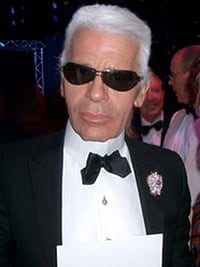
Karl Lagerfeld was a German fashion designer, creative director, photographer, illustrator and brand builder whose work helped define late-20th- and early-21st-century luxury fashion. Best known for leading Chanel from 1983 until his death in 2019, he also shaped the identity of Fendi and his own Karl Lagerfeld label, while becoming a public figure through his stark silhouette of white hair, dark glasses and high-collar suits.
- He turned the role of fashion designer into a highly visible, media-facing authorship.
- At Chanel, he refreshed a dormant house code by combining historic motifs with sharp, commercial ready-to-wear.
- His output included clothing, sketches, photography, books and exhibition work, not only garments.
- He helped make luxury fashion look fast, image-led and internationally legible.
- His style mixed tailoring discipline, wit and a strong sense of brand theatre.
How did Karl Lagerfeld become so influential?
Lagerfeld entered fashion in the 1950s and first gained attention at a competition that also launched Yves Saint Laurent. He worked for several houses over time, including Balmain, Chloé, Fendi and Chanel, which gave him unusual range across couture, fur, accessories and ready-to-wear. That breadth mattered: he understood both the craft of making clothes and the business of keeping a house visible.
His influence came from speed and synthesis. Lagerfeld absorbed archive details, silhouettes and logo language, then recomposed them into something contemporary enough to sell and recognisable enough to circulate in magazines, campaigns and shop windows. He treated fashion as an image system as much as a garment system.
What did he change at Chanel?
When Lagerfeld took over Chanel in 1983, the house risked becoming a museum of its founder’s legacy. He kept the core signs — tweed, camellias, pearls, quilted handbags, braided trim and the interlocking C — but changed their scale, cut and context. Jackets became shorter or more exaggerated, skirts more directional, and the old codes were placed on models, celebrities and runway sets that felt modern rather than reverent.
He also pushed Chanel into a full visual culture operation. Shows became elaborate productions, often staged as supermarkets, airports, brasseries or art-like installations, while campaigns, packaging and editorial images reinforced one coherent identity. The result was not nostalgia but continuity with momentum.
What did a Lagerfeld design look like in practice?
A Lagerfeld garment often paired structure with ease: a sharply cut jacket over slim trousers, a controlled palette interrupted by a graphic detail, or a historic reference stripped into a cleaner line. He liked black and white contrasts, polished tailoring, high collars, fingerless gloves and metallic finishes. Even when he used opulent materials such as silk, tweed, leather or mink, he usually arranged them with precision rather than softness.
He worked across fashion categories, so “Lagerfeld” also meant accessories, perfume, campaign photography and lookbooks. His own label often carried a cooler, more urban attitude than Chanel or Fendi, but the same principles remained: disciplined line, recognisable silhouette and a strong editorial point of view. The clothes were meant to be seen as much as worn.
Why does Lagerfeld still matter?
Lagerfeld helped define the modern fashion director as a polymath: designer, image-maker, commentator and brand custodian. That model now feels normal across luxury fashion, where one figure is expected to shape clothes, campaigns, runway staging and public identity at once. He also showed how a heritage house can be commercially renewed without abandoning its signature materials and codes.
His legacy is not free of contradiction. He was admired for ingenuity and relentless productivity, but also criticised for sharp public remarks and for making exclusivity look effortless. Even so, the scale of his impact is hard to ignore: many contemporary houses still work in the visual grammar he helped standardise.
Frequently Asked Questions
Was Karl Lagerfeld only a designer?
No. He worked as a designer, but also as a photographer, illustrator, publisher and visual strategist for fashion houses. Those roles were connected: he often shot his own campaigns and used drawing and image-making to test ideas before they reached the runway.
What was his relationship to Chanel’s original style?
He did not copy Chanel’s original clothes literally. He kept the house vocabulary — tweed, pearls, quilting, camellias, contrast trim — and made it feel current by changing proportions, styling and presentation. That balance between memory and update is central to his reputation.
Why is Lagerfeld’s personal image so famous?
He turned himself into a brand mark. The white ponytail, dark glasses, stiff collar and gloves created an instantly recognisable silhouette that echoed the precision of his clothes. In fashion, that kind of self-styling mattered because it made the designer part of the same image system as the label.
</analysis to=final 天天中彩票实名 to=final .loads 天天中彩票如何json