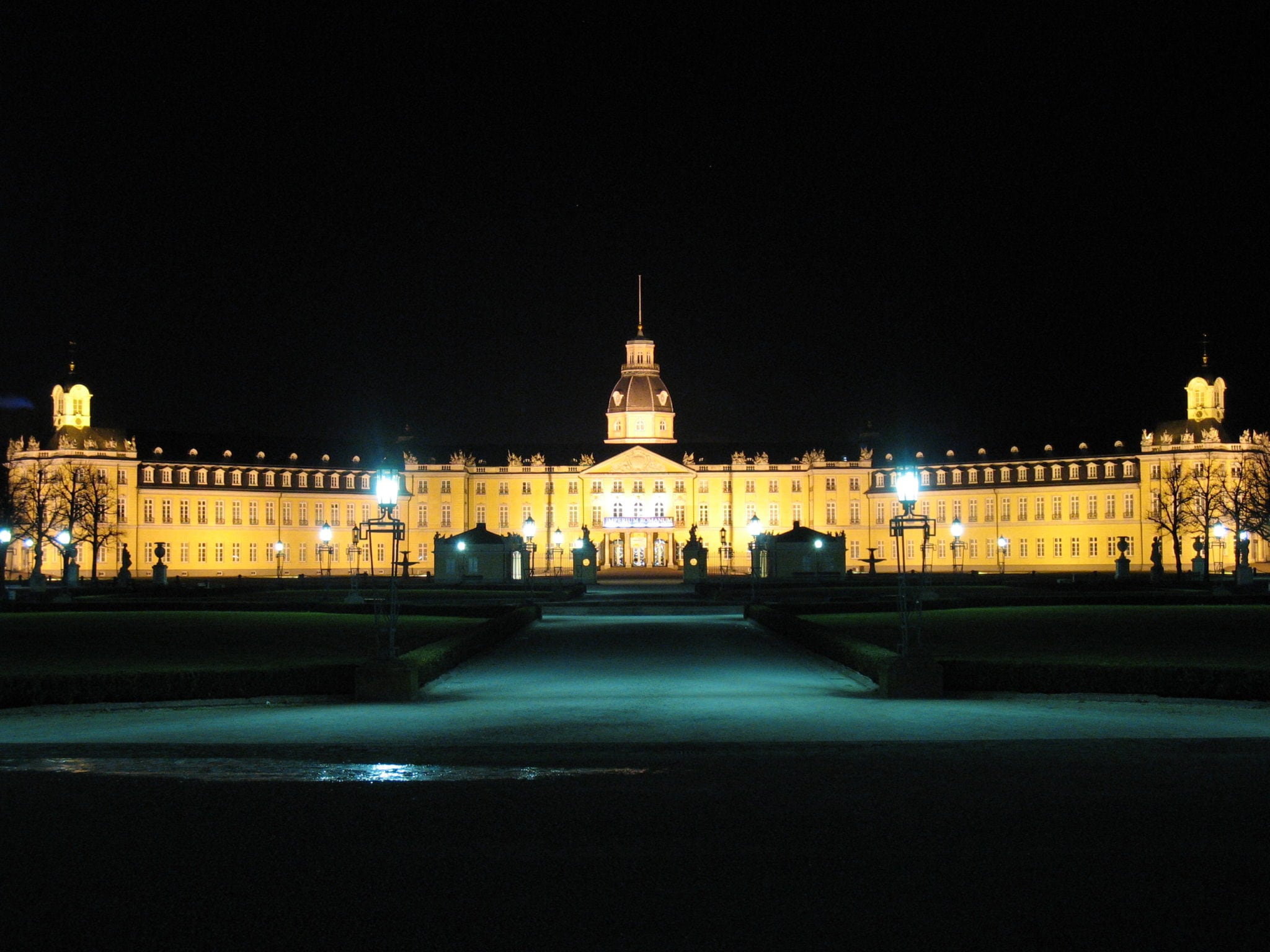
Karlsruhe is a city in southwest Germany, in the state of Baden-Württemberg, known for its fan-shaped plan, its 18th-century palace, and its role as a major judicial center. Founded in 1715 around Karlsruhe Palace, it developed from a court residence into a city whose streets spread outward from a central point. Today it houses two of Germany’s highest courts: the Federal Constitutional Court and the Federal Court of Justice.
- Founded in 1715 as a planned residence city around Karlsruhe Palace
- Located in Baden-Württemberg, near the Franco-German border
- Known for a radial street layout with roads extending from a central core
- Seat of the Federal Constitutional Court and the Federal Court of Justice
- Often compared, though not definitively, with Washington, D.C. for its central plan
Why does Karlsruhe’s layout matter?
Karlsruhe is best known for its urban design. The city plan places the palace at the center, with streets radiating outward like spokes on a wheel. That arrangement gives the city a strong visual identity and makes the central axis easy to read from maps, aerial views, and ground level alike. It is the reason Karlsruhe is sometimes called the “fan city.”
This geometry matters beyond city branding. Planned layouts shape how people move, where institutions cluster, and how power is represented in space. Karlsruhe’s form reflects the absolutist court culture of its founding period, when cities were often designed to organize movement around a ruler’s residence.
How did Karlsruhe begin?
Karlsruhe was founded in 1715 by Margrave Charles III William of Baden-Durlach after he reportedly sought a more suitable hunting and residence site. The palace came first, then the city grew around it according to a fixed plan. The original name, Carlsruhe, refers to the margrave and to the idea of a “resting place” or “quiet of Charles.”
Like other planned cities of the early modern period, Karlsruhe was both practical and symbolic. It provided a controlled urban environment for administration and court life, while also displaying order through architecture and street planning. Its growth later expanded beyond the original radial scheme, but the historic center still preserves the founding idea clearly.
Is Karlsruhe really a model for Washington, D.C.?
The comparison with Washington, D.C. comes from the shared visual logic of a center with radiating streets. Both cities use a strong core and branching routes that create a legible map from above. In Karlsruhe, that core is the palace; in Washington, it is the Capitol and the wider network of diagonals and avenues.
The claim of direct influence remains speculative rather than settled fact. What can be said with confidence is that Karlsruhe belongs to a longer tradition of planned capitals and residence towns that use geometry to express authority, visibility, and control. It stands as one of Europe’s clearest examples of this kind of urban composition.
What does Karlsruhe mean in practice today?
Today Karlsruhe combines its historic plan with a strong institutional identity. The city is home to important legal bodies, universities, and technology-oriented industries, which gives it a profile that is unusually administrative and technical for a city of its size. The palace, the courts, and the carefully ordered streets remain central to how it is seen.
For readers interested in visual culture, Karlsruhe is useful as a case study in how urban space can be designed to communicate power. Its plan is not just a historical curiosity. It is a built diagram, one that still shapes the city’s image and the way it is represented in maps, photographs, and aerial views.
Frequently Asked Questions
Why is Karlsruhe sometimes called a “fan city”?
The nickname comes from the way its streets spread outward from a central point, creating a shape that resembles a fan or a sunburst. This is one of the most recognizable examples of radial urban planning in Europe. The name captures the city’s form more quickly than its official history does.
What is Karlsruhe Palace?
Karlsruhe Palace is the building around which the city was founded in 1715. It served as the residence of the margrave and established the center from which the city plan radiated. The palace remains the key historical anchor of Karlsruhe’s layout.
Why is Karlsruhe important beyond architecture?
Karlsruhe matters because it is a major legal center in Germany and a symbol of planned civic space. The presence of two of the country’s highest courts gives it national significance far beyond its size. Its urban form also makes it a reference point in discussions of city planning and political symbolism.
At a glance
- Address
- Karlsruhe Government Region, Germany
- Coordinates
- 49.016666, 8.4
Articles mentioning Karlsruhe