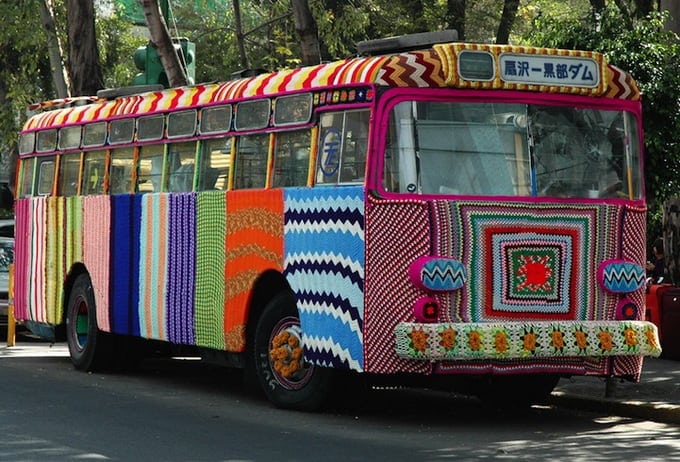
Knitta Please is a Houston street-art collective that started the knit-graffiti movement by covering public objects with knitted and crocheted fabric. Founded in 2005, the group used yarn to wrap lampposts, parking meters, telephone poles, benches, and signs, turning hard urban fixtures into soft, temporary installations.
- Founded in Houston, Texas, in 2005
- Associated with Magda Sayeg, the group’s best-known founder and figurehead
- Helped establish “knit graffiti,” also called “yarn bombing” or “yarn storming”
- Uses knitted and crocheted coverings on existing street furniture and architecture
- Known for making public space feel more playful, handmade, and less permanent
What Knitta Please does
Knitta Please works by placing textile covers over found objects rather than making sculpture from scratch. The pieces are usually made off-site, then fitted to the target surface and secured so they can sit on poles, rails, or posts without damaging them. The effect depends on contrast: soft yarn against metal, concrete, plastic, or painted wood.
The group’s approach is simple but technically specific. Makers must measure irregular surfaces, join panels so they can be wrapped around them, and choose yarn that can hold color and shape outdoors for as long as needed. That combination of craft and street placement is what made the work legible as both textile practice and public art.
How did knit graffiti begin?
Knitta Please began in Houston in 2005, when Magda Sayeg and collaborators started marking the city with knitted covers. The name itself is a joke on graffiti crews, but the method replaces spray paint with yarn and needles. Instead of leaving a tag on a wall, the group “tags” urban infrastructure by dressing it in fabric.
The movement spread quickly because it was easy to recognize and simple to adapt. Other artists and groups borrowed the idea, and the practice became known more broadly as yarn bombing or yarn storming. Those names describe the same basic act: using knitted or crocheted material to alter a public surface, usually without permission, but also without the permanence of paint or carving.
Why does it matter?
Knitta Please matters because it shifted knitting from domestic craft into a public, confrontational medium. The work challenged the assumption that textiles belong indoors or in private hands. On the street, yarn became a material for scale, surprise, and temporary intervention rather than only warmth or clothing.
The group also helped broaden the language of street art. Graffiti often emphasizes speed, mark-making, and ownership of space; knit graffiti adds labor, softness, and handmade texture. That contrast changed how audiences read public objects, and it gave textile artists a visible place in conversations about urban art.
What does it look like in practice?
A Knitta Please piece usually appears as a fitted sleeve, wrap, or panel in bright color. It may cover a single pole or extend across several surfaces, using stripes, patches, ribbing, or loose stitched sections. Because the material is fabric, the work can sag, bunch, fray, or fade, and those changes are part of its appearance.
The result is often playful rather than monumental. A dull parking meter can become a striped column; a rail can look dressed for a parade; a signpost can seem oddly human. That small shift in appearance is the point: the group uses handwork to interrupt the routine look of the street.
Frequently Asked Questions
Is Knitta Please the same as yarn bombing?
Not exactly. Knitta Please is the group that helped popularize the practice, while yarn bombing is the broader term for the act of covering public objects with knitted or crocheted material. In other words, Knitta Please is a maker, and yarn bombing is the form of street art associated with them.
What materials are used?
The work uses yarn, thread, and knitted or crocheted fabric, usually made into panels before installation. Some pieces rely on acrylic yarn because it is inexpensive, colorful, and fairly durable outdoors. The exact material choices affect how the work stretches, holds shape, and weathers over time.
Is it permanent public art?
No. Knitta Please installations are usually temporary and can be removed by weather, city workers, or the artists themselves. That transience is part of the medium, since the work changes the street without claiming it forever.
At a glance
- Founded
- 2005
- Address
- Houston, United States
Articles mentioning Knitta Please