
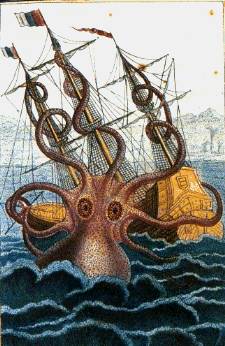
The Kraken is a legendary sea monster from Scandinavian maritime folklore, usually described as an enormous creature that rises from the cold waters off Norway and Greenland. The name later became a catch-all for giant, tentacled sea beasts in modern culture, especially once sailors’ reports were folded into natural history and popular illustration. Its enduring force comes from the way it sits between myth and marine biology: part monster story, part attempt to explain real encounters at sea.
- Origin: Scandinavian seafaring legend, especially Norway and Greenland.
- Form: usually imagined as a giant squid- or octopus-like animal with long arms and a massive body.
- Source of the myth: likely reports of real giant squid, later expanded by retelling.
- Why it matters: it shaped how people pictured the deep ocean long before modern marine science.
- Modern use: a symbol of scale, danger, and the unknown in art, film, and design.
Where did the Kraken come from?
Early descriptions of the Kraken appear in Nordic and Danish writing about the sea, where it was treated as a dangerous creature large enough to threaten boats or disturb the surface like an island. Sailors’ accounts were often inconsistent, which is typical of folklore built from repeated second-hand stories. The Kraken survived because it fit the experience of northern waters: poor visibility, severe weather, and rare but startling encounters with very large marine life.
Later writers and illustrators exaggerated its size and appetite, turning it into a fully monstrous figure. By the 18th and 19th centuries, it had become one of the most famous creatures in sea literature, alongside mermaids and leviathans. That reputation spread through books, engravings, and eventually cinema and fantasy art.
Is the Kraken based on a real animal?
The legend is often linked to the giant squid, a deep-sea cephalopod with long tentacles and a body capable of reaching impressive lengths. Scientists have identified giant squid species and documented their anatomy, but no known animal matches the Kraken exactly as folklore presents it. The association exists because giant squid can look uncanny when hauled near the surface or found washed ashore, especially before modern marine biology explained what people were seeing.
That tension between evidence and exaggeration is what keeps the Kraken interesting. Real squid provide a biological kernel for the story, while folklore adds impossible scale, agency, and menace. The result is not a mistaken species name but a cultural composite: observation turned into myth.
What does the Kraken look like in practice?
In visual culture, the Kraken usually appears as a colossal cephalopod with a bulbous head, multiple long arms, and grasping suckers. Artists often give it the ability to wrap around ships, pull sailors under, or erupt from the sea in a dramatic spiral of limbs. The proportions vary, but the essential design is always the same: a body large enough to dominate the frame and tentacles that create motion, threat, and scale.
That image has proved useful in sculpture, branding, game design, and environmental art because it reads instantly. A Kraken can signify power, submerged danger, or the hidden life of the ocean without much explanation. It also carries a strong tactile logic: slick surfaces, muscular limbs, and a shape built for pressure and movement rather than for the land.
Why does the Kraken still matter?
The Kraken remains a useful figure because it captures how people imagine the deep sea: remote, difficult to measure, and full of creatures that seem almost impossible. It also shows how folklore can preserve fragments of observation before science has language for them. As a result, the Kraken belongs to both myth history and the history of marine knowledge.
For artists and makers, the creature offers a ready-made vocabulary of form. Tentacles can be scaled up into public sculpture, repeated in pattern, or translated into reef-like structures that echo living organisms. That flexibility explains why the Kraken continues to surface in contemporary work: it is old enough to feel legendary and adaptable enough to carry new meanings.
Frequently Asked Questions
Is the Kraken the same as a giant squid?
No. The Kraken is a mythic creature, while the giant squid is a real animal documented by marine science. The legend may have grown from sightings or captures of giant squid, but the Kraken itself includes supernatural size and behaviour that no known species matches.
Why do artists keep using Kraken imagery?
Kraken imagery gives artists a simple way to show scale, danger, and the power of the unseen. Tentacles are visually flexible: they can be sculptural, ornamental, or threatening, depending on context. That makes the creature useful in everything from fantasy illustration to large-scale installation.
Where was the Kraken said to live?
Traditional accounts place it in the waters off Norway and Greenland. Those regions matter because they were familiar to northern sailors and difficult to navigate, which made them fertile ground for sea legends. The setting also reinforces the Kraken’s identity as a creature of cold, deep, uncertain water.