
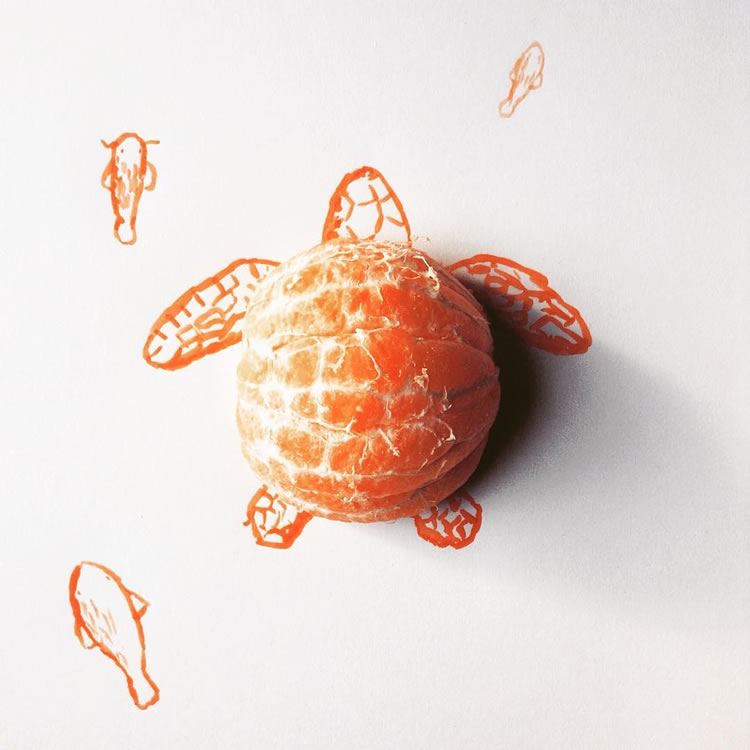
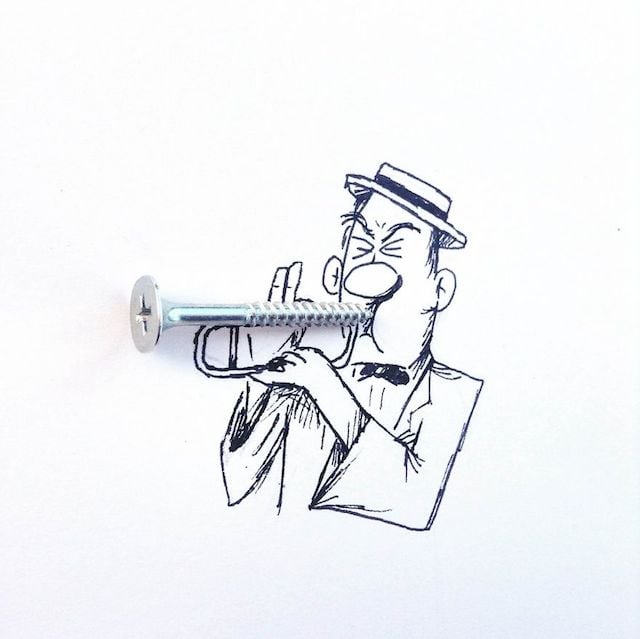
Kristian Mensa is a Czech visual artist known for making minimal illustrations around everyday objects. He turns spoons, toothbrushes, leaves, cables, and other ordinary things into compact visual jokes or clever scene pieces, often by drawing only a small addition that changes how the object is read. His work sits between illustration, object art, and visual punning, and it depends on sharp observation as much as drawing skill.
Kristian Mensa on FreeYork

About Kristian Mensa
- He builds images from found objects rather than fully rendering scenes from scratch.
- His style is minimal: one or two drawn marks can complete the idea.
- The work often relies on surprise, scale shift, and double meaning.
- It belongs to a broader tradition of playful conceptual illustration.
- He also works across dance, theater, and music, which feeds the performance aspect of his art.
How Kristian Mensa works
Mensa’s practice starts with looking closely at the shape of an object already in hand. A banana peel can become part of a mouth, a pencil can become a tool in a tiny scene, or a cup can become a body or a landscape. The drawing usually does not dominate the object; instead, it completes or redirects it. That restraint is the point. The object remains recognisable, but the new drawing gives it a second reading.
This method makes his pieces feel immediate and accessible. They do not need long explanation because the visual idea lands at once. At the same time, the work depends on composition and timing. A line placed a few millimetres differently can ruin the joke or weaken the image. The process is close to cartooning, but it also borrows from collage, still life, and ready-made thinking.
What makes his illustrations distinctive?
Mensa’s work stands out because it uses the ordinary as both subject and material. Many illustrators draw objects; he lets the object do part of the drawing. That creates a compact form of visual wit. The final image often feels like an observation from daily life that has been slightly shifted into the surreal, without losing its physical reality.
The tone is playful, but the work is not random. It often depends on strong formal control: clean lines, minimal intervention, and a clear relationship between the added mark and the object’s silhouette. This gives the illustrations a polished look even when the materials are humble. The result can be humorous, but it can also feel elegant, even tender, because it makes room for the overlooked qualities of things most people handle without noticing.
Why does his work matter?
Mensa belongs to a contemporary strain of illustration that values concept over decoration. In a visual environment crowded with complex images, his work shows how little is needed to make an idea visible. That has made him widely shareable on social platforms, where the format of a quick image suits his short visual setups. But the popularity of the work also comes from a longer tradition of artists who use wit, reduction, and found materials to challenge how images are read.
His practice also speaks to a broader interest in sustainability and attention. By working with existing objects, he gives them a temporary new life and asks the viewer to notice form, texture, and function in a different way. The pieces are small, but they reward close looking. They turn everyday matter into a site for imagination rather than disposal.
What else is part of his creative practice?
Beyond illustration, Mensa has worked in dance, theater, and music production. That mix matters because his images often feel performative: an object enters the frame, a simple gesture changes it, and a visual punchline lands. The work has a sense of staging, as if the object has been cast in a role. This gives his art a lively, theatrical quality even when it is made from the smallest possible means.
That cross-disciplinary background helps explain why his illustrations feel so immediate. They are not just drawings of objects but small events. The object, the added line, and the viewer’s recognition all happen at once. In that sense, Mensa’s practice is less about illustrating a theme than about setting up a brief moment of transformation.
Questions
Is Kristian Mensa mainly an illustrator or an object artist?
He is best described as an illustrator, but his work overlaps with object art and conceptual visual art. The drawn element matters, yet the object is just as important because it supplies the meaning and shape of the image. The finished piece depends on the relationship between the two.
What materials does he use?
He typically works with everyday objects and simple drawing materials, often adding only a few lines or marks to complete the image. The exact object changes from piece to piece, but the method stays minimal. That economy is central to the work.
Why are his images so easy to recognise?
They are built on a clear visual twist: one object is re-read as something else with very little intervention. The images are easy to understand because they rely on familiar shapes and strong visual logic. Their simplicity is what makes them memorable.